

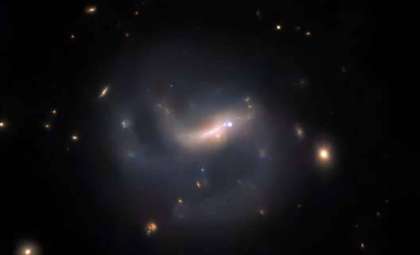
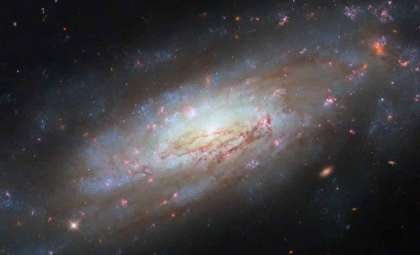
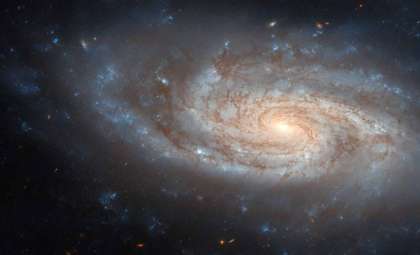
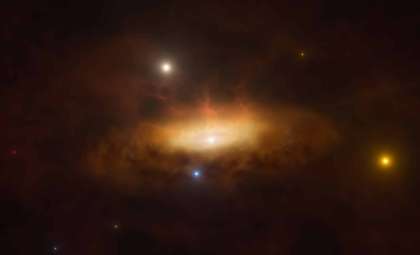
The NASA/ESA Hubble Space Telescope has delivered an extraordinary view of the spiral galaxy IC 4709, situated some 240 million light-years away in the southern skies of Telescopium.
Stretching roughly 60,000 light-years across, this galaxy boasts a luminous center powered by an enormous black hole weighing 65 million times the mass of the Sun. These findings offer fresh perspectives on the mechanisms behind active galactic nuclei (AGN) and their influence on galaxy development.
Exploring the Active Nucleus of IC 4709
The heart of IC 4709 shines with an intensity that stars alone cannot justify. This brightness stems from the supermassive black hole at the galaxy's core, around which a swirling disk of gas compresses and heats to extreme temperatures, emitting powerful radiation across the electromagnetic spectrum—from infrared and visible light to ultraviolet and X-rays.

Hubble’s advanced imaging has uncovered intricate details of this core region, showing not just the AGN but also surrounding features. Although a dark dust lane partially veils the optical signals from the nucleus, Hubble’s sharp imagery penetrates this veil, exposing the galaxy’s internal processes. According to the Hubble team, “If IC 4709’s core were simply filled with stars, it wouldn’t radiate so brightly. Instead, it hosts a massive black hole, with a mass 65 million times that of the Sun.”
The radiant energy originates as gas spirals inward, heating intensely near the black hole. “Temperatures soar so high that the gas emits enormous electromagnetic radiation, spanning from infrared through visible to ultraviolet, including X-rays,” the researchers added. This broad-spectrum emission makes the AGN in IC 4709 a key focus for comparative studies of galactic nuclei.
Combining Telescope Data to Decode AGNs
Detailed studies of IC 4709 contribute to a larger initiative examining AGNs across the cosmos using a range of space observatories, each capturing distinct electromagnetic wavelengths. The Hubble Space Telescope excels at delivering high-resolution images of optical and near-infrared light from these energetic cores. Meanwhile, other instruments like the Swift X-ray/UV telescope and ESA’s Euclid, which specializes in infrared observations, complement Hubble’s findings.
Integrating these diverse datasets allows astronomers to assemble a fuller understanding of AGN behavior and their effects on their host galaxies. As noted by the Hubble team, “Hubble’s exceptional clarity provides an in-depth look at how the relatively small active galactic nucleus interacts with the larger galaxy.” Such interactions are fundamental to comprehending how supermassive black holes influence galaxy evolution throughout the universe.
Broader Impact on Studying Faraway Galaxies
Insights from IC 4709’s active nucleus serve as a crucial reference point for investigating AGNs in far more distant galaxies. “This knowledge is vital for interpreting supermassive black holes in galaxies beyond IC 4709, where detailed resolution is currently unattainable,” the astronomers explained. Understanding IC 4709 helps scientists decode the properties of more remote and faint AGNs that lie beyond current imaging limits.
Grasping the processes fueling AGNs and their interaction with galactic environments is central to contemporary astrophysics. These energetic cores are among the universe’s most dynamic zones, shedding light on key cosmic mechanisms that drive galaxy formation and change.
As observatories like Hubble and Euclid continue to gather expansive data, researchers anticipate uncovering further clues about the enigmatic nature of AGNs and their supermassive black holes. These advances deepen our comprehension of the universe’s most powerful phenomena and reveal the intricate cosmic web that shapes our cosmos.
- Categories:
- Astronomy ,
- News ,
- Space ,
- Nasa







0 comments
Sign in to Comment