
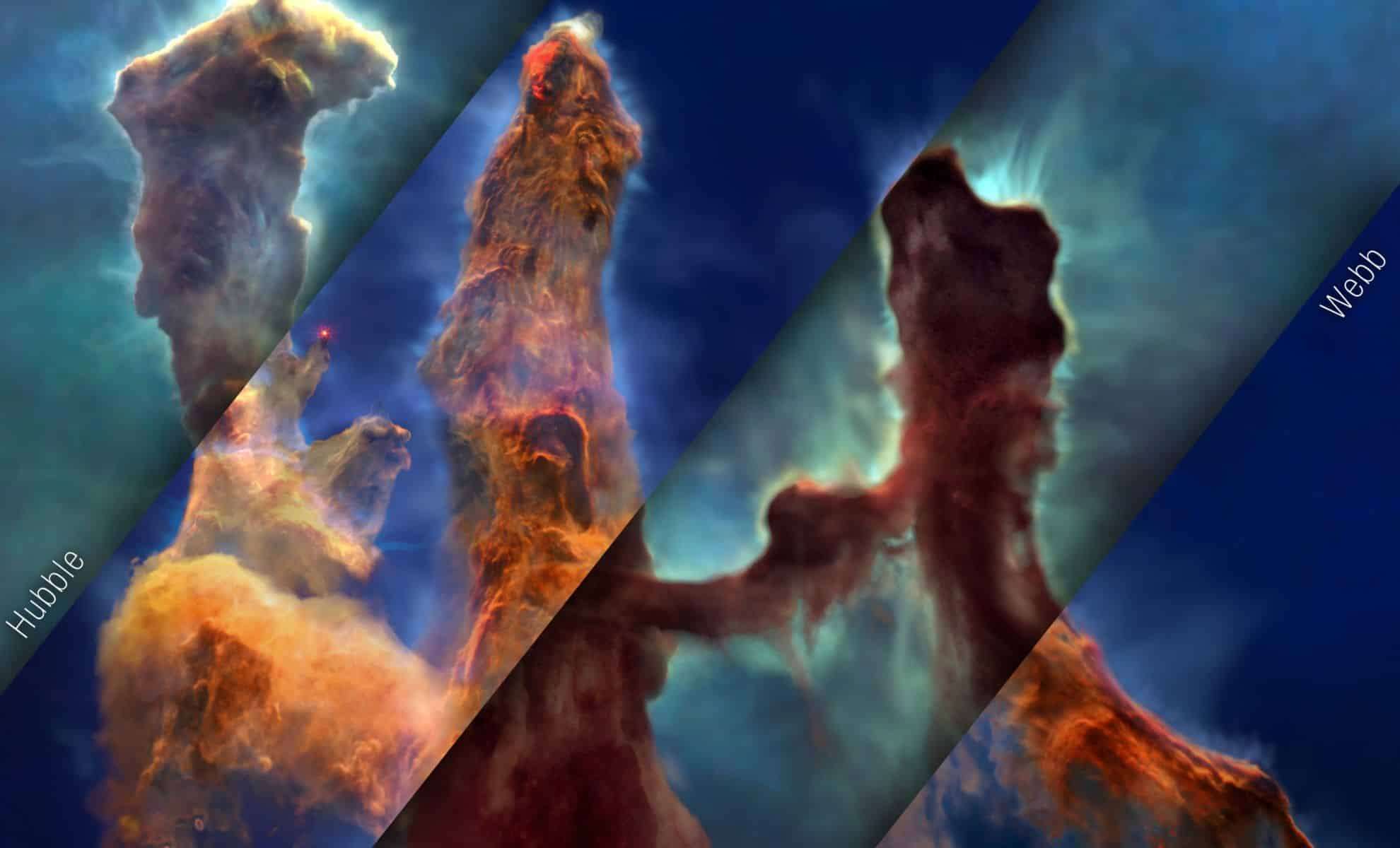
NASA has released an extraordinary 3D rendition of the Pillars of Creation, integrating observations from both the Hubble Space Telescope and the James Webb Space Telescope (JWST).
This intricate visualization sheds new light on these famous cosmic formations, offering enhanced understanding of star formation and the dynamic forces shaping our universe.
Introducing the Pillars of Creation
The Pillars of Creation reside within the Eagle Nebula (M16) and have fascinated astronomers and the public since their iconic image was first captured by Hubble in 1995. These majestic towers of gas and dust serve as stellar nurseries, where new stars emerge. The recent collaboration between Hubble and JWST has produced an extensive multiwavelength film exploring these birthplaces of stars with unprecedented depth.

The 3D visualization is grounded in authentic data gathered from both telescopes, foregoing artistic interpretation. This methodology guarantees a scientifically accurate representation that allows audiences to perceive the Pillars of Creation’s structure and makeup realistically.
“Zooming through and around the pillars lets viewers appreciate the three-dimensional nature and observe how the scene varies between Hubble’s visible-light perspective and Webb’s infrared view,” said Frank Summers, lead visualization scientist at the Space Telescope Science Institute (STScI).
Revealing New Scientific Details and Technological Progress
The distinct observations from Hubble and JWST emphasize their complementary strengths. While Hubble captures the cosmic landscape in visible wavelengths, highlighting ionized gases and pillar outlines, JWST’s infrared capabilities penetrate dusty regions to uncover cooler materials and hidden stellar objects. Together, they provide scientists with a richer and more nuanced understanding of the Eagle Nebula’s star-forming environment.
Composed mainly of cold molecular hydrogen and dust shaped by energetic radiation and winds from nearby young stars, the Pillars of Creation reach heights of about three light-years. Within these colossal formations, nascent stars are developing, some displaying early signs such as material jets being ejected from their surfaces.
Enhancing Public Understanding Through Visualization
This visualization project is part of NASA’s broader mission to captivate and educate the public about its astrophysics research. Created by STScI, in partnership with NASA’s Universe of Learning and Caltech/IPAC, the video invites viewers to explore key scientific questions and immerse themselves in the universe’s wonders. Mark Clampin, Astrophysics Division director at NASA Headquarters, commented, “The Pillars of Creation keep providing fresh insights that improve our knowledge of star birth. This new visualization allows the public to experience this mesmerizing cosmic landscape in a novel way.”
Alongside the video, a 3D printable model of the Pillars of Creation has been produced, enabling hands-on exploration of these structures. This tool, among others, supports NASA’s commitment to making space science engaging and accessible to audiences worldwide.
Looking Ahead: Continued Discovery and Exploration
The partnership between Hubble and JWST marks a significant leap forward in astronomical study by merging data across multiple light wavelengths. This integrated approach equips researchers with more detailed insights into star formation, stellar evolution, and the complex interactions between stars and the interstellar environment.
As NASA carries on its cosmic investigations with advanced telescopes, outcomes from projects like the Pillars of Creation visualization will inspire future breakthroughs. Efforts to boost public engagement and science education ensure these revelations resonate, motivating new generations of space enthusiasts and researchers to delve deeper into the universe’s marvels.
- Categories:
- Astronomy ,
- News ,
- Space ,
- Nasa




0 comments
Sign in to Comment