
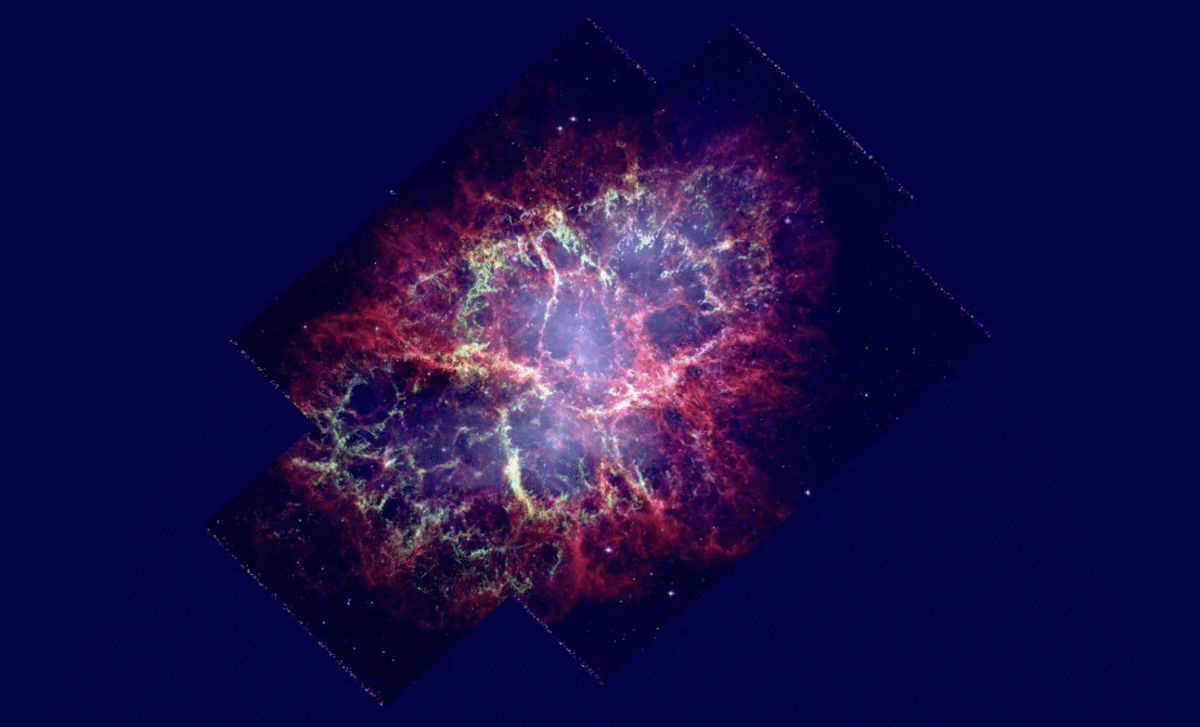
The Crab Nebula, a well-known remnant from a supernova explosion witnessed almost a millennium ago, has recently been captured again by the Hubble Space Telescope. A new analysis published on ArXiv examines the nebula’s growth and unveils previously unnoticed “knots” within its structure. Building upon data from Hubble’s 1999-2000 observations, this study offers novel insights into the nebula’s evolving complexity and sets the stage for continued investigation into its fascinating anatomy.
Reexamining a Cosmic Icon: Tracking the Crab Nebula’s Growth
Originating from a supernova explosion in 1054 CE, the Crab Nebula has long intrigued astronomers. Despite extensive scrutiny, it remains a treasure trove of scientific puzzles. At its core lies a pulsar—a swiftly spinning neutron star—that energizes an elaborate network of plasma shells, filaments, and knots, captivating ongoing research efforts.
Led by Professor William Blair of Johns Hopkins University, the recent research available on ArXiv introduces data collected by Hubble in 2025—the first detailed imaging in nearly a quarter-century. As Professor Blair explained in a conversation with IFLScience,

“The main reason was that on a detailed scale, the nebula is expanding, so that over time the knots and filaments move in position on the sky. As more recent data [from other telescopes] are obtained, it is hard to compare directly.”
The study’s goal was to update our understanding by observing how the nebula has expanded and evolved in fine detail.
The significance lies in the Crab Nebula’s nature as a dynamic entity rather than a fixed relic. This new dataset establishes a fresh reference point for upcoming research. The nebula’s noticeable expansion over the last 20-plus years provides clues about its changing environment. While the nebula’s brightness remained largely steady, novel features discovered offer added depth to our comprehension of its ongoing transformation.
Examining Transformations: Were Nebular Features Altered?
Astronomers anticipated some variation over nearly 24 years between high-resolution observations. Other supernova remnants, like Cassiopeia A and Kepler’s supernova remnant, have exhibited shifts in brightness or morphological features over similar periods. Professor Blair remarked, “Secondly, again over 24 years, one might have expected some features to get brighter or fade, as has been seen for knots and filaments in Cassiopeia A and Kepler’s supernova remnant, which are seen to change over roughly a decade.”
Contrary to these expectations, the Crab Nebula exhibited fewer pronounced changes. This apparent stability is noteworthy, indicating the nebula’s persistent structural features. The continued presence and expansion of the same knots and filaments underline their longevity within the remnant.
Nevertheless, surprises remain. The most striking discovery was the detection of two new clusters of knots. These sets, revealed in high-definition Hubble images, differ markedly from other known structures within the nebula.
Decoding the Knots: Unraveling Their Origin
The newfound knots are compelling not only because they escaped notice until now but also because their locations suggest a connection to the Crab Nebula’s central pulsar. Professor Blair shared with IFLScience, “Our new observations have revealed two groupings of knots that ‘stand out from the crowd,’ so to speak. They are present in earlier data if one looks carefully, but they jump out in the way our data are displayed. These two filament groupings are similar to each other in their characteristics, and are nearly diametrically opposed to the pulsar position.”
Situated almost directly opposite the pulsar, these knot clusters may unlock fresh understanding of the nebula’s internal mechanics. Though faintly visible in prior observations, they only now emerge clearly with advanced imaging techniques. Future observations will track their trajectories and analyze their composition to better comprehend what sets them apart.
At present, the exact cause of these distinctive knots remains elusive. They might arise from interactions between the pulsar’s energetic winds and surrounding material or hint at unknown processes within this supernova remnant. Researchers eagerly anticipate further data to solve the mysteries these knots present in the nebula’s complex landscape.
- Categories:
- Space






0 comments
Sign in to Comment