
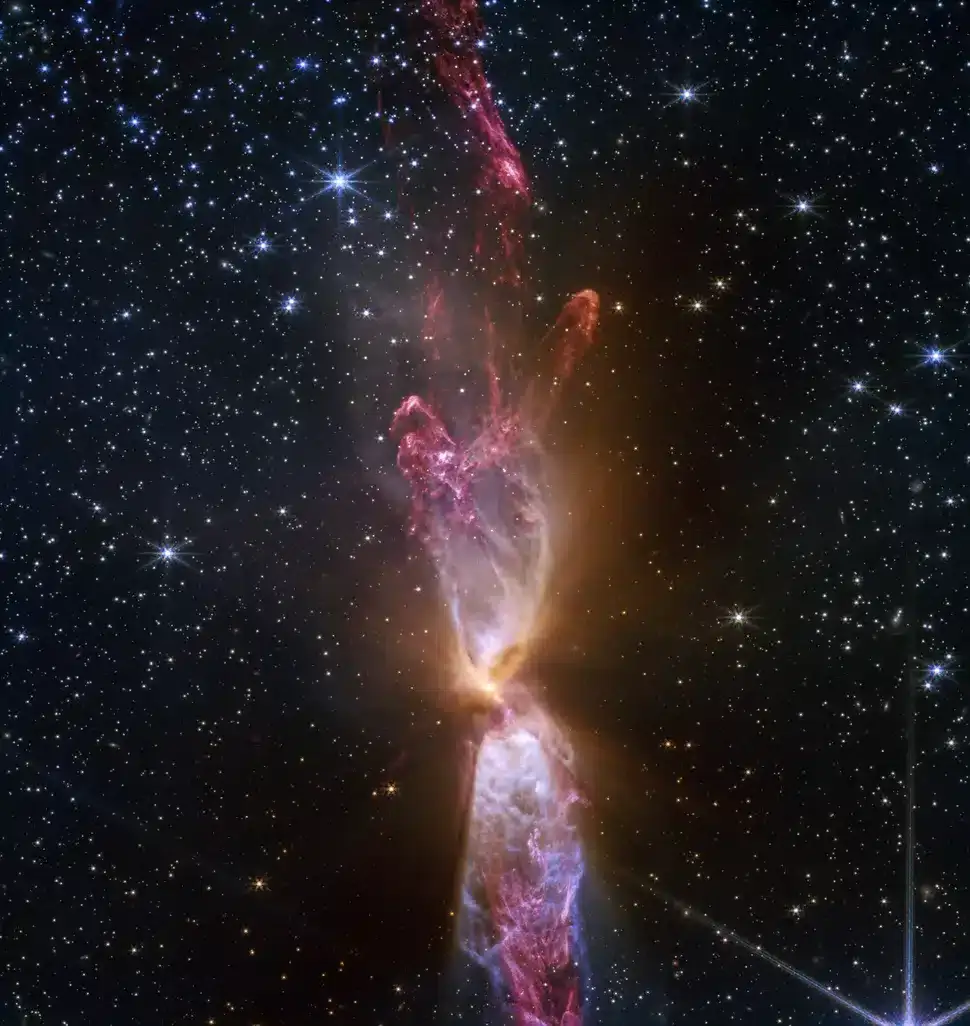
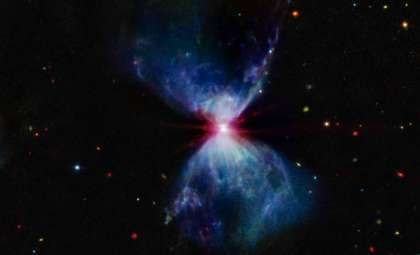
The James Webb Space Telescope (JWST) has unveiled a striking image of Lynds Bright Nebula 483 (LBN 483), a nebula shaped like a butterfly located approximately 650 light-years from Earth. This mesmerizing cosmic formation is far from calm—its complex appearance results from the dynamic interplay of two nascent stars engaged in a turbulent creative process.
How Do Young Stars Shape Their Surroundings?
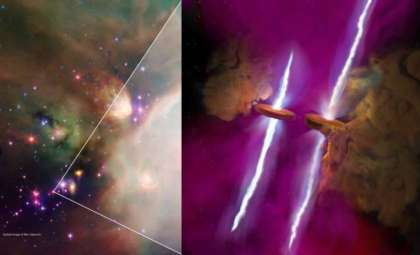
Stars emerge when a dense cloud of molecular gas collapses under gravity, gathering material from its environment. However, instead of consuming all surrounding matter, these young stellar objects emit powerful jets and streams of gas and dust.
These emissions generate shock waves by interacting with the interstellar medium, gradually molding the nebula’s distinctive features. A remarkable example is LBN 483, where bipolar outflows from the twin protostars have sculpted the nebula into its recognizable hourglass or butterfly silhouette.
Bright areas of the nebula represent regions where light from the protostars shines through gaps in dense dust, while the dark sections indicate parts where dust completely obscures starlight.

Double Protostars Hidden Within LBN 483’s Core
Central to LBN 483 are two infant stars growing together. One was only discovered as recently as 2022 by a research team led by Erin Cox from Northwestern University, utilizing observations from the ALMA (Atacama Large Millimeter/submillimeter Array) in Chile.
The stars are currently separated by around 34 astronomical units (AU), equivalent to roughly 3.2 billion miles (5.1 billion kilometers)—a distance a bit greater than that between Neptune and the Sun.
The gravitational interaction between these stars plays a significant role shaping the nebula’s morphology. Scientists suspect they originally orbited farther apart, but one star’s inward migration disrupted angular momentum in the system, influencing the twisting nature of the outflows.
Magnetic Twisting Within a Stellar Birthplace
The James Webb Space Telescope (JWST) captured an incredible view of Lynds Bright Nebula 483 (LBN 483), a butterfly-shaped nebula roughly 650 light-years away. Its form is carved by violent gas and dust outflows emanating from two young protostars.
ALMA’s polarized radio wave measurements reveal a twisted magnetic field threading through cold dust inside the nebula. This magnetic field aligns with the outflows but stands perpendicular to the infalling gas, playing a vital role in shaping LBN 483.
At about 1,000 AU (93 billion miles / 150 billion km), the magnetic field exhibits a notable 45-degree twist counterclockwise, likely resulting from the gravitational pull between the binary stars.
Unlike extensive star-forming regions such as the Orion Nebula, LBN 483 exists in relative isolation, offering a unique opportunity to study star formation processes undisturbed by external influences.
An Exceptional and Solitary Star-forming Cloud
Contrasting with massive nurseries like the Orion Nebula, which contain thousands of forming stars, LBN 483 stands alone. This isolation provides astronomers with an invaluable laboratory to examine star evolution without the complexities introduced by neighboring stars.



0 comments
Sign in to Comment