
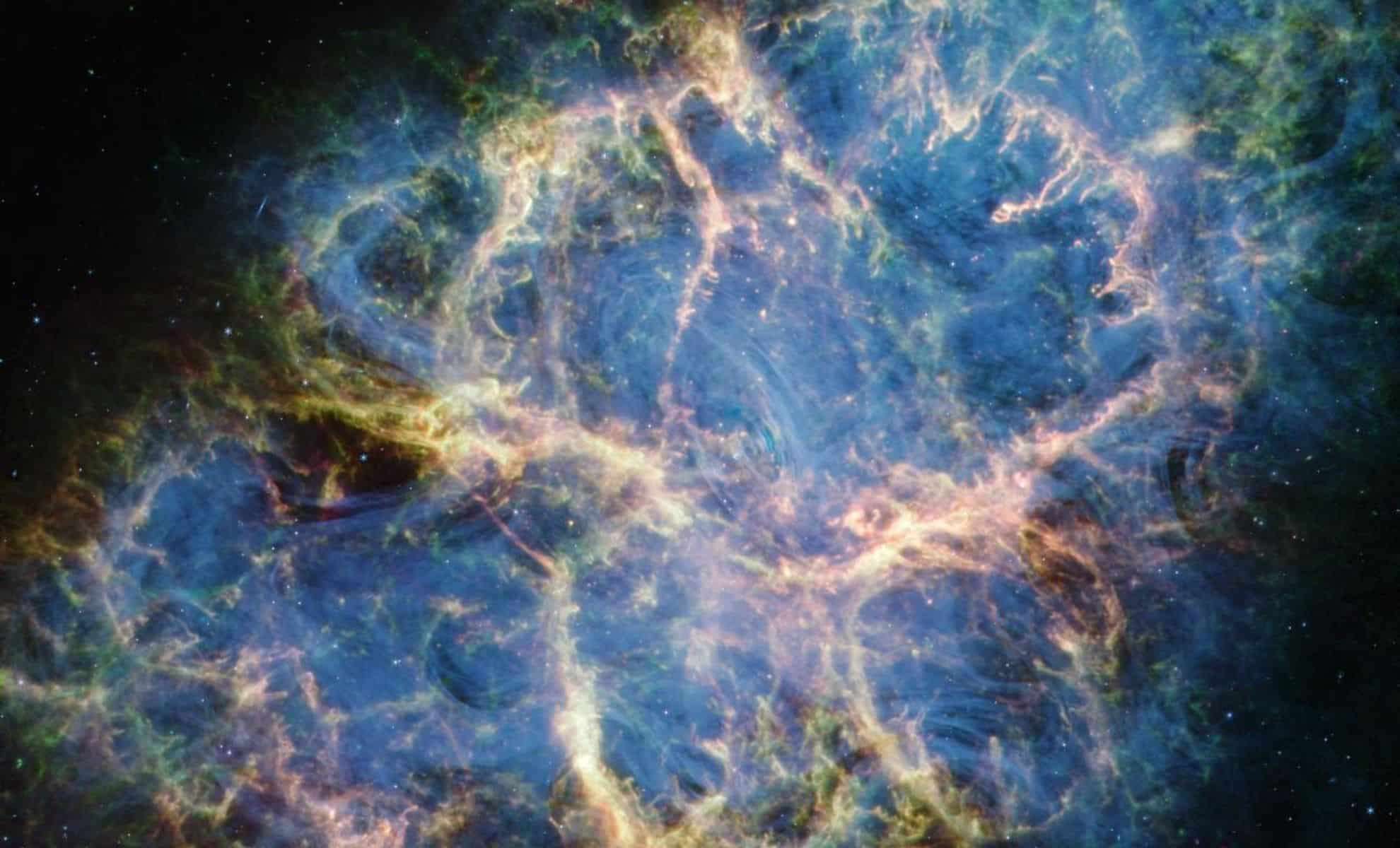
Researchers have harnessed the capabilities of NASA’s James Webb Space Telescope (JWST) to deepen our knowledge of the Crab Nebula, a supernova remnant situated approximately 6,500 light-years away in Taurus.
Leveraging the observatory’s Mid-Infrared Instrument (MIRI) and Near-Infrared Camera (NIRCam), scientists have gathered critical data that enhances our comprehension of the nebula’s intricate past. These observations have broad implications for understanding the nature of supernovae and the life cycles of stars.
Tracing the Crab Nebula’s Historical Background
The Crab Nebula originates from a core-collapse supernova triggered by the explosive death of a massive star. This cosmic event was witnessed on Earth in 1054 CE, shining brightly enough to be visible during the day. Today’s nebula consists of an expanding cloud of gas and dust energized by a pulsar—a fast-spinning, magnetized neutron star left in the aftermath.

Its unusual chemical makeup and comparatively low energy release had earlier been interpreted as evidence of an electron-capture supernova, a rare explosion type arising from stars with cores made predominantly of oxygen, neon, and magnesium rather than iron.
Previous studies estimated the kinetic energy of the blast by measuring the ejecta’s mass and velocity. These analyses pointed to a relatively faint explosion, with the progenitor star’s mass falling between eight and ten solar masses, near the limit for stars undergoing such cataclysmic ends. Nonetheless, some inconsistencies—such as the rapid movement of the pulsar—have challenged this hypothesis.
Revolutionary Findings through Webb’s Precision Instruments
New observations from the JWST have expanded the range of explanations regarding the Crab Nebula’s formation. Under the leadership of Tea Temim from Princeton University, the team examined spectroscopic signals from two concentrated areas inside the nebula’s filaments.
These findings indicate the nebular material’s composition may no longer uniquely point to an electron-capture event but might also be consistent with a weaker iron core-collapse supernova. As Temim stated, “The composition of the gas no longer requires an electron-capture explosion, but could also be explained by a weak iron core-collapse supernova.”
By analyzing the abundance ratio between nickel and iron (Ni/Fe)—which theoretical models suggest should be elevated in an electron-capture supernova compared to a typical core-collapse—researchers found Webb’s infrared measurements provide a more accurate ratio. While still higher than solar values, it is significantly less than earlier estimates, allowing for the possibility of a low-energy iron core-collapse.
Martin Laming from the Naval Research Laboratory, co-author of the paper, highlighted the need for further exploration: “Currently, Webb’s spectral data covers limited sections of the Crab. Expanding coverage and investigating spatial variation will be crucial. Detecting emission lines from other elements like cobalt or germanium could provide valuable clues.”
Charting Dust and Emission Patterns
Beyond spectroscopy, the researchers utilized MIRI to image the Crab Nebula's broader environment, concentrating on synchrotron emission and the patterns of dust. High-resolution imaging enabled them to distinctly map dust distribution throughout the nebula for the first time.
By synthesizing Webb’s observations of warmer dust with cooler dust data collected by the Herschel Space Observatory, the team produced a detailed dust map showing warmer grains primarily in the outer filaments, with cooler dust concentrated closer to the center.
Nathan Smith of the University of Arizona's Steward Observatory, a co-author, commented, “The dust distribution in the Crab differs noticeably from other supernova remnants like Cassiopeia A and Supernova 1987A, where dust accumulates centrally. The Crab Nebula’s dust resides mainly in the denser outer filament structures, maintaining its reputation as one of astronomy’s most fascinating and peculiar objects.”
Implications and Future Directions
These breakthroughs highlight the lasting value of detailed monitoring using cutting-edge observatories such as the JWST. Precise elemental analysis combined with high-resolution dust mapping enhances astronomers’ ability to unravel the complex life cycles leading to and following supernova explosions.
As the investigation continues to examine broader regions of the nebula, researchers aim to resolve outstanding uncertainties about the nature of the Crab Nebula’s progenitor star and the exact explosion mechanism behind the supernova.
The study was unveiled at the 244th American Astronomical Society meeting and is slated for publication in The Astrophysical Journal Letters. Continued research promises to advance our grasp of supernova mechanics and the evolution of their remnants, enriching our overall cosmic perspective.
- Categories:
- Astronomy ,
- News ,
- Space ,
- Nasa



0 comments
Sign in to Comment