

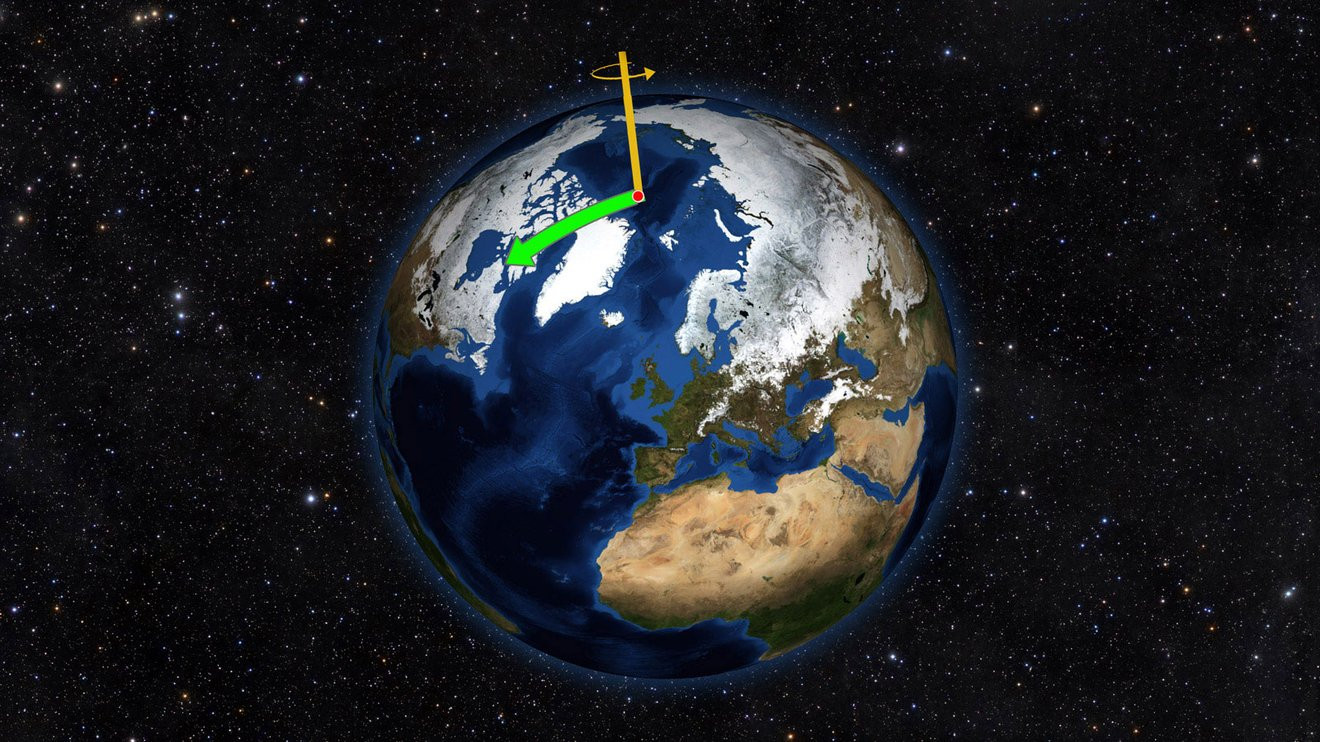
Extracting vast quantities of groundwater impacts more than regional water supplies. A 2023 study revealed that groundwater loss from 1993 to 2010 caused Earth’s rotational axis to shift by approximately 31.5 inches (80 centimeters).
Earth’s rotational pole constantly shifts as masses such as water and ice redistribute globally. Although these adjustments are minute on a planetary scale, they are precisely measurable.
Scientists have long investigated what influences these pole movements. While melting ice sheets and ocean flows are well-established factors, groundwater depletion has recently been identified as a significant driver. New findings indicate that human-driven groundwater extraction directly affects Earth’s subtle wobble.

Trillions of Tons of Groundwater Removed
A paper published in Geophysical Research Letters estimates that roughly 2,150 gigatons of groundwater were pumped from underground reservoirs worldwide between 1993 and 2010. This water was primarily used for agriculture and human needs before eventually reaching rivers and oceans.
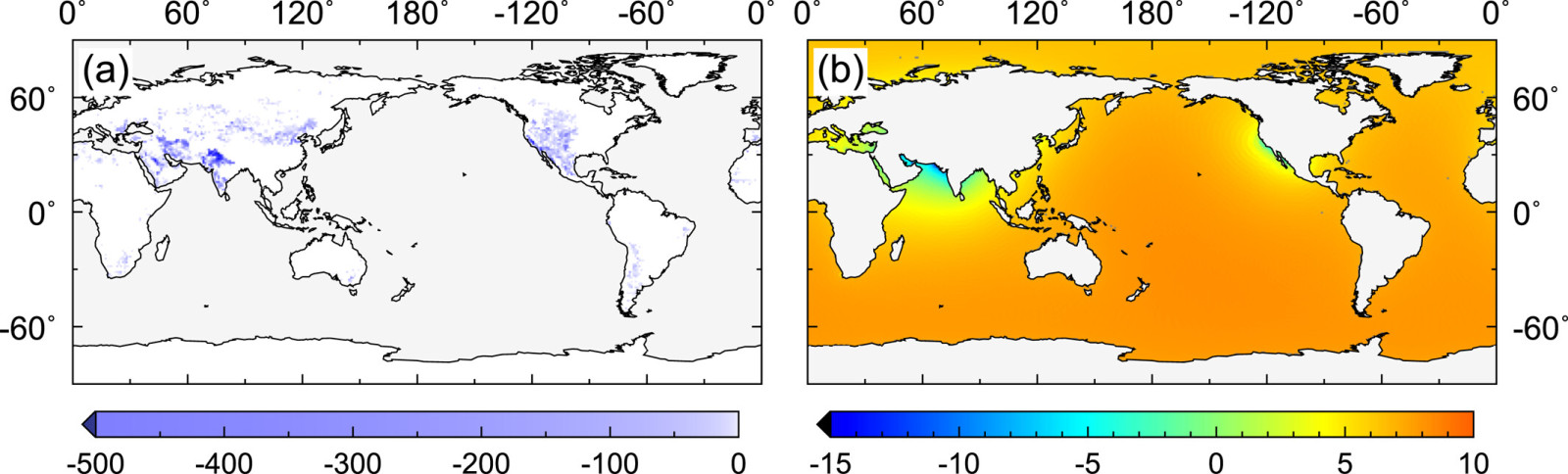
Incorporating this groundwater depletion into models of polar motion produced results that nearly matched observed pole shifts. The research concluded the groundwater loss was responsible for about 31.5 inches (80 centimeters) of the drift in Earth’s rotational pole over 17 years, and contributed to an estimated 6.24 millimeters of global sea-level increase.
“Earth’s rotational pole actually changes a lot,” said Ki-Weon Seo, a geophysicist at Seoul National University and lead author of the study. “Our study shows that among climate-related causes, the redistribution of groundwater actually has the largest impact on the drift of the rotational pole.”
How Water Movement Influences Earth’s Spin
Though it may be unexpected, the physics behind this is straightforward. Earth’s rotational behavior depends on how mass is distributed across its surface.
NASA compares it to adding weight to a spinning top’s side. While the top keeps rotating, its balance—and thus its motion—alters slightly. Earth’s rotation behaves similarly.
Water stored underground represents part of Earth’s mass. When people extract this water and it enters the oceans, the planet’s balance shifts. The effect is subtle but detectable with modern instruments.
The location of groundwater withdrawal is critical. Significant losses in western North America and northwestern India were particularly influential in the modeled pole movement. Midlatitude water withdrawals tend to have a greater impact on polar shifts than those elsewhere.
Completing the Puzzle of Earth’s Movements
A 2026 study in the Journal of Geodesy found that terrestrial water changes remain crucial to understanding pole shifts. Their results attributed long-term shifts primarily to snowpack variations and melting Greenland ice, with groundwater having a smaller influence in their model.
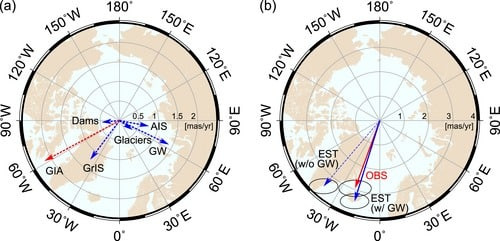
Efforts are underway to extend water storage records further back. In 2026, scientists introduced two datasets: TWSTORE, starting from 1984, and ML-TWiX, covering 1980 to 2012. These are designed to improve understanding of water changes before satellite monitoring became available.
Although observational methods and models have improved, the mechanisms behind polar motion are complex and interconnected. Nevertheless, this research highlights the tangible impact of human groundwater extraction on our planet’s behavior.
“Observing changes in Earth’s rotational pole is useful,” Seo said, “for understanding continent-scale water storage variations.”
- Categories:
- Science












0 comments
Sign in to Comment