
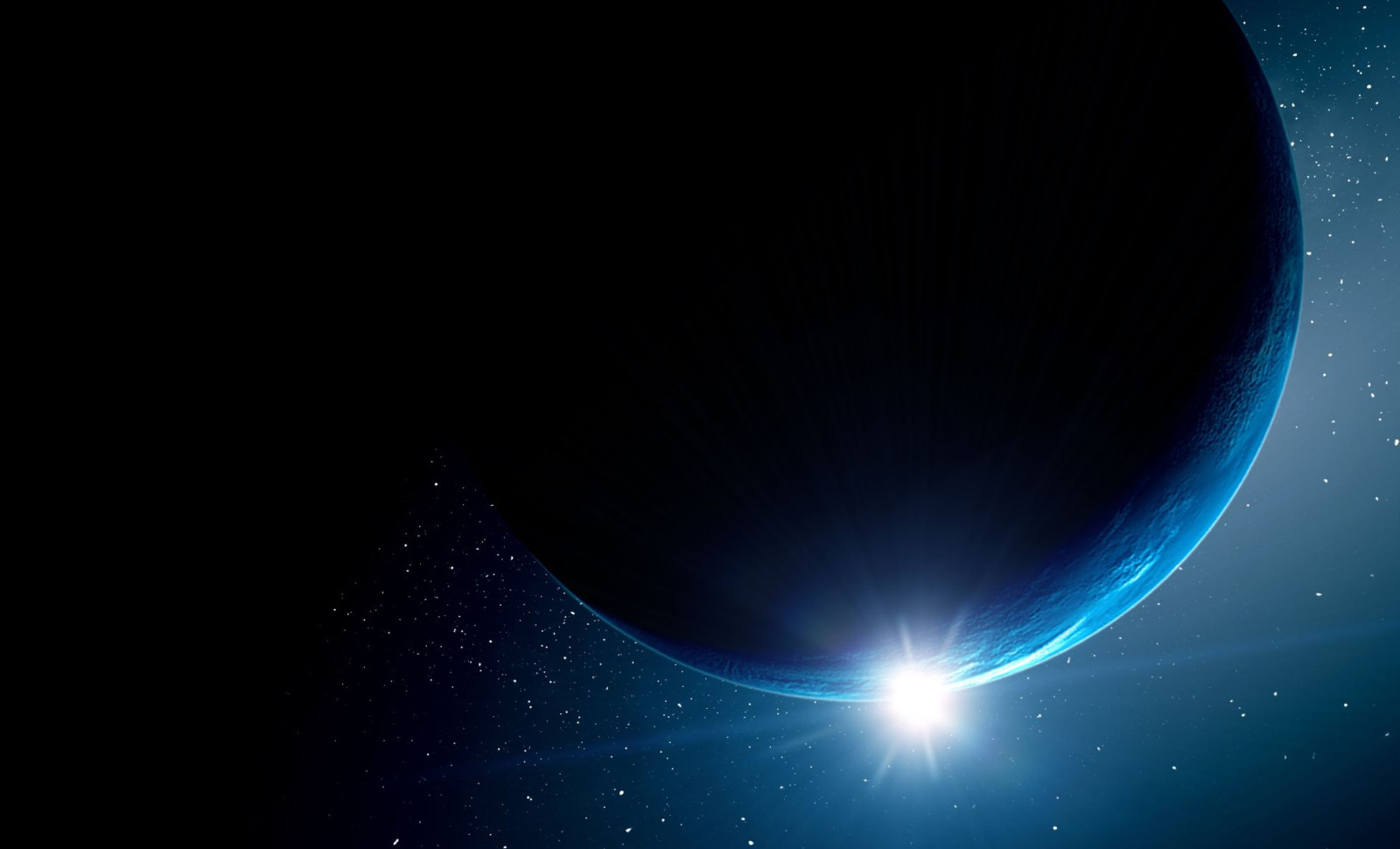
Recent research suggests that Neptune’s distinctive axial tilt might be the result of a long-lasting gravitational interaction with its largest satellite, Triton. Over millions of years, this interplay could have gradually shifted the planet’s orientation.
Located far from the Sun, Neptune is one of the coldest and most distant planets in our solar system, orbiting at almost 30 times the distance of Earth. It experiences temperatures near -200°C and completes a full orbit around the Sun every 165 Earth years. Despite its remoteness, Neptune exhibits intense atmospheric activity and a complex internal structure.
A persistent puzzle for scientists has been the planet’s 28-degree tilt relative to its orbital plane. Although planetary tilts are common, the exact reason behind Neptune’s angle has eluded clear explanation. Researchers have proposed that forces external to the planet, such as an influential moon, played a crucial role in shaping its current tilt.

Triton’s Backward Orbit Tells a Tale of Capture
The subject of this investigation is Triton, Neptune’s primary moon and one of the most enigmatic in the solar system. Uniquely, Triton orbits in a retrograde manner, moving contrary to Neptune’s rotation.
“Triton has always been one of the most exciting and intriguing bodies in the solar system,” Louise Prockter, who leads the Trident proposal team at the Lunar and Planetary Institute in Houston. “I’ve always loved the Voyager 2 images and their tantalizing glimpses of this bizarre, crazy moon that no one understands.”
According to the study shared on the arXiv preprint platform, Triton’s retrograde orbit strongly implies it was not native to Neptune. Instead, this moon probably began as a Kuiper Belt object that was later captured by Neptune’s gravity.
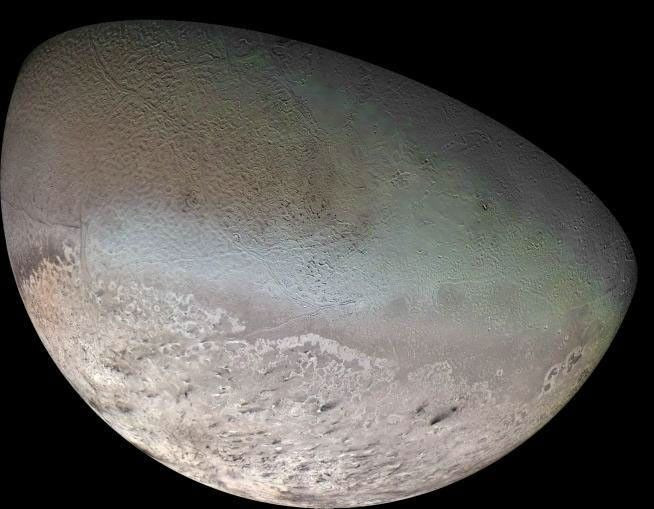
The capture itself was likely turbulent. Rather than settling into a calm orbit, Triton initially followed a highly eccentric and tilted trajectory around Neptune. Over time, tidal forces worked to circularize and stabilize this orbit into the shape we observe today.
The Gradual Gravitational Influence that Shifted Neptune’s Axis
Led by Rodney Gomes from São Paulo State University, the research illustrates that Triton’s shifting orbit did more than achieve stability—it modified Neptune’s axial tilt.
Gomes explained that as Triton slowly spiraled inward over millions of years, its gravitational pull interacted with the planet’s spin axis through a resonance effect called s8. This resonance is a characteristic frequency within the solar system that can amplify changes in orbital and rotational dynamics.
This interaction acts much like gently pushing a spinning top repeatedly—the influence from each nudge might seem subtle, but over vast stretches of time, the cumulative effect can be substantial. Simulations from the study demonstrate that Neptune’s tilt could be amplified significantly by this process.
Data indicates that axial tilts greater than 50 degrees are achievable in some models, and roughly 25% of simulations generated tilts over 20 degrees, which aligns closely with Neptune's actual tilt.
Future Collision or Ring Creation?
The role Triton plays extends into the distant future. Its orbit continues to evolve due to ongoing tidal forces between the moon and Neptune. According to this research, Triton is slowly drawing nearer and is projected to reach Neptune’s Roche limit in approximately 3.6 billion years. Crossing this limit means tidal forces would overpower the moon’s structural integrity.
At that point, Triton may either disintegrate to form a new ring system around Neptune or crash into the planet itself. Either scenario would cause significant changes to Neptune’s landscape and atmospheric conditions.
- Categories:
- Science










0 comments
Sign in to Comment