
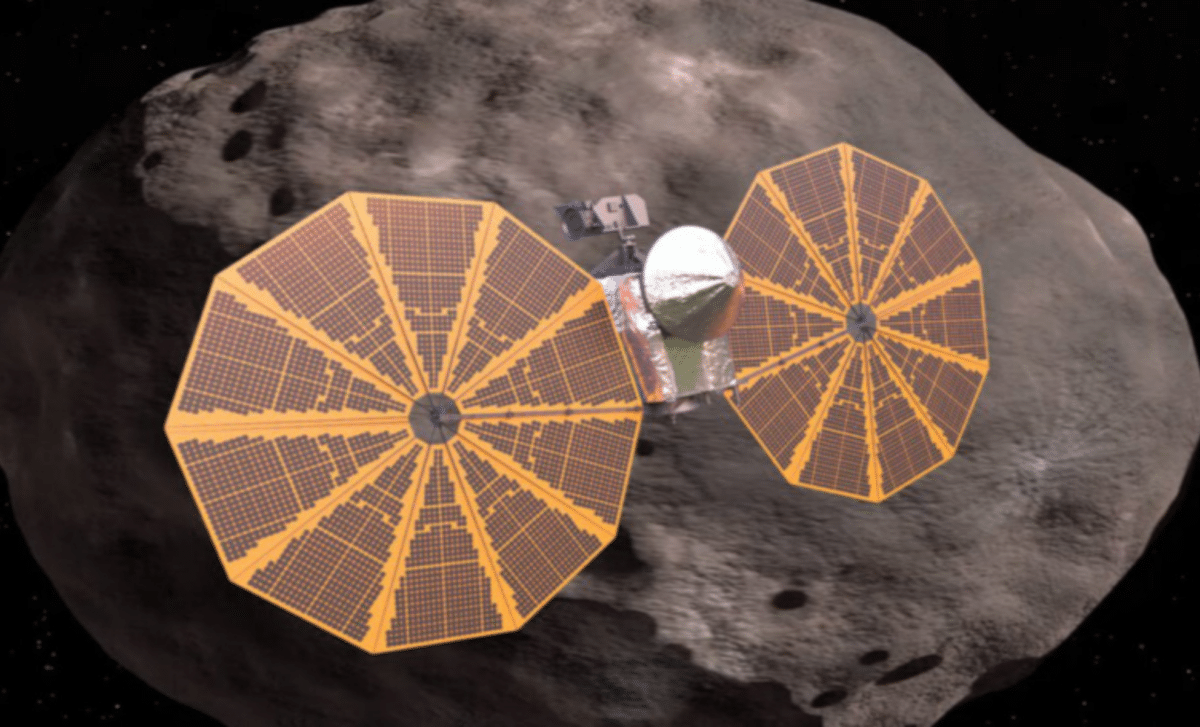
A group of scientists has introduced a novel mathematical approach that could revolutionize spacecraft navigation strategies for visiting multiple dynamic space objects—a challenge that has long confounded space mission designers. Featured in the INFORMS Journal on Computing, this methodology offers an optimized path for asteroid exploration, promising significant savings in mission duration, fuel usage, and overall costs.
Transforming Space Mission Planning Through the Asteroid Routing Challenge
Visiting several asteroids comes with a unique set of complexities: these celestial bodies continually shift positions along their orbits, causing changing distances over time. Isaac Rudich from Polytechnique Montréal and Michael Römer at Universität Bielefeld tackled this by reimagining it as the “Asteroid Routing Problem” (ARP). This problem investigates the sequence in which a spacecraft should encounter multiple asteroids to minimize both travel duration and fuel expenditure.
The researchers' method involves pinpointing the best departure moments and flight paths connecting each asteroid. “Our work lays the groundwork by establishing the mathematical tools space agencies can utilize to plan effective missions,” Rudich and Römer explained to Space.com. By integrating travel time and fuel use into one optimization framework, ARP presents a realistic model for managing the complexities inherent in space navigation.

Extending Lambert’s Problem to Multiple Celestial Targets
Central to ARP is a classical optimization problem known as Lambert’s problem, first formulated in the 18th century by Swiss mathematician Johann Heinrich Lambert. This problem addresses determining the optimal spacecraft trajectory between two moving objects—already a complex task when only one pair is involved.
“The ARP is particularly challenging because determining the exact cost and travel time requires solving another challenging optimization problem, which is Lambert’s problem,” the researchers explained.
Rudich and Römer expanded this problem to cover an entire network of asteroids, which causes a sharp increase in computational difficulty. To overcome this, they utilized Decision Diagrams, a sophisticated evolution of Decision Trees. These diagrams cluster numerous options leading to identical destinations into unified nodes, thereby reducing the instances of Lambert’s problem computations. This strategy yields paths that are up to 20% more efficient when balancing fuel consumption and travel duration against conventional methods.
Relevance for Ongoing and Upcoming Space Endeavors
The ARP has significant practical benefits. Missions like NASA’s Dawn spacecraft that studied Ceres and Vesta, along with the Lucy mission journeying toward the Trojan asteroids orbiting Jupiter, underline the rising importance of multi-asteroid exploration. Rudich and Römer suggest that even marginal efficiency gains, around 1%, could culminate in considerable savings in mission time, budget, and propellant.
Beyond space exploration, these algorithms hold promise for earthbound applications such as optimizing adaptive bus schedules, managing supply chains, and streamlining maritime shipping routes—areas where dynamic conditions mimic the movement of celestial bodies. By addressing a long-standing logistical hurdle in space missions, this study illustrates how mathematical optimization can contribute solutions both in terrestrial and extraterrestrial domains.
- Categories:
- Astronomy







0 comments
Sign in to Comment