

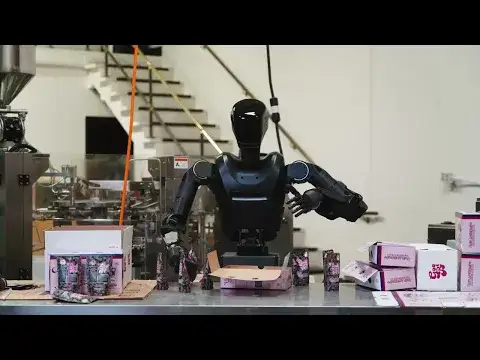
For years, the vision of humanoid robots operating on battlefields was confined to the realm of science fiction. These figures haunted dystopian stories in The Terminator, marched alongside armies in Star Wars, and appeared as eerie digital soldiers in movies and video games. In 2025, however, this fiction edged closer to reality. A fledgling company named Foundation revealed what they call the globe’s inaugural combat-ready bipedal humanoid machine: Phantom MK-1.
Measuring 5’9” and weighing just below 80 kilograms, Phantom MK-1 moves beyond experimental prototypes. It’s designed as a functional combat support unit engineered for durability, agility, and versatility. Its developers hail it as the “strongest and most fluid” humanoid robot on Earth—a claim bolstered by their ambition to roll out 10,000 units by the close of 2026.
Currently, Phantom’s tasks mostly consist of practical activities: carrying loads, ascending stairs, and handling fine objects. Yet according to Foundation, this robot’s ultimate role extends well beyond mundane duties. Designed specifically for combat deployment, Phantom MK-1 signals a new era amid a landscape dominated by autonomous drones and remote-controlled vehicles—this robot’s distinctly human shape enables it to traverse cramped environments, balance on two legs, and potentially host weapon systems.

What distinguishes Phantom is more than its form; it’s its functional authenticity. Rather than being entirely autonomous, the robot operates in a semi-autonomous mode: it employs onboard AI for environmental sensing and navigation, but remains under direct control of a human operator via a virtual reality headset. This approach sidesteps controversial “killer robot” debates—Phantom acts as a mechanical body with human intellect at the helm.
Transitioning from Fictional Dreams to Industrial Reality
The notion of humanoid war machines isn't novel. Since the Cold War era, military agencies have tested unmanned systems for scouting, logistics, and bomb disposal. The U.S. Department of Defense has poured billions into robotic development through initiatives like the DARPA Robotics Challenge, which produced prototypes such as Boston Dynamics' Atlas. Yet these robots remained costly, complicated, and largely impractical outside lab settings.
Phantom MK-1 breaks away from these earlier models. Instead of costly LIDAR, it employs camera-based vision and uses cycloidal actuators in place of bulky hydraulic parts, opting for compact electric drives. This design keeps it lightweight and quiet, ideal for confined spaces without the mechanical noises common to traditional systems. Foundation asserts the robot can carry loads up to 20 kilograms and move at speeds reaching 1.7 meters per second.
Though the firm hasn’t released peer-reviewed performance metrics yet, footage on its website and social media displays the robot executing logistical operations in warehouse and lab environments. While skeptics note these demos fall short of proving combat readiness, defense analysts view the company’s transparency and ambition—openly discussing military deployment—as a critical signal.
Dual-Purpose Design for Military and Civilian Applications
Despite its combat-oriented image, Phantom MK-1 features a modular frame. This design is deliberate. The same capabilities that help it maneuver through disaster zones or manage critical equipment on battlefields could also serve in hazardous environments like nuclear plants, space missions, or emergency response operations. The founders of Foundation have even proposed deploying these robots for future Mars explorations, attracting interest from both defense firms and space agencies.
This strategy reflects the evolution of prior defense breakthroughs—technologies like GPS, the internet, and drones initially built for war eventually transformed civilian sectors. Phantom's fate hinges on two key factors: affordability and versatility. A robot as costly as a tank won’t become a warehouse helper. But a robust, adaptable biped capable of navigating extreme conditions while maintaining human control could revolutionize multiple industries.
However, these advancements raise concerns. Authorities such as the United Nations Institute for Disarmament Research (UNIDIR) caution about the fast progress of semi-autonomous military machines, especially with private enterprises propelling development. Although Phantom MK-1 currently falls short of fully autonomous lethal weapon criteria, its explicit combat focus prompts critical ethical questions: Who governs its actions? What are the engagement protocols? And how soon might semi-autonomy evolve into complete independence?
- Categories:
- News











0 comments
Sign in to Comment