
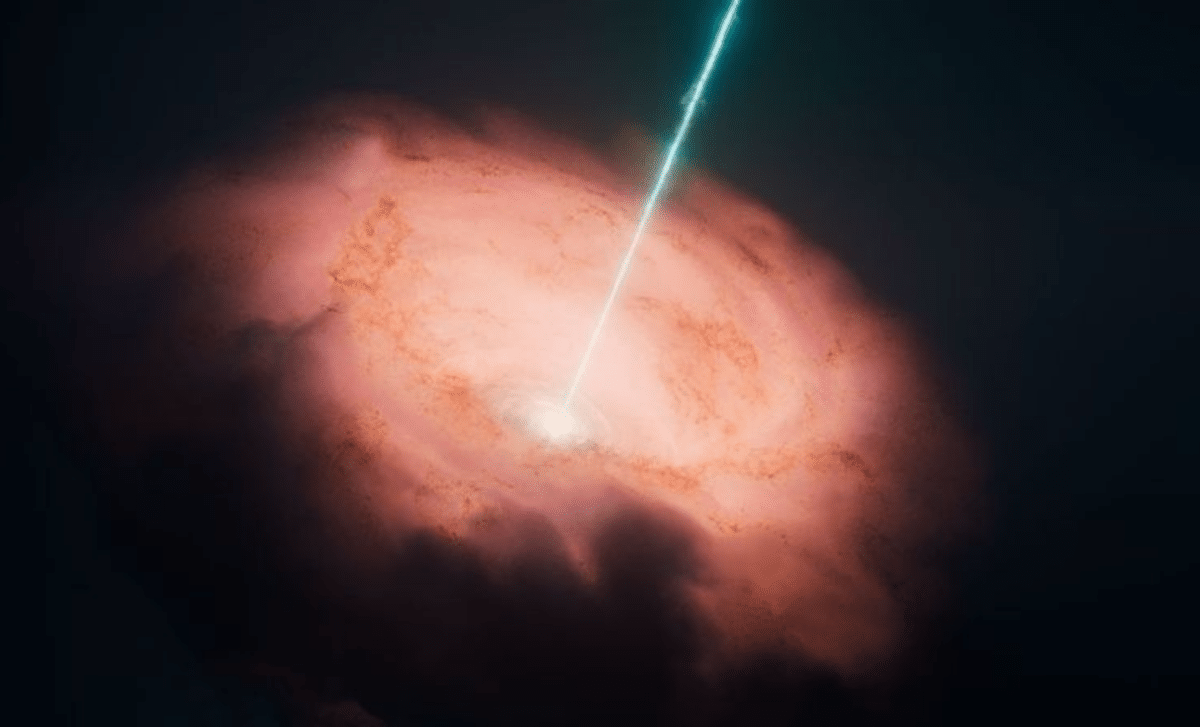
NASA’s James Webb Space Telescope (JWST) has delivered an extraordinary glimpse into the central region of the Circinus galaxy, situated approximately 13 million light-years from Earth. Published in Nature, this research challenges previous conceptions about the behavior of matter surrounding supermassive black holes, revealing that most of the luminous, dusty material is actually being pulled inward rather than expelled.
Webb Challenges Previous Views on Black Hole Accretion
For years, scientists have held the view that the prominent infrared radiation from active galaxies such as Circinus largely comes from intense outflows—streams of gas and dust propelled away by the central black hole. Webb’s unmatched imaging clarity now shows a different reality: nearly 87 percent of this light originates from the innermost dust torus, the hot ring of material enveloping the black hole, indicating that most matter is being ingested rather than ejected.
Researchers reached this milestone thanks to the Aperture Masking Interferometer on Webb’s NIRISS instrument, which merges light from multiple small mirror segments to create an extraordinarily sharp image. This approach provided astronomers with the ability to isolate and examine the light from Circinus’ core across a broad range of wavelengths for the first time.

Lead investigator Enrique Lopez-Rodriguez from the University of South Carolina commented, “To study this supermassive black hole, we collected the total intensity of the inner galaxy region over various wavelengths and integrated this information into detailed models.” Their findings, detailed in Nature, illustrate a balanced energy scenario where only a small fraction of dust escapes in outflows, while the majority spirals inward—rewriting the narrative on black hole feeding processes scientists have followed.
Cracking the Puzzle of Infrared Emissions
Since the 1990s, astronomers have grappled with unexplained excess infrared glow observed in the centers of active galaxies. Despite numerous attempts, existing models struggled to replicate telescope measurements—until Webb provided the missing piece.
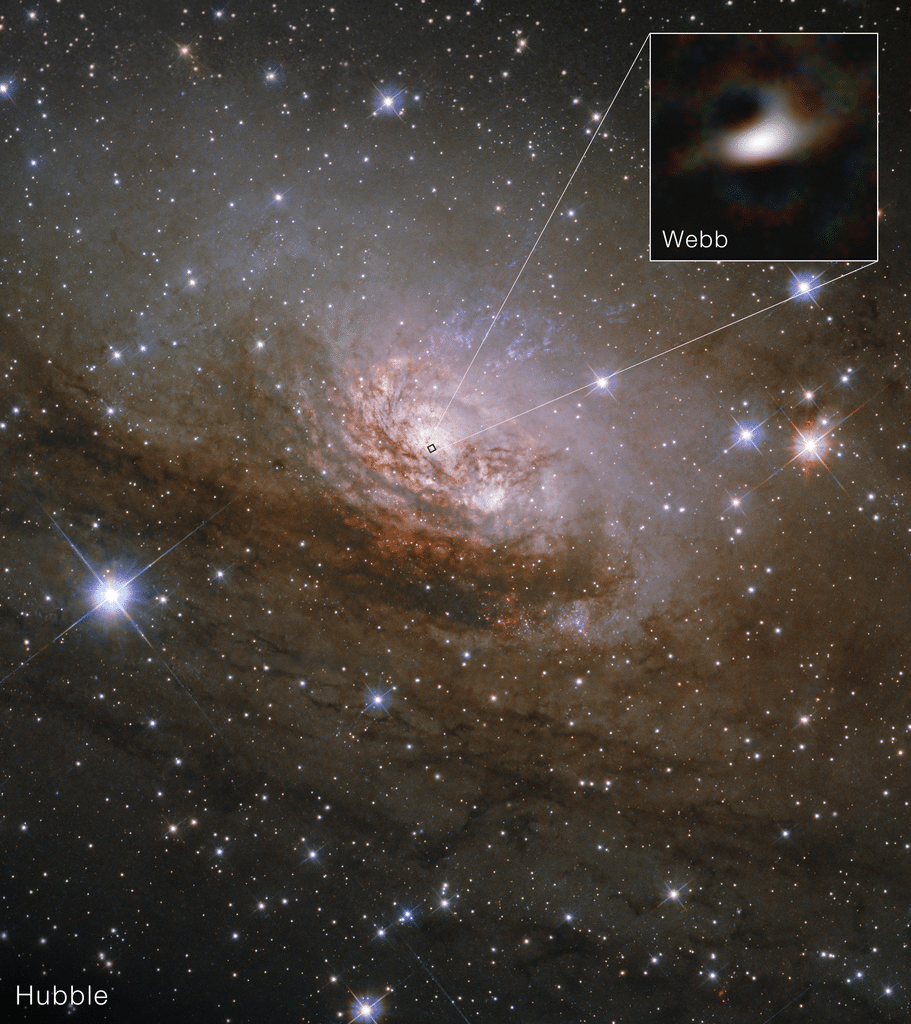
“Since the ‘90s, it has not been possible to explain excess infrared emissions that come from hot dust at the cores of active galaxies, meaning the models only take into account either the torus or the outflows, but cannot explain that excess,” said Lopez-Rodriguez.
By distinguishing the infrared light from the torus versus that from outflows, Webb has shown that nearly all of the energy is emitted by the black hole’s surrounding dust ring, where accretion occurs. Webb’s ability to filter out overwhelming starlight from Circinus enabled scientists to peer deep into the hidden core for the first time.
An Imaging Breakthrough Doubling Resolution
A key achievement in this study is Webb’s use of a novel imaging technique. By converting the telescope’s aperture mask into seven small hexagonal collectors, researchers effectively doubled resolution for a focused section of sky.
“Employing this sophisticated camera mode lets us double the resolution over a tighter sky area,” explained Joel Sanchez-Bermudez of the National University of Mexico. “This is as if we observed this zone with a 13-meter space telescope rather than Webb’s 6.5-meter mirror.”
This represents the first-ever infrared interferometric observation of an extragalactic source from space. The crispest image yet of Circinus’ central black hole reveals fine structures undetectable by Earth-based observatories.
Opening New Doors for Galactic Exploration
“This is the inaugural use of Webb’s high-contrast mode to study an extragalactic object,” said Julien Girard, senior researcher at the Space Telescope Science Institute. “Our results encourage astronomers to use the Aperture Masking Interferometer mode to investigate faint, compact dusty regions around bright targets.”
The potential applications are enormous. Webb’s interferometric capabilities can now extend to black holes in nearby galaxies, providing a fresh approach to probe connections between accretion flows, jets, and luminosity. Lopez-Rodriguez notes that Circinus’ black hole emits at moderate brightness, likely explaining why its torus dominates the radiation.
“The intrinsic brightness of Circinus’ accretion disk is very moderate,” Lopez-Rodriguez said. “So it makes sense that the emissions are dominated by the torus. But maybe, for brighter black holes, the emissions are dominated by the outflow.”
Towards a Comprehensive Black Hole Survey
To determine if Circinus is an outlier or part of a wider pattern, astronomers require a larger sample. Lopez-Rodriguez and collaborators intend to utilize Webb’s advanced imaging to examine dozens of nearby galaxies.
“A statistically significant number—between a dozen and two dozen black holes—will be needed to decode how accretion disk mass and outflows relate to black hole power,” Lopez-Rodriguez stated.
These investigations will aid in unraveling the mechanisms behind galaxy formation, black hole growth, and the cycling of energy within the cosmic environment. With Webb’s precise infrared vision, astronomers can now cut through dusty veils to observe black holes actively consuming matter and influencing their surroundings.
- Categories:
- Space



0 comments
Sign in to Comment