
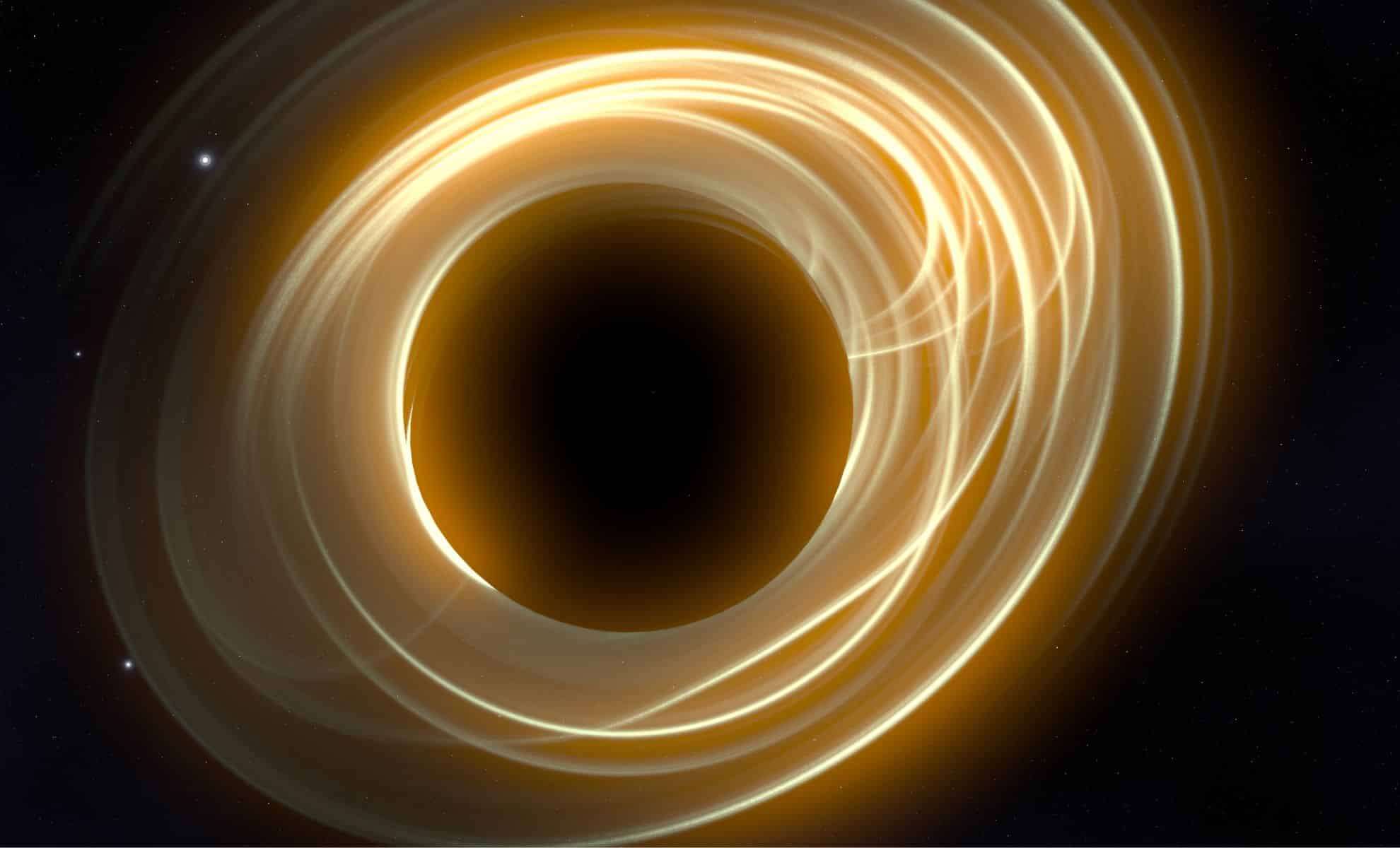
Researchers have made a significant advance in black hole physics by utilizing the sophisticated exact Wentzel-Kramers-Brillouin (WKB) technique. Featured in Physical Review Letters, this work unravels subtle structures in the “ringing” signatures of black holes, also called quasinormal modes. These findings promise to refine gravitational wave detection and deepen our cosmic insight.
Revealing the Secret Tones of Black Holes
Contrary to the perception of black holes as silent, they emit distinct oscillations when disturbed—such as during collisions. These quasinormal modes produce ripples in space-time, which generate gravitational waves that instruments on Earth can pick up.
Historically, the faintest and most ephemeral vibrations were difficult to analyze fully, limiting our understanding. By adopting the exact WKB framework, scientists from Kyoto University traced the nuanced dynamics of these waves, uncovering long-hidden patterns.

Mathematics Provides the Breakthrough: The Exact WKB Technique
This discovery hinges on a mathematical method seldom used in astrophysics but well-regarded in other fields. The exact WKB technique enables the extension of analysis into the complex plane, unveiling intricate features like endlessly spiraling Stokes curves.
These curves pinpoint regions where wave behavior experiences sudden shifts, illuminating the underlying framework of black hole oscillations.
"We identified spiraling formations that were previously unnoticed, and these are crucial for comprehending the quasinormal modes," explained Taiga Miyachi, the team’s principal investigator.
Impact on Gravitational Wave Research
The breakthrough has significant consequences for observatories such as LIGO, Virgo, and the future Einstein Telescope. These detectors depend on precise theoretical models to decode gravitational wave signals accurately.
By capturing the full range of black hole vibrational frequencies—including those that diminish rapidly—this research sets the stage for enhanced estimations of black hole properties like mass, spin, and shape. Additionally, it may support identifying subtle anomalies hinting at novel physics, such as signatures of quantum gravity.
Exploring Future Paths: Spinning Black Holes and Quantum Theories
Kyoto University’s group is advancing this work to include rotating black holes, which introduce additional complexities due to their angular momentum affecting space-time.
Moreover, the team aims to investigate the role of exact WKB methods in addressing questions around quantum gravity, potentially bridging the gap between general relativity and quantum mechanics.
By precisely analyzing these cosmic resonances, scientists are transforming sophisticated mathematics into a powerful lens for discovery across the universe.
- Categories:
- News







0 comments
Sign in to Comment