
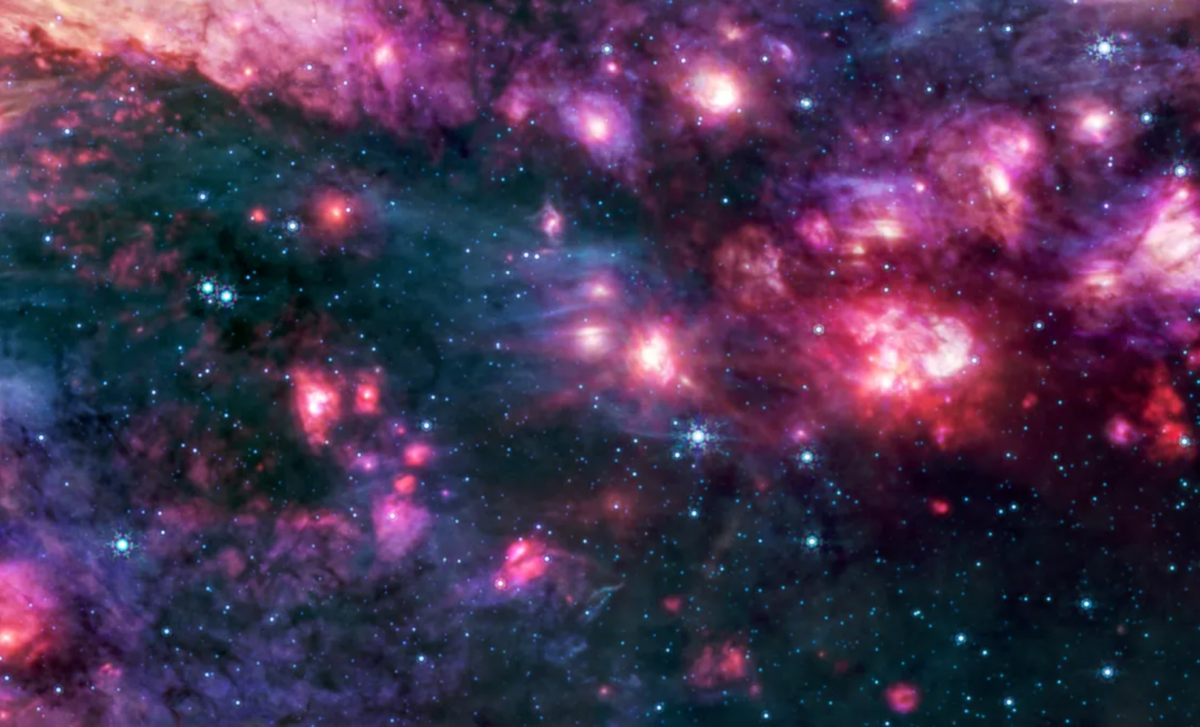
The James Webb Space Telescope (JWST) has delivered an extraordinary and scientifically intriguing image of Sagittarius B2 (Sgr B2), a colossal molecular cloud situated close to the center of the Milky Way galaxy. While its infrared appearance is visually captivating, its true enigma lies in its remarkable star formation efficiency—generating half of the stars in its vicinity using merely a tenth of the available gas. This discovery, recently emphasized by NASA in a spotlight article, contributes important insights into the mechanisms governing galactic development.
An Immense Cloud Harboring a Stellar Enigma
Positioned about 26,000 light-years away toward the Sagittarius constellation, Sgr B2 ranks among the Milky Way's densest and largest molecular clouds. Known as a prolific stellar nursery, what surprises researchers is its astonishing productivity: it has birthed 50% of stars found in the galactic center while only containing 10% of its molecular gas mass.
Leveraging JWST’s cutting-edge Mid-Infrared Instrument (MIRI) and Near-Infrared Camera (NIRCam), scientists have penetrated its thick layers, observing glowing clusters of dust and gas in vibrant red, pink, and purple hues. These colors not only reveal vigorous star formation sites but also expose regions so dense that even JWST’s infrared vision cannot fully see through. These concealed pockets may shelter proto-stars in their earliest phases, waiting to be unveiled.

A Stellar Maker With Complex Chemistry
The most fascinating regions lie in the reddish clusters located on the cloud’s right side in the mid-infrared images from MIRI. These zones are among the most chemically intricate ever detected within our galaxy. Previous observations from ALMA, Herschel, and other platforms hinted at this complexity, but JWST now offers unparalleled detail.
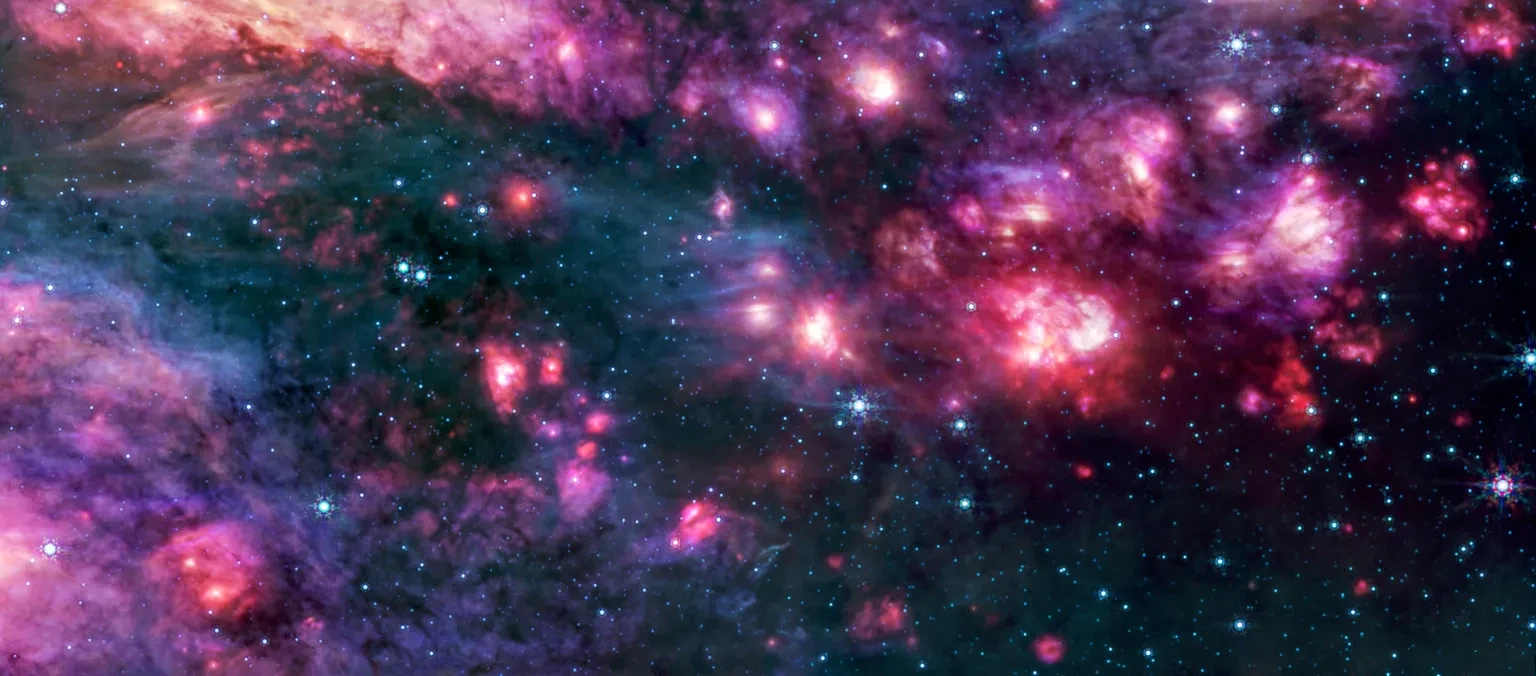
These crimson areas potentially hold vital clues explaining why Sgr B2 is so productive at star formation. Scientists hypothesize that the interplay of turbulence, magnetic forces, and temperature changes could be accelerating gravitational collapse, yet no existing model fully accounts for this behavior. This data reshapes our comprehension of the conversion of gas into stars, especially under extreme conditions like those near the galactic center, where intense radiation and gravity prevail.
NASA’s Imaging Reveals New Insights
The high-resolution visuals shared by NASA and elaborated upon in their December 2025 report offer a detailed and captivating view of this efficient stellar nursery. Beyond striking color, the imagery maps temperature, density, and chemical makeup utilizing infrared emissions. Dark patches do not signify emptiness but rather thick dust clouds obstructing visible light, obscuring incipient star birth even from the most sophisticated instruments.
The findings suggest that deciphering these phenomena will improve models for galaxy formation and progression, notably in dense and turbulent cores like that of the Milky Way. A team from NASA, collaborating with experts from the University of Florida and STScI, conducted the image processing and analysis. Their results indicate multiple generations of star formation occurring simultaneously, likely explaining the cloud’s high density and remarkable efficiency.
Unveiling Secrets Through Infrared Observations
JWST offers layered observations by combining different instruments that emphasize various features of the region. The near-infrared perspective from NIRCam highlights a star-filled sky, since stars shine brightly at these wavelengths. Meanwhile, mid-infrared views expose warm dust and gas essential to star formation. This spectral combination enables astronomers to examine the molecular cloud’s structure and chemical environment, helping determine the age, mass, and arrangement of embedded stars. Unlike optical telescopes that are obscured by dust, JWST pierces these veils, delivering real-time insights into star birth, the chemistry fueling it, and how factors like radiation influence stellar development.
The Impact of Sagittarius B2 on Our Understanding of Galaxy Formation
The revelation of such a productive star-forming region in Sagittarius B2 challenges established ideas about stellar genesis. If these highly efficient zones are more prevalent near galactic centers, it may necessitate refining star formation models that assume constant efficiency levels. This knowledge might also explain varied rates of galaxy evolution, particularly in those with active cores.
The evidence implies that dense molecular clouds are dynamic, shaped by shockwaves, magnetic dynamics, and chemical feedback, rather than passive structures on the brink of collapse. Future studies of comparable regions will determine whether Sgr B2 is unique or emblematic of a broader phenomenon.
- Categories:
- Space




0 comments
Sign in to Comment