

Scientists utilizing the James Webb Space Telescope (JWST) have uncovered a surprising phenomenon that questions established views on the early cosmos.
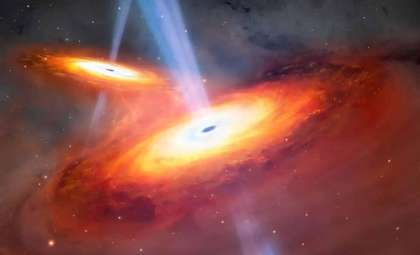
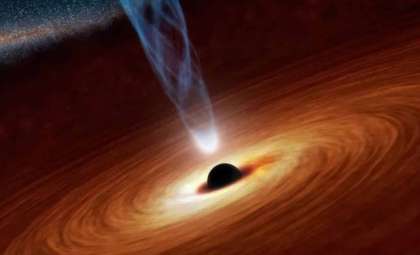
Recent JWST observations pinpointed quasars—brilliant galactic cores energized by supermassive black holes—located in regions where fewer galaxies were anticipated. These ancient and faraway quasars appear isolated, lacking the usual dense galactic neighborhoods. This raises puzzling questions about how these supermassive black holes amassed vast amounts of matter within the first few hundred million years after the Big Bang, especially with seemingly scant nearby material to consume.
Isolated Quasars: An Unexpected Phenomenon
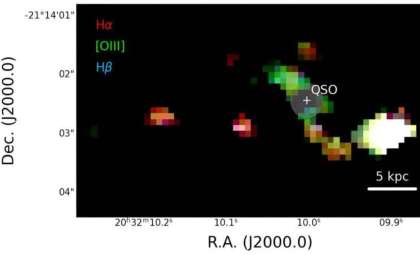
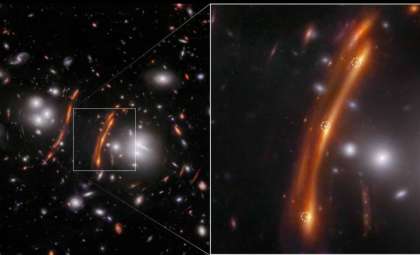
The JWST offers a window into cosmic history stretching back over 13 billion years. The team examined five quasars dating to roughly 600–700 million years post-Big Bang. Previously, quasars were believed to be anchored in clustered regions rich with galaxies that supply enough material to fuel black hole growth. Contrarily, these five quasars appear in relatively isolated cosmic locales, with a sparse presence of neighboring galaxies.

“Contrary to previous belief, we find on average, these quasars are not necessarily in those highest-density regions of the early universe. Some of them seem to be sitting in the middle of nowhere,” said Anna-Christina Eilers, lead author and MIT professor. “It’s difficult to explain how these quasars could have grown so big if they appear to have nothing to feed from.”
This observation contradicts the traditional view that supermassive black holes swell predominantly by accreting gas and dust from dense galactic neighborhoods. The apparent lack of such material around these quasars challenges our understanding of their rapid early growth.
Challenging Theories on Black Hole Formation
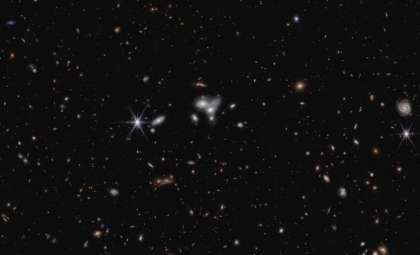
The study reveals stark contrasts in the environments of the quasars under scrutiny. While one quasar is surrounded by nearly 50 galaxies, another has only two neighbors. Despite this environmental disparity, the quasars exhibit similar luminosities, sizes, and ages, suggesting concurrent formation periods in comparable cosmic epochs. “That was really surprising to see,” remarked Eilers. “For instance, one quasar has almost 50 galaxies around it, while another has just two.”
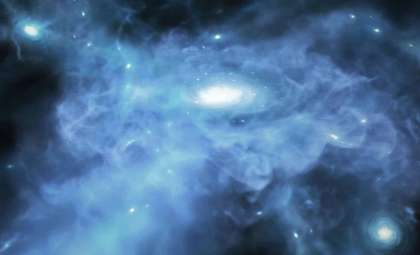
This diversity disrupts the classic model in which dark matter filaments funnel matter into dense nodes, fostering star, galaxy, and black hole development. The discovery of these seemingly isolated quasars implies alternative growth mechanisms may be at play, allowing some supermassive black holes to form without dense galactic support.
“Our results show that there’s still a significant piece of the puzzle missing of how these supermassive black holes grow,” Eilers added. “If there’s not enough material around for some quasars to be able to grow continuously, that means there must be some other way that they can grow, that we have yet to figure out.”
Reevaluating Early Universe Models
These isolated quasar findings could transform our perception of the early cosmic landscape. The prevailing cosmological framework, which positions quasars within the universe’s most crowded sectors, may require revision. The presence of quasars in seemingly empty expanses suggests that the development of supermassive black holes might involve processes not yet fully understood.
The remarkable capabilities of JWST to detail quasars from over 13 billion years ago mark a major advance in astronomy. “It’s just phenomenal that we now have a telescope that can capture light from 13 billion years ago in so much detail,” Eilers noted. The team’s study, published in The Astrophysical Journal, offers new insights into the formation of the earliest galaxies and their central black holes, potentially unveiling novel pathways for early black hole growth.
This discovery opens avenues for further research aimed at unlocking the mechanisms enabling these quasars to emerge in apparently sparse cosmic regions. Future investigations, including comprehensive studies of their surroundings, could help solve longstanding enigmas in modern cosmology.
- Categories:
- Astronomy ,
- News ,
- Nasa




0 comments
Sign in to Comment