

The James Webb Space Telescope has delivered a strikingly detailed view of Arp 107, a duo of galaxies colliding roughly 465 million light-years away. This cosmic event, which began hundreds of millions of years ago, has sparked fresh waves of star birth and formed a gaseous and dusty bridge linking the two galaxies. Webb’s infrared sensors offer an unmatched glimpse into the unfolding celestial drama.
Star Formation Triggered by Galaxy Collisions
When galaxies meet, gravitational forces squeeze vast clouds of gas, setting the stage for new stars to ignite. In Arp 107, the encounter between a spiral and an elliptical galaxy compresses gas intensely, causing vigorous star formation. Using Webb’s NIRCam and MIRI instruments, astronomers have pinpointed luminous star-forming clusters nestled along the spiral galaxy’s arms. These zones glow with polycyclic aromatic hydrocarbons, complex organic molecules radiating in infrared light, marking hotspots of stellar activity.

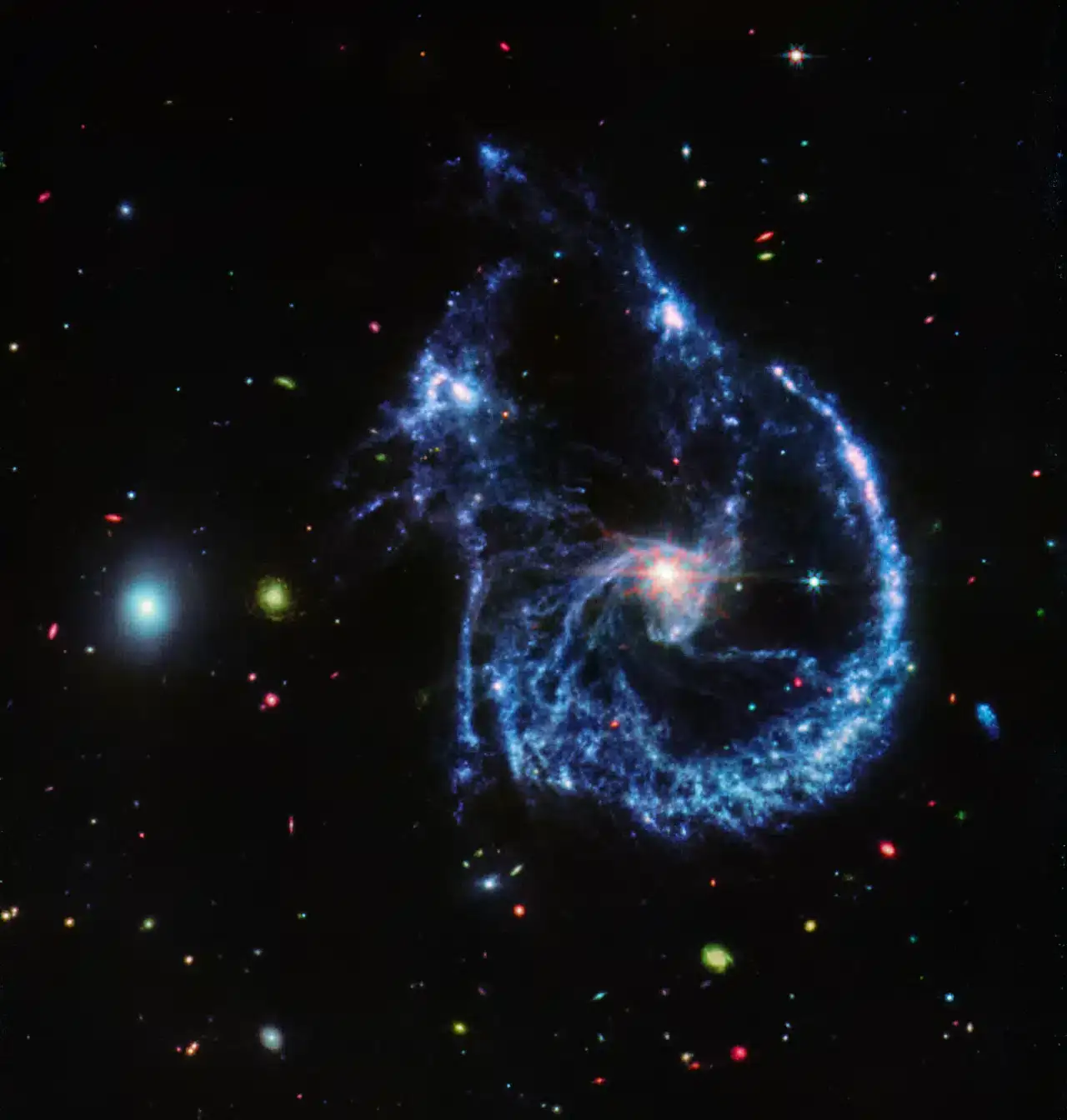
This in-depth observation is key to unraveling how galactic collisions fuel new star creation. The James Webb Space Telescope’s infrared insights expose that the cosmic clash doesn’t simply destroy—while some gas is squeezed to generate stars, other material disperses into space, potentially curbing future star formation. Understanding this balance sheds light on galaxy growth and transformation.
Black Holes Influencing Galactic Encounters
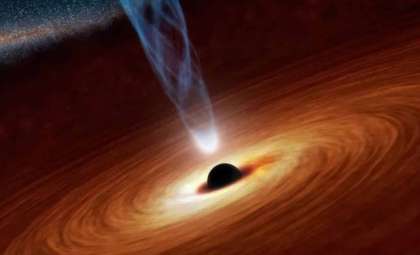
The spiral galaxy in Arp 107 is known as a Seyfert galaxy, distinguished by its luminous core energized by a supermassive black hole. During collisions, such black holes significantly impact the interaction’s evolution. Webb’s data reveal how the supermassive black hole in Arp 107 not only attracts gas and dust but also sculpts the surrounding stellar environment.
The black hole’s powerful gravity distorts the spiral arms, altering their shapes amid the galactic encounter. This mechanism sparks star formation and redistributes material within the system. Some gas absorbed by the black hole emerges as energetic jets or winds, ejecting matter and energy outward, which can suppress star formation by clearing away the star-building fuel.
Thanks to Webb’s sharp infrared images, scientists can observe these complex phenomena, enhancing our knowledge of how supermassive black holes both foster and hinder star development during mergers. This research is vital for understanding the intertwined growth of galaxies and their central black holes, especially amid intense interactions. It informs models of galaxy evolution and the balance between black hole activity and star formation.
What's Next for the Arp 107 Merger?
The collision in Arp 107 continues and will likely take hundreds of millions more years to complete. As these galaxies interact, the connecting bridge of gas and stars may fade, eventually forming a single, combined galaxy. Webb’s observations allow astronomers to monitor this gradual transformation, offering valuable insights into how galaxies reform after violent encounters.
The James Webb Space Telescope opens an unprecedented window to witness these cosmic changes. By studying Arp 107 and similar systems, researchers piece together the story of galaxy evolution, gaining clues about the early cosmos and the intricate structure of the cosmic web. Each new observation from Webb enriches our understanding of the universe’s history and its continual evolution.




0 comments
Sign in to Comment