
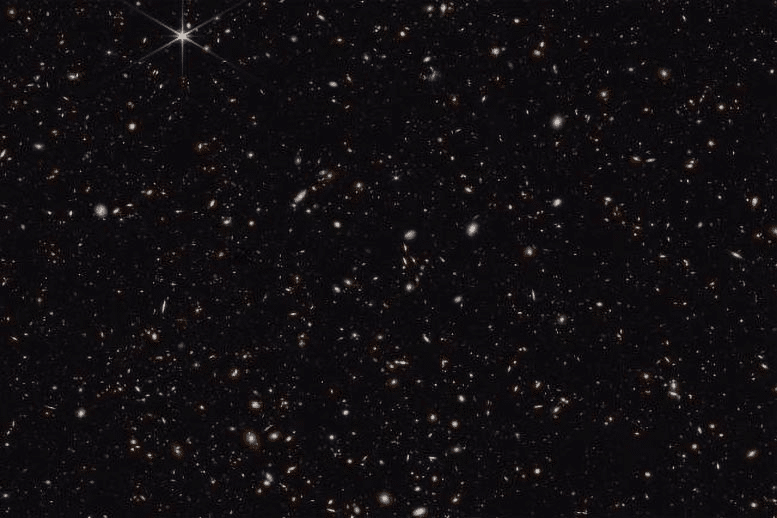
The James Webb Space Telescope (JWST) has uncovered a fascinating new class of galaxies, dubbed "tiny scarlet dots" (TSDs), which have captured the attention of astronomers worldwide. These minute, extremely distant galaxies remained hidden until JWST’s advanced deep-field observations exposed their unique features. A recent article published in the Astrophysical Journal Letters suggests these TSDs might be fundamental to understanding the early cosmos, possibly marking the birth sites of primordial black holes. Researchers Fabio Pacucci and Avi Loeb propose that TSDs originate from dark matter halos with exceptionally low angular momentum, offering an explanation for their compactness, red coloration, and distinct compact size.
The Enigmatic Little Scarlet Dots
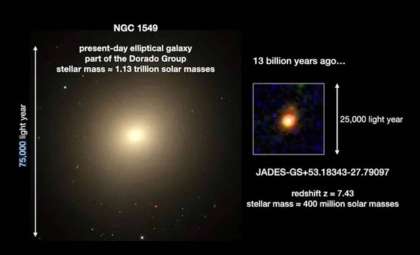
Prior to JWST’s launch, these TSDs were completely undetectable by existing telescopes. “Tiny scarlet dots are compact, distant galaxies with a red hue that had escaped detection before JWST,” explained Pacucci. These galaxies represent some of JWST’s most astonishing finds. Contrary to expectations that early galaxies would be expansive and blue due to rapid star birth, TSDs appear older, denser, and challenge conventional galaxy formation models.
The galaxies are incredibly dense, packing an extraordinary number of stars into an exceptionally tight space. A pressing question remains: do these galaxies encompass massive black holes given their mass density, or are they merely compact clusters of stars? “This remains a core puzzle,” said Pacucci. “If black holes reside there, they would be disproportionately massive relative to the galaxy size. Yet, if only stars are present, their density is unprecedentedly high and difficult to reconcile.”

Dark Matter Halos: The Hidden Sculptors of TSDs
The core of this research presents a novel explanation for the TSDs' origins. Scientists argue that these galaxies emerged within dark matter halos — vast, invisible structures that govern galaxy formation. What sets these halos apart is their remarkably low spin rates, differing vastly from the halos of more typical galaxies. “Dark matter halos exhibit varying rotational speeds; some rotate sluggishly, while others spin rapidly,” Loeb explained. This low-spin feature may be critical in the development of the tiny scarlet dots.
According to Pacucci and Loeb, low-spin halos efficiently funnel matter into central regions, fostering either swift star formation or black hole growth. This central mass accumulation helps explain the TSDs’ extreme compactness and density compared to more spread-out early galaxies. “Low-spin halos tend to drive mass toward their centers, facilitating black hole accretion or rapid stellar birth,” Pacucci noted.
Unveiling the Universe’s Earliest Black Holes
Perhaps the most intriguing implication is that TSDs may host supermassive black holes at their centers. The unique environments within these low-spin dark matter halos could have accelerated gas inflow, allowing black holes to expand rapidly shortly after the Big Bang. “Our findings offer new insights into these elusive objects,” Pacucci stated. “Tiny scarlet dots might hold clues to how the universe’s first black holes formed and evolved alongside their host galaxies.”
The possibility that TSDs represent early incubators of supermassive black holes is groundbreaking. Confirming this would shed light on a largely hypothesized phase of cosmic history, illustrating black hole formation at the dawn of time—perhaps even preceding the emergence of the first stars. This could revolutionize our comprehension of the interplay between dark matter, galaxy formation, and black hole genesis.
- Categories:
- News








0 comments
Sign in to Comment