
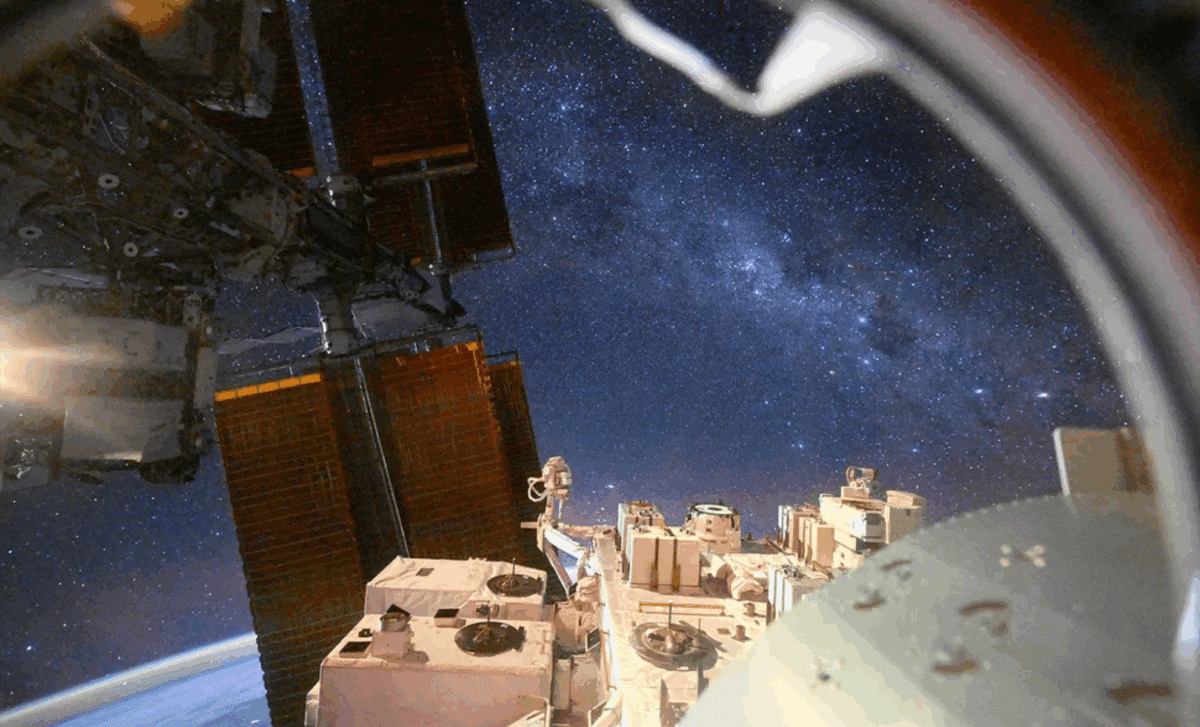
The International Space Station (ISS) crew frequently shares spectacular images of our planet, but a recent shot by Japanese astronaut Kimiya Yui has truly mesmerized viewers around the globe. On October 14, 2025, Yui unveiled a stunning photograph featuring the Milky Way arching above Earth’s curve, illuminated by vibrant green and red auroras. Taken from the Kibo laboratory onboard the ISS, this remarkable image blends scientific wonder with Yui's unique perspective.
An Uncommon View Through the Kibo Module Window
Kimiya Yui humorously remarked, “Could this be among the top five views captured through the ‘Kibo’ window? I might be boasting a little…” he shared, expressing his admiration for the scene. Serving as a flight engineer during Expedition 73, Yui has witnessed countless Earth vistas, yet this particular view stood apart. With the Milky Way stretching across the skyline and auroras flickering below, the image conveys a special moment of reflection and beauty from his vantage point in space.
The station's altered orientation at the time offered an exceptional perspective, differing from the usual scenery. “The ISS adopted a new attitude, causing the window view to transform,” Yui explained, highlighting how slight changes in the station's position can reveal fresh images of our planet.

Understanding Auroras from Space
Auroras arise when charged particles from the solar wind collide with Earth's magnetic field, energizing atoms that then emit light. Most commonly spotted near the poles, witnessing these luminous displays from orbit provides a deeper insight. Yui’s vivid photo, showing both green and red auroras, beautifully emphasizes Earth’s dynamic atmospheric processes and how orbiting platforms enable their study from above.
Orbiting roughly 400 kilometers (250 miles) above Earth’s surface, the ISS offers a prime vantage point to observe such natural light shows. Although astronauts often observe auroras firsthand, capturing such vivid images via spacecraft windows is less common. Yui’s photograph from the Kibo module not only highlights auroral beauty but also underscores the ISS’s critical role in monitoring Earth’s atmospheric events, including space weather phenomena like solar storms and cosmic radiation.
A Personal Connection and Upcoming Missions
Beyond the striking visuals, Yui’s bond with the space station and his mission shines through. He’s actively preparing for the launch of Japan's advanced HTV-X cargo spacecraft, set for October 20, 2025. Playfully, Yui commented, “I’m ready for you! I’ll gently catch you, so no worries!” referring to the arrival. Using the Canadarm2 robotic arm, he plans to capture and berth the HTV-X upon its approach.
This lighthearted remark reflects the blend of technical challenges and excitement astronauts experience. Alongside rigorous scientific experiments and maintenance duties, moments like anticipating cargo deliveries inject human warmth into life aboard the ISS. These personal touches deepen our understanding of astronaut life and the complexities of space operations.
Daily Life and Crew Dynamics Aboard the ISS
Yui’s images and social media updates offer a rare window into the lives of those living in orbit. The current crew of seven includes Expedition 73 Commander Sergey Ryzhikov, Russian cosmonauts Alexey Zubritsky and Oleg Platonov, NASA astronauts Jonny Kim, Zena Cardman, Mike Fincke, and Yui himself. Together, they handle research, station upkeep, and ensure smooth operations.
Besides their scientific responsibilities, crew members frequently share space vistas with the public through photographs, streaming, and posts. Yui’s aurora tweet exemplifies how astronauts build connections with audiences on Earth, showcasing both the celestial wonders beyond and the dedicated science advancing multiple disciplines from orbit.
ISS: A Beacon of Global Cooperation and Innovation
The ISS stands as a landmark of international partnership involving NASA, Roscosmos, ESA, JAXA, and CSA. This collaborative environment brings astronauts worldwide together to conduct research benefiting humanity at large.
Yui’s participation highlights Japan’s vital role in space exploration and illustrates the expanding importance of global collaboration. Research on the ISS, covering aurora phenomena, space weather, and human physiology in microgravity, depends on the combined expertise of multinational crews. These cooperative missions continue to push the frontiers of knowledge, setting the stage for future explorations to the Moon, Mars, and beyond.
- Categories:
- News







0 comments
Sign in to Comment