
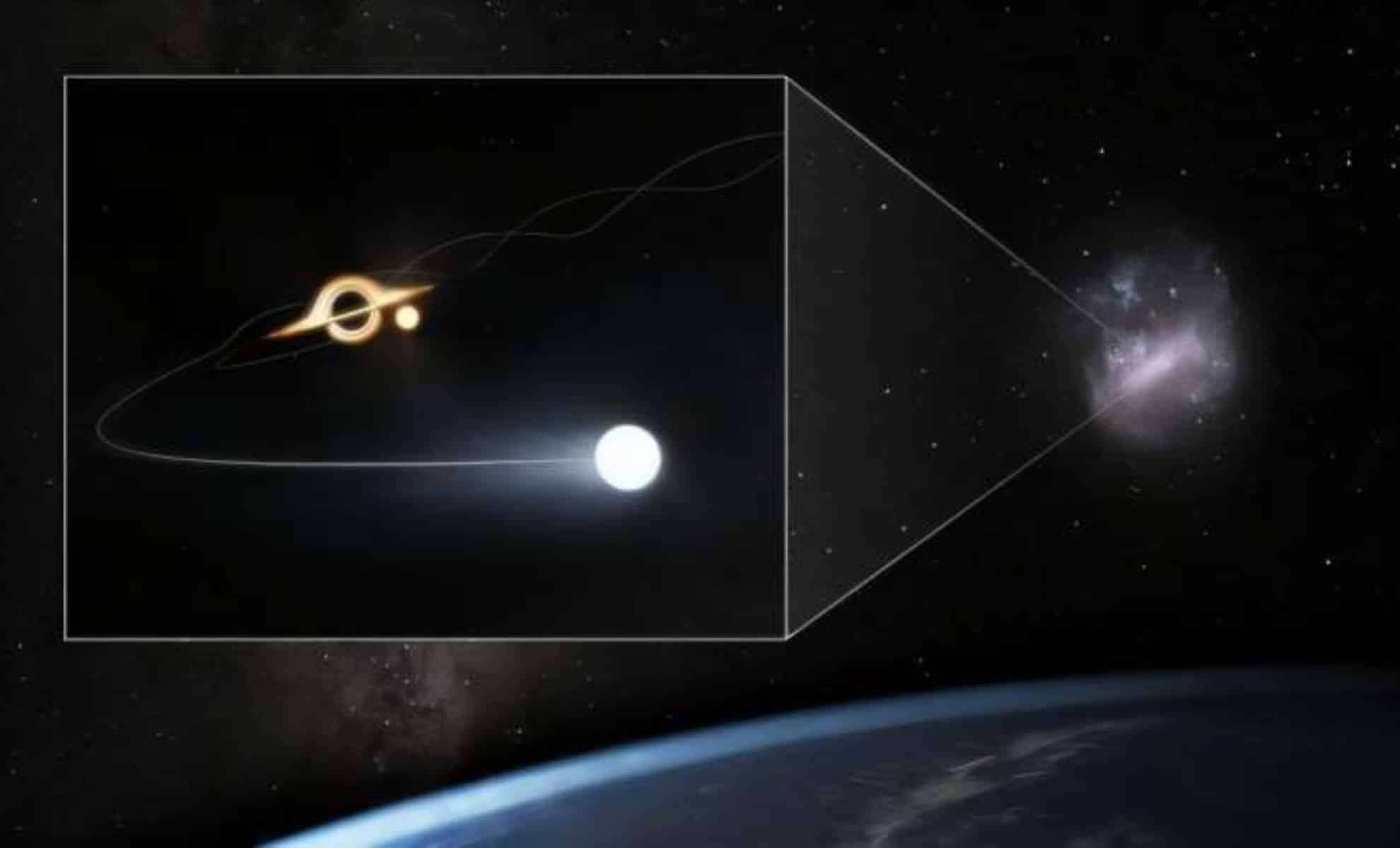
In a remarkable breakthrough, researchers have identified a previously undetected supermassive black hole within the Large Magellanic Cloud (LMC), one of the closest satellite galaxies to the Milky Way. Utilizing observations from the European Space Agency's Gaia spacecraft, this newly found black hole, weighing around 600,000 times the mass of the Sun, has been revealed by the rapid expulsion of stars traveling at extraordinary speeds into intergalactic space. The full details are presented in a recent arXiv publication, which offers fresh insights into the origins of these runaway stars.
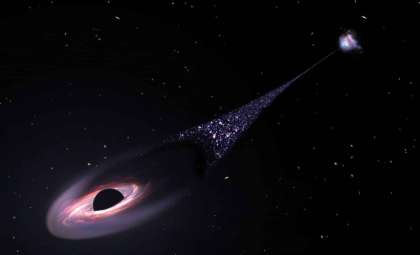
Since black holes emit no visible light, pinpointing them is a challenging task. Yet this particular black hole became evident as it propelled hypervelocity stars—stellar objects moving so fast they escape the gravitational pull of the Milky Way entirely. According to scientists at the Harvard-Smithsonian Center for Astrophysics, roughly half of such swift stars come from our galaxy’s central black hole, Sagittarius A*. The other half, however, originates from an unexpected source, prompting a surprising new discovery.
Tracing the origins of hypervelocity stars
Astronomers, much like forensic analysts tracking a bullet’s trajectory, have studied the paths of 21 hypervelocity stars located on the outskirts of the Milky Way. These observations exposed an unexplained pattern that eventually led them to investigate the LMC.

“Discovering there’s a supermassive black hole just a stone’s throw away, in cosmic terms, is truly incredible,” stated Jesse Han, the study's principal author. “This black hole has stealthily remained hidden right under our gaze.”
Some stars were found to be accelerating past a million miles per hour—too rapid to have originated from the Milky Way alone. Orbital modeling pointed to the center of the LMC as their launch site, revealing a previously unknown massive black hole in the galaxy.
How supermassive black holes catapult stars at incredible speeds
The presence of the LMC black hole is connected to the dramatic acceleration of hypervelocity stars. These stars often begin in binary systems, where two stars orbit one another. If such a pair ventures near a supermassive black hole, powerful gravitational forces tear them apart. One star becomes bound to the black hole’s orbit, while the other is flung outward at extreme velocities.
“When a binary star system approaches a supermassive black hole, the immense gravitational force disrupts it,” explained Kareem El-Badry, a co-author. “One star is trapped by the black hole, and its partner is hurled away from the galaxy at remarkable speeds.”
While astronomers had theorized that the LMC might shelter a hidden black hole, this is the first time meaningful evidence has confirmed its existence. The team’s simulations forecast that if such a black hole existed, hypervelocity stars would appear clustered in a specific sector of the Milky Way, matching the observed data exactly.
A colossal presence in our neighboring galaxy
Though the LMC’s black hole is smaller than Sagittarius A*—which boasts a mass about four million times that of the Sun—it still qualifies as supermassive and is unusual for a satellite galaxy. Weighing in at roughly 600,000 solar masses, it surpasses typical stellar black holes but is modest compared to the giants residing in distant galaxies.
“The evidence points unmistakably to a massive black hole living next door, in the LMC,” said Scott Lucchini, also contributing to the study.
Besides marking the first confirmed supermassive black hole in the LMC, this finding broadens our comprehension of galactic interactions. Since the LMC is on a trajectory to eventually merge with the Milky Way over several billion years, this could result in new material funneling toward our central black hole, Sagittarius A*.
- Categories:
- News


0 comments
Sign in to Comment