

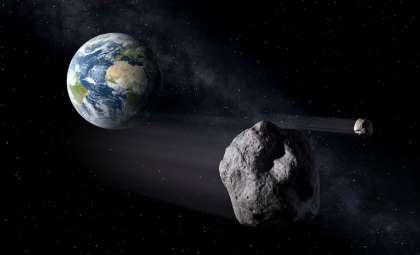
On October 24, 2024, Earth will experience a rapid series of close encounters with four sizable asteroids within just 12 hours.
These celestial bodies, measuring between 30 and 177 meters (100 to 580 feet) in diameter, have been classified as “potentially hazardous” due to their size and trajectory, although none present any immediate collision risk. Their proximity and dimensions have attracted keen scientific attention.
An Intense Sequence of Flybys
The asteroids—named 2015 HM1, 2024 TP17, 2002 NV16, and 2024 TR6—will come within 4.5 to 5.6 million kilometers (2.8 to 3.5 million miles) of Earth. The earliest, 2015 HM1, will pass closest at 12:36 a.m. EDT and is the smallest, roughly 30 meters wide. Shortly after, 2024 TP17, measuring about 52 meters across, will approach at 4:20 a.m. EDT. The largest, 2002 NV16, spanning about 177 meters—taller than many skyscrapers—will fly by at 11:47 a.m. EDT at a distance of 4.5 million kilometers.

Although these distances far exceed the average gap between Earth and the Moon, approximately 384,400 kilometers (238,855 miles), the asteroids’ proximity is close in astronomical terms. In particular, 2002 NV16 is categorized as a “city killer,” underscoring the significant damage an impact of its scale could cause.
Recent Discoveries and Hazard Evaluation
Two asteroids in this group, 2024 TP17 and 2024 TR6, were identified only in October 2024, mere weeks before their Earth flybys. This underscores a common challenge in asteroid detection: many objects are discovered shortly before their near-Earth approaches. The Catalina Sky Survey reports the discovery of nearly 2,000 near-Earth asteroids annually, emphasizing the importance of vigilant observation to assess potential threats.
Despite no immediate hazard from these four asteroids, their “potentially hazardous” status indicates a need for ongoing surveillance. NASA’s Near-Earth Object Program classifies asteroids as hazardous if their orbits bring them within 30 million miles of Earth. These bodies move at speeds of several kilometers per second, meaning an impact would be catastrophic.
Close passes like these also present prime opportunities for scientists to gather radar data. Such observations allow researchers to analyze an asteroid’s size, shape, and orbit, informing predictions about their future paths. Live Science notes that radar imaging has revealed surprising details about some asteroids, including unexpected trajectory shifts.
Upcoming Close Encounters
Beyond October 24, two asteroids from this group will return for closer flybys in coming decades. 2024 TR6 is predicted to approach within just 1.2 million miles (1.9 million kilometers) on August 5, 2039, and 2024 TP17 will pass at about 1.3 million miles (2.1 million kilometers) on October 25, 2040. Although these future distances are still safe, they highlight the necessity of long-term asteroid tracking.
Advances in detection methods are enhancing astronomers’ abilities to identify threats earlier than ever before. The fast succession of flybys tomorrow exemplifies the ever-shifting cosmic environment. While no impact risk is present now, these close calls provide critical data for refining protective strategies.
Monitoring near-Earth objects remains a priority for global space agencies. For continuous updates on asteroid trajectories, NASA’s Asteroid Watch Dashboard offers real-time information. As asteroids like 2002 NV16 and 2024 TR6 approach Earth in the future, scientists will have additional chances to study them and strengthen planetary defense efforts.








0 comments
Sign in to Comment