
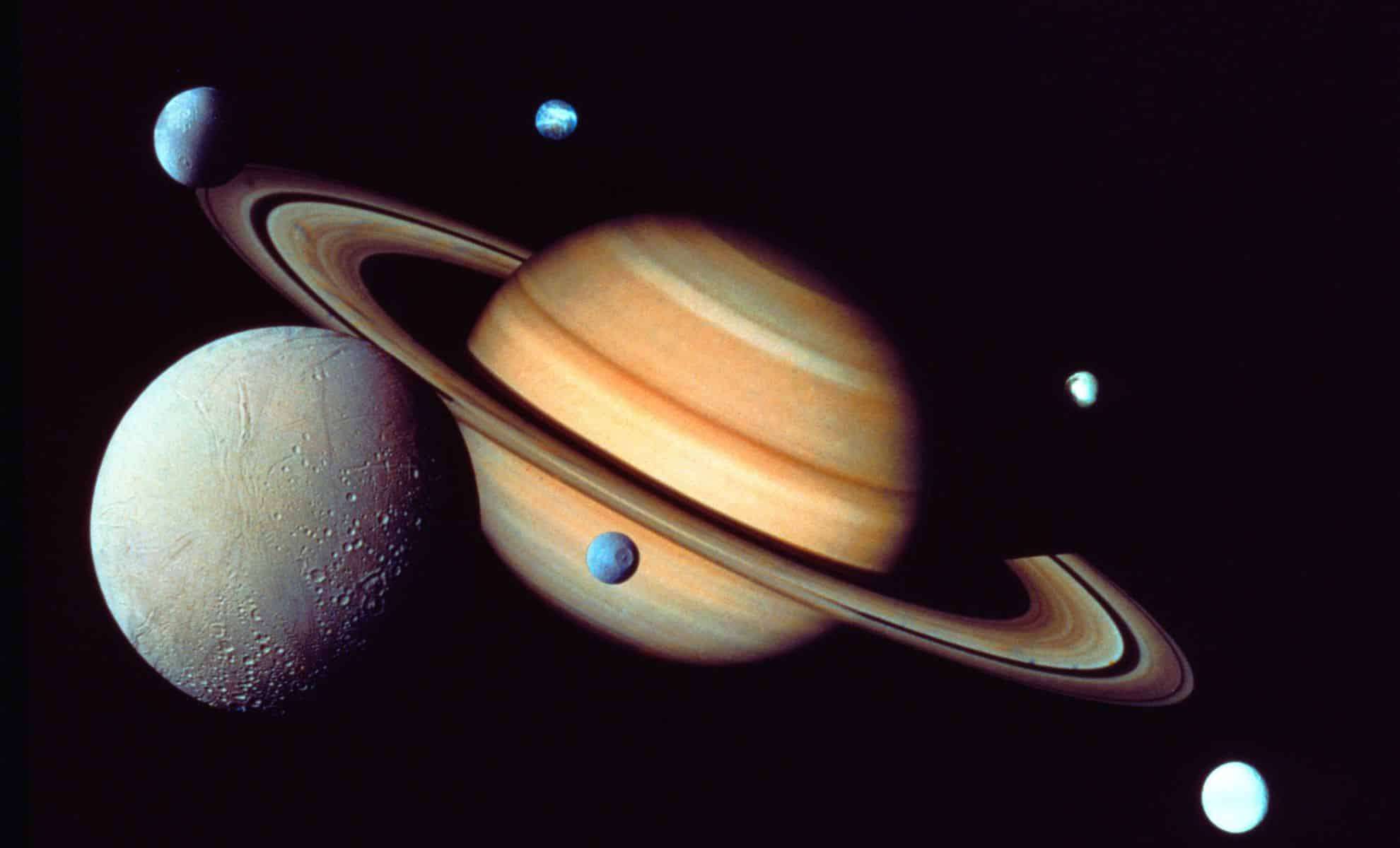
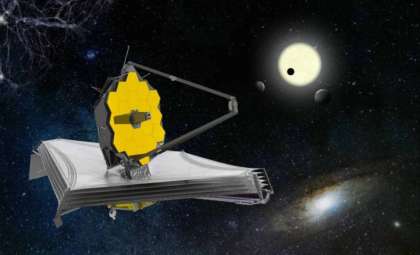
Thanks to the cutting-edge instruments aboard NASA’s James Webb Space Telescope (JWST), researchers are making significant progress in analyzing the chemical compositions of far-flung moons. A new investigation slated for publication in The Planetary Science Journal explores the various forms of carbon dioxide (CO₂) present across Saturn’s mid-sized satellites. Utilizing extensive JWST observations, the team identified four unique CO₂ varieties on moons including Dione, Enceladus, Hyperion, and Iapetus. These insights extend our understanding of these moons’ origins, development, and potential for hosting life, while also drawing parallels with the Galilean moons orbiting Jupiter.
Significance of CO₂ on Saturn’s Satellites
Carbon dioxide serves as a crucial marker in planetary research, allowing scientists to infer geological and atmospheric histories not only on moons and planets but also on exoplanets. Although CO₂ is a minor component of Earth’s atmosphere, it is essential in maintaining our planet’s climate and biological equilibrium. Detecting CO₂ on Saturn’s moons offers valuable clues about their past conditions, their potential to support life forms, and the processes behind their formation.
Studying Saturn’s moons is especially compelling due to their diverse chemical environments. The researchers report that the CO₂ on Dione and Rhea is primarily sourced from Saturn’s E-ring, characterized by a complex mixture of particles and radiation. This implies that the ring system has profoundly shaped the moons’ surface chemistry. In contrast, the CO₂ on Phoebe has an origin tied to organic substances and is subsequently transferred to other moons like Iapetus and Hyperion.

This raises important questions about the mechanisms trapping CO₂ on these cold, airless moons. Unlike Earth’s dynamic atmosphere, these satellites lack significant gaseous envelopes, yet the presence of CO₂ points to intricate chemical interactions occurring over time. The researchers note that these findings might also provide insights into moons orbiting beyond Saturn, such as Jupiter’s Galilean satellites, where the nature of CO₂ offers further clues into their evolutionary histories.
Unveiling the Four Varieties of CO₂ on Saturn’s Moons
The investigation categorizes four distinct CO₂ types detected on Saturn’s moons. A notable outcome is that the CO₂ on Dione and Rhea appears to be largely influenced by the influx of particles from the E-ring, signaling close chemical interactions with Saturn’s ring environment. Moving further outward, the study reveals that Phoebe generates CO₂ through organic matter degradation, which then migrates to satellites like Iapetus and Hyperion. The CO₂ presence serves not only as a surface composition indicator but also attests to ongoing, deeper chemical processes within these icy worlds.
These discoveries offer essential clues about the moons’ histories and the potential impact of Saturn’s rings on shaping their chemical makeup. Additionally, the research draws connections to the icy Galilean moons, where CO₂ may share similar origins despite variations in their spectral signatures. As the study mentions, “These observations have interesting implications for the icy Galilean satellites and the state of their CO₂ as well. Interpretations for the CO₂ detected on the Galilean satellites are sometimes similar to the interpretations we have made here for the Saturnian satellites, though in some cases the similarity of the interpretation is in spite of large spectral differences.”
What This Means for Life Potential on Saturn’s Moons
Although the mere presence of CO₂ does not confirm biological processes, it opens intriguing possibilities concerning the habitability of these moons. On Earth, CO₂ is fundamental for photosynthesis and sustaining ecosystems. Similarly, detecting CO₂ on satellites like Enceladus and Iapetus could hint at environments that might support microbial life, especially if combined with other factors such as liquid water reservoirs or geothermal energy sources.
Scientists have long considered moons like Europa and Enceladus as candidates for hosting subsurface oceans where life might exist. The latest insights regarding Saturn’s moons provide critical comparative data that broaden our understanding of where life-sustaining environments can occur, even in worlds lacking atmospheres or conventional surface conditions. As the study suggests, these icy satellites may reveal crucial information about habitats capable of nurturing life in extreme, atmosphereless regions.
- Categories:
- News



0 comments
Sign in to Comment