
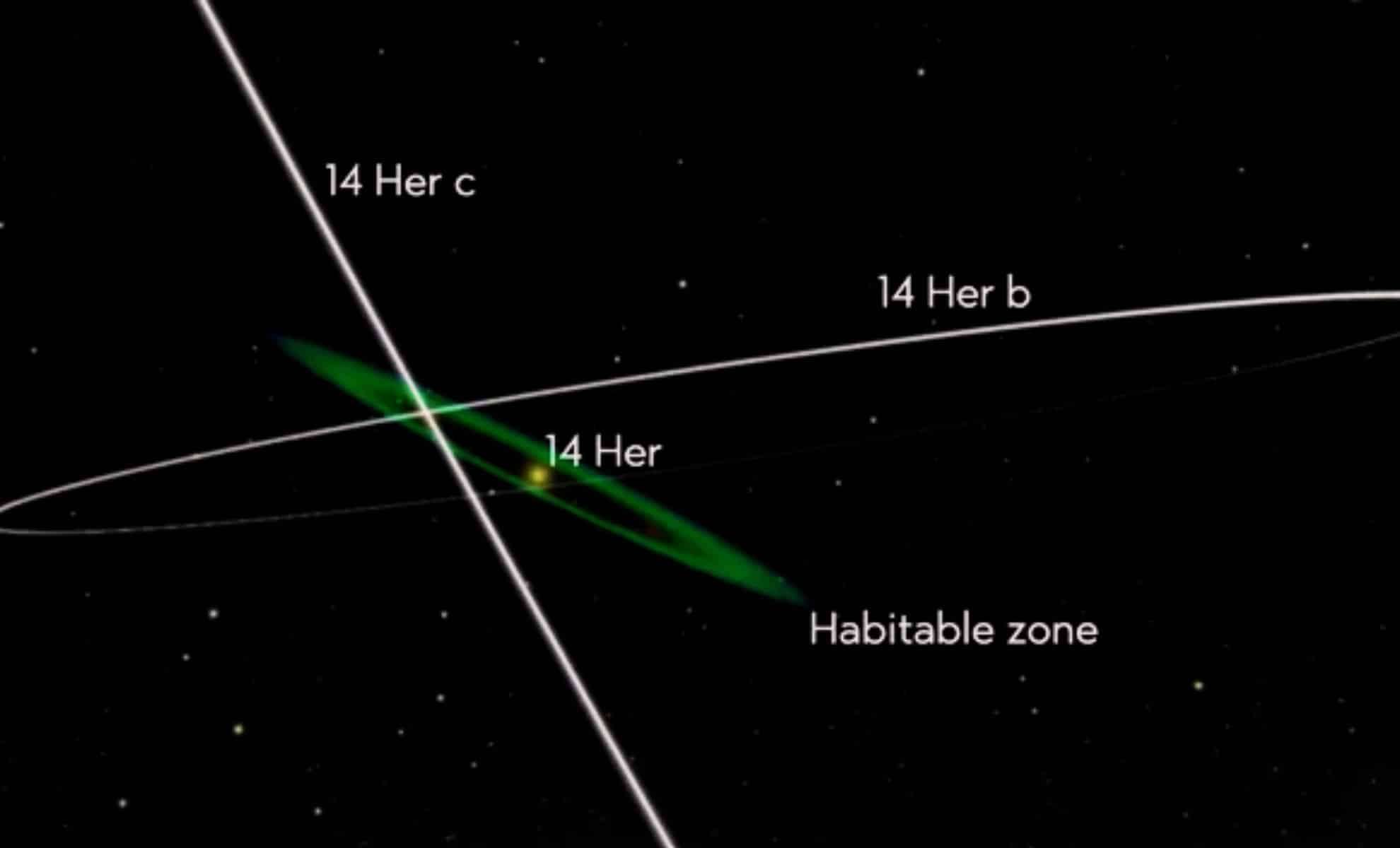
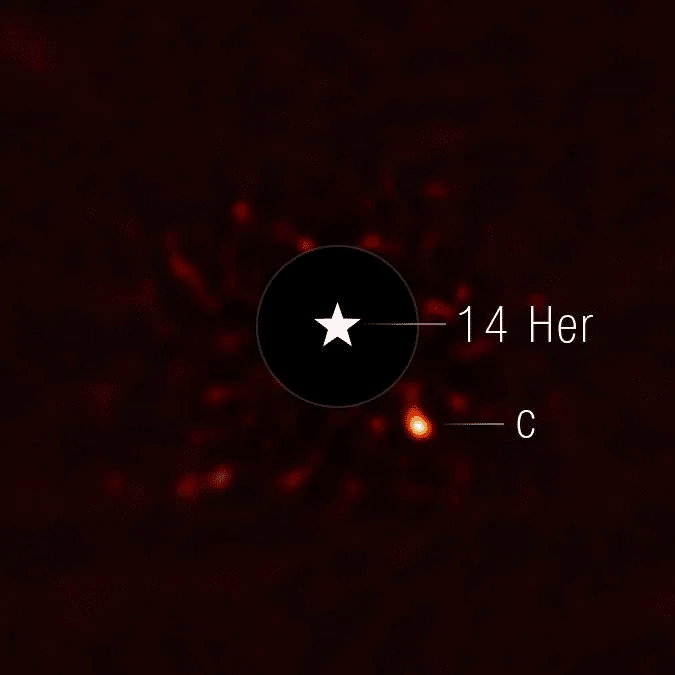
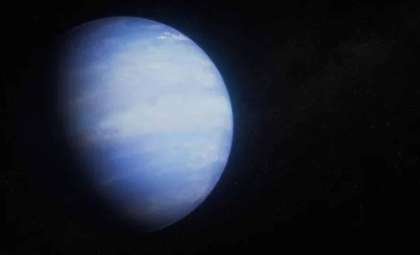
The James Webb Space Telescope (JWST) has recently obtained an extraordinary image of a distant, icy exoplanet named 14 Herculis c, situated around 60 light-years away in the Hercules constellation. This landmark discovery promises to give astronomers a novel perspective on an ancient world never previously observed in such detail. According to NASA’s mission page, the planet 14 Herculis c is an old, roughly 4-billion-year-old celestial body orbiting its star, which is similar to the Sun, at a distance near 1.4 billion miles—about 15 times farther than Earth’s distance from the Sun. Despite its extremely cold atmosphere measured at just 26°F (-3°C), JWST’s sensitive instruments successfully captured the planet’s near-infrared image directly.
Unusual Orbital Dynamics of 14 Herculis c
A remarkable aspect of 14 Herculis c lies in its highly tilted and eccentric orbit. Unlike the relatively aligned orbits of planets in our solar system, 14 Herculis c and its companion planet in the same star system follow orbits inclined about 40 degrees from each other, forming a distinctive “X” pattern around their host star. Such an orbital layout stands in stark contrast to planetary arrangements observed closer to home.
Scientists believe that the system’s erratic orbital pattern may have resulted from the early ejection of a third massive planet, which disturbed the gravitational balance and caused the remaining planets to settle into their present positions. Described as a “planetary tug of war,” this interplay of gravitational forces may give rise to a prolonged, unstable orbital configuration.

“These wobbles appear to be stable over long time scales,” said astronomer W. Balmer. “We’re trying to understand what kinds of planet-planet scatterings could produce such an exotic configuration of orbits.”
JWST's Cutting-Edge Imaging Triumph
Imaging 14 Herculis c directly presented a significant technical challenge, given that exoplanets shine far dimmer than their host stars—sometimes by factors of millions or even billions. Balmer likened the challenge to spotting “fireflies next to lighthouses.”
JWST overcame this hurdle using a coronagraph, which blocks out the intense starlight, revealing the faint infrared glow emanating from the planet. This marks the first time astronomers have imaged a planet of such low temperature and considerable age directly in infrared light, advancing the study of older and colder planetary bodies.
Surprisingly Dim Infrared Signature of 14 Herculis c
Although the planet boasts a mass about seven times that of Jupiter, its infrared brightness was unexpectedly low. Scientists anticipated a brighter detection based on its mass and age, but the observations showed much less luminosity.
“The planet’s actually significantly fainter than what we’d expect,” said Balmer. “We don’t think that this is a problem with the evolutionary models, however.”
This discrepancy may be attributed to atmospheric dynamics and composition. The JWST instruments identified carbon monoxide and carbon dioxide where methane was expected, indicating strong upward gas flows transporting hot material from the planet’s interior to cooler upper layers. This process likely traps heat below, thereby lowering the planet’s overall brightness and temperature appearance.
- Categories:
- News







0 comments
Sign in to Comment