
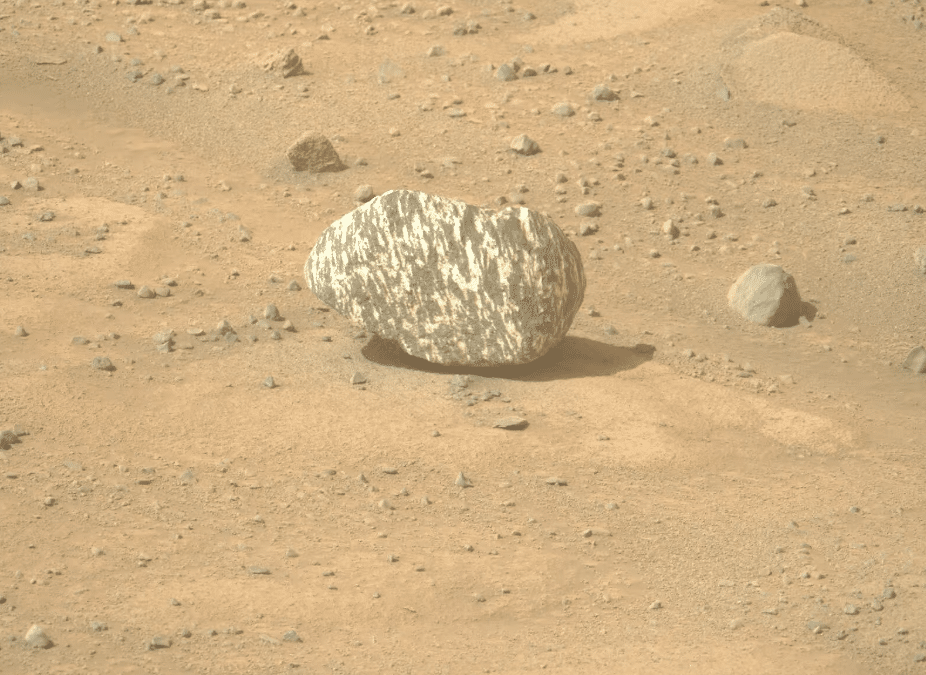
NASA’s Perseverance rover has recently identified an unusual black-and-white striped rock on Mars, instantly intriguing researchers and space observers. Nicknamed “Freya Castle,” this striking rock contrasts vividly with the planet’s characteristic rusty terrain, prompting in-depth scientific inquiry into its origins.
The puzzling characteristics of Freya Castle
During its ascent of Jezero Crater on September 13, 2024, Perseverance captured an image of a distinct rounded boulder featuring a bold pattern of black and white stripes. This peculiar texture indicates it may be an igneous or metamorphic rock, sparking keen interest among Mars geologists.
The zebra-like markings on Freya Castle point toward two main geological origins:

- Gabbroic cumulate: Formed via the fractional crystallization process within a magma chamber
- Metamorphic rock: Resulting from the alteration of existing rocks under intense pressure and heat
Both possibilities suggest that this rock was once buried deep beneath Mars’ surface, raising questions about the processes that transported it to its current location. This aligns with other recent discoveries such as unusual subsurface formations revealed through gravitational studies, pointing to a diverse and intricate geological past for the Red Planet.
Insights into the geological evolution of Mars
Freya Castle presents an extraordinary glimpse into Mars’ ancient geological activity. Due to the absence of active plate tectonics on Mars, unlike Earth, bringing deep crustal rocks to the surface is less common. A prevailing theory is that the creation of Jezero Crater by a massive impact event might have excavated this rock from the planet’s interior.
Considering the formation processes in detail:
ProcessDetailsGeological SignificanceCumulate FormationGradual cooling and crystallization of magma within a chamber, producing layered mineral depositsIndicates complex magmatic history on MarsMetamorphismAlteration of rocks under varying pressure and temperature conditionsReflects dynamic crustal changes during Mars’ early geological timeline
Studying Freya Castle may unlock new understanding of Mars’ thermal dynamics and tectonic phenomena, potentially transforming prevailing concepts of its planetary development. This finding further underscores the critical role of rover missions in uncovering hidden aspects of planetary geology, much like recent lunar explorations that confirmed widespread water presence on the Moon, as reported in this article.
What Freya Castle reveals for Mars research and exploration
The appearance of Freya Castle opens fresh paths for Mars geological studies. Its striking structure points to the likelihood of an original source rock somewhere higher on the crater slopes. If Perseverance locates this parent formation, it could revolutionize our understanding of Jezero Crater and offer broader insights into Martian geology.
Key potential insights from this discovery include:
- New information on ancient magmatic processes on Mars
- Proof of deep-seated crustal materials being exposed
- Clues to the impact events that shaped Jezero Crater
- New possibilities for dating Mars’ early geological activity
As Perseverance advances along the crater rim, scientists remain hopeful about encountering additional unique rock formations or even uncovering Freya Castle’s origin point. Each new find contributes vital knowledge toward piecing together Mars’ geological narrative, enriching our understanding of the planet’s past habitability and its geological transformation.
Continuing to explore Mars’ hidden secrets
Freya Castle represents just one intriguing feature among many yet to be fully understood on Mars. Its existence highlights the necessity of ongoing exploration and the exciting potential for surprising revelations on the Martian surface. Through persistent efforts, every cliff, boulder, and crater adds to the mosaic of Mars’ history.
This striped boulder in Jezero Crater exemplifies the rich variety of geological processes that have operated on Mars over billions of years. Beneath the barren appearance of the Martian terrain lies a complex world of geological marvels awaiting discovery. With missions like Perseverance leading the way, we stand at the threshold of breakthroughs that could reshape our knowledge of planetary formation and evolution across our solar system.
- Categories:
- Nasa








0 comments
Sign in to Comment