
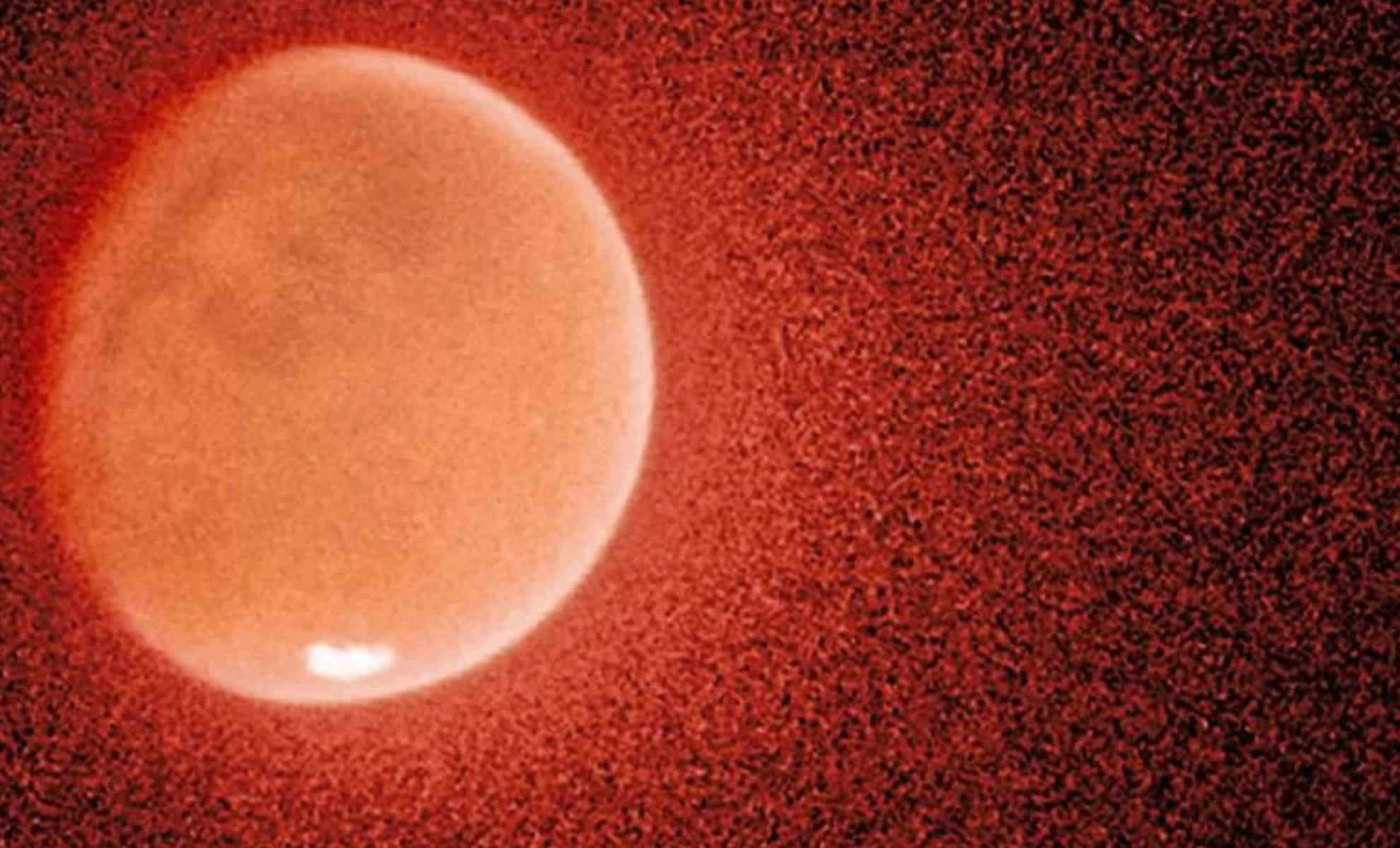
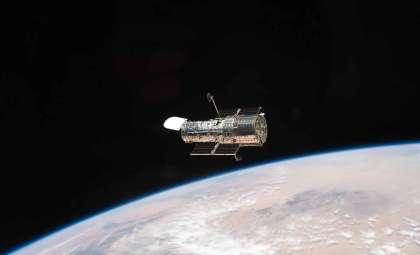
By combining data from NASA’s Hubble Space Telescope with insights from the MAVEN mission, scientists have pieced together how Mars lost its once-abundant surface water over billions of years.
Unraveling the Mechanism of Water Loss on Mars
Researchers discovered that solar ultraviolet radiation breaks down water molecules in Mars’ atmosphere into separate hydrogen and oxygen atoms. Hydrogen, especially its heavier form known as deuterium—a variant containing an extra neutron—is less likely to escape due to its greater mass. Mars preferentially lost lighter hydrogen atoms, raising the proportion of deuterium over time. This elevated ratio allows scientists to estimate the volume of water Mars possessed during its wetter epochs.
“Water molecules have only two endpoints: either they freeze into the soil or they split and escape atom by atom into space,” explained John Clarke, lead scientist at Boston University’s Center for Space Physics. Combining observations from Hubble and MAVEN, Clarke’s team quantified current hydrogen loss rates and extrapolated these findings to reconstruct Mars’ historic water depletion. This approach sheds light on the planet’s ancient climate and water cycle spanning billions of years.

Insights into Mars’ Highly Variable Atmosphere
One revealing outcome of the Hubble and MAVEN missions is the discovery that Mars’ atmosphere experiences rapid fluctuations throughout its orbital cycle. As the planet swings closer to the Sun at perihelion, the heated atmosphere causes water vapor to ascend swiftly. This accelerates the breakdown of molecules at high altitudes, increasing hydrogen and oxygen loss into space.
Clarke noted, “Mars exhibits an atmospheric cycle far more dynamic than previously believed. Temperatures and turbulence can change markedly within hours.” The realization that Mars’ atmosphere expands and contracts with solar proximity challenges earlier ideas that hydrogen atoms gradually diffused upward, instead highlighting a much faster water escape during close solar approaches.
Using Hubble’s far-ultraviolet imaging alongside MAVEN’s atmospheric measurements, scientists mapped these seasonal variations comprehensively. During aphelion, when Mars is farthest from the Sun, hydrogen escape slows, but near perihelion, the rate surges. This overturns previous models that underestimated the speed and intensity of water loss on Mars.
Solar Wind and Atmospheric Chemistry’s Role in Hydrogen Escape
The research also indicates that additional forces beyond heat enable hydrogen and deuterium atoms to break free from Mars’ gravity. The thermal energy alone cannot accelerate enough atoms to escape velocity, so scientists identified solar wind impacts and sunlight-driven chemical reactions as crucial contributors.
Charged particles streaming from the Sun collide with Mars’ atmospheric atoms, transferring energy that boosts hydrogen speeds. Meanwhile, ultraviolet radiation initiates reactions creating super-thermal hydrogen atoms capable of overcoming gravitational bounds. These combined effects intensify atmospheric loss, particularly during periods of elevated solar activity, underlining how solar proximity influences Mars’ water retention.
Mars as a Model for Understanding Exoplanetary Atmospheres
These breakthrough findings extend beyond Mars, illuminating the evolution of terrestrial planets within habitable zones—both in our solar system and beyond. Earth, Venus, and Mars occupy regions where liquid water could exist, yet their atmospheric histories differ drastically. While Earth retains abundant water, Venus experienced runaway heating, and Mars gradually lost its atmosphere.
“Decoding Mars’ water history is key to grasping how Earth-like planets develop,” Clarke emphasized. As astronomers discover numerous exoplanets in habitable zones around distant stars, Mars serves as an accessible analogue to study planetary atmospheric loss and water depletion over billions of years.
The synergy between Hubble and MAVEN offered the first complete perspective on Mars’ hydrogen escape, furnishing a valuable framework to explore the atmospheres of distant rocky worlds with similar orbits.
Prospects for Continued Martian Research
With MAVEN approaching its 10th anniversary at Mars in September 2024, ongoing observations promise to deepen our understanding of the planet’s atmospheric dynamics and water escape. Managed by NASA’s Goddard Space Flight Center, MAVEN remains instrumental in mapping how Mars loses its atmosphere, complemented by the long-operating Hubble Space Telescope, which continues to probe planetary evolution and cosmic processes.
Together, these missions refine our knowledge of Mars’ historical environment and assess its potential habitability. As John Clarke summarized, “To quantify how much water Mars once held and where it went, we must first understand the escape pathways of individual atoms.” Future research driven by these insights will shape upcoming Mars missions and enrich our grasp of planetary science within the solar system.




0 comments
Sign in to Comment