

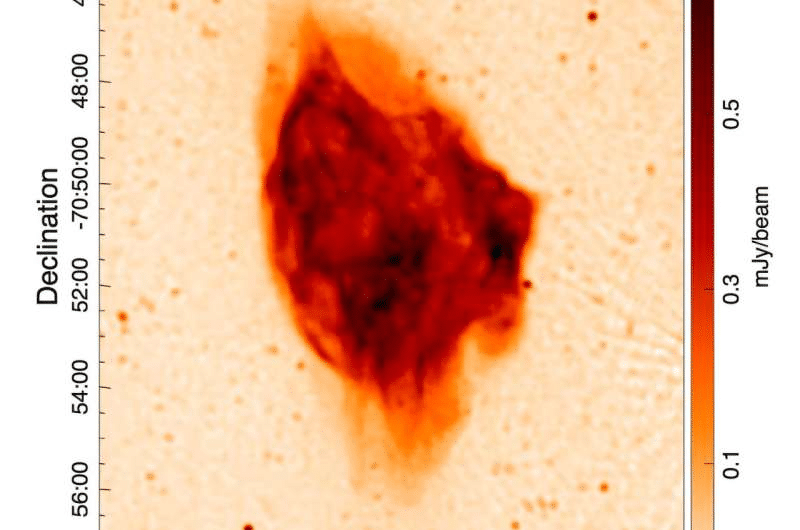
A global collaboration of astronomers has unveiled remarkable new details about the supernova remnant SNR J0450.4−7050 located in the Large Magellanic Cloud (LMC). Published on arXiv, the findings demonstrate that this remnant is substantially larger than past estimates, now measuring 489 by 264 light years compared to the earlier 332 by 244 light years. Employing data from an array of spaceborne and terrestrial telescopes, the investigation, spearheaded by Zachary J. Smeaton from Western Sydney University, has reshaped perceptions of this extraordinary astrophysical object, highlighting its distinctive composition and scale that differentiate it from other remnants both within and beyond our galaxy.
Revealing Veliki’s Expanded Reach
Previously examined supernova remnant SNR J0450.4−7050 has intrigued scientists for its immense size and intricate structure. Once thought to stretch 332 by 244 light years, new observations reveal added extensions to its northern and southern boundaries. This enhanced scale has inspired the team to nickname it “Veliki,” derived from the Serbian word for “large,” reflecting its grander extent. At 489 by 264 light years, Veliki stands among the most expansive supernova remnants documented outside our own Milky Way. This breakthrough offers valuable perspectives on the growth and transformation of supernova remnants over cosmic time, particularly in the unique environment of the LMC, where interstellar matter and shock dynamics differ markedly from those in our galaxy.
The identification of these previously hidden filamentary formations was made feasible by cutting-edge instruments such as the Australian Square Kilometer Array Pathfinder (ASKAP) and MeerKAT, renowned for their sensitivity to faint cosmic signals. Complementary observations from additional ground observatories and space missions further refined the picture, enabling an unprecedented analysis of Veliki’s physical attributes. This comprehensive study will likely provide a foundation for future research into supernova remnants across the cosmos.

Exploring Veliki’s Distinct Characteristics
Veliki’s significance extends beyond its size, as it also exhibits unusual physical traits. Observations show that it boasts a notably strong radio surface brightness alongside one of the lowest average radio spectral indices recorded for remnants of comparable dimensions. These surprising results challenge prevailing models of supernova remnant evolution, which do not typically anticipate such features in objects of this scale.
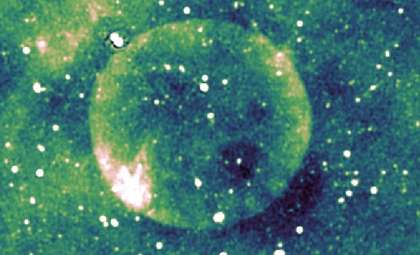
A key discovery is the presence of a prominent hydrogen-alpha shell wrapping Veliki, indicative of predominantly radiative shocks at work. This suggests that shockwaves generated by the original supernova event mainly interact with surrounding interstellar gas in ways that emit visible light. Radiative shocks are generally linked to older remnants or those in advanced evolutionary stages, where shock energy dissipates and results in increased visible emission rather than non-thermal radiation.
From their analysis, the researchers proposed that Veliki’s extraordinary features could stem from a heightened shock compression ratio. “This is most likely an older, predominantly radiative SNR with a higher shock compression ratio, which gives a flatter non-thermal spectrum, in combination with a thermal (bremsstrahlung) emission contribution,” the team stated. This framework implies that Veliki has evolved to a phase where the shockwaves have intensely compressed surrounding gas, producing its bright surface radio signature and atypical spectral profile. These advances deepen our comprehension of supernova remnant physics and their impact on galactic evolution.
- Categories:
- News








0 comments
Sign in to Comment