
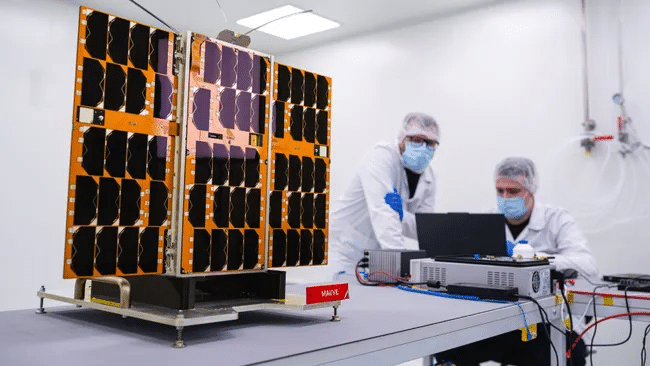
The upcoming launch of the Mauve space telescope marks a significant milestone in space exploration as the first privately owned deep space observatory. Developed by the London-based startup Blue Skies Space, Mauve aims to transform our knowledge of the cosmos, zeroing in on stars that may harbor planets capable of supporting life. Its specialized instruments will focus on ultraviolet emissions and stellar flares, offering astronomers important data to decode planetary habitability. With its scheduled deployment in 2025, this compact telescope is set to open new frontiers in cosmic research.
The Rise of Commercial Space Observatories
Space exploration has recently witnessed a shift with private enterprises entering a domain once dominated by government institutions such as NASA and ESA. Among these advancements, commercial space telescopes are gaining momentum, providing cost-effective and timely alternatives for space science. Blue Skies Space has pioneered this movement through Mauve, an innovative yet affordable telescope designed to deliver meaningful scientific insight efficiently.
The mission behind Mauve is straightforward: to develop a compact, budget-friendly observatory specializing in monitoring stellar flare activities—sudden, intense bursts of energy from stars. While this focus might seem specialized, it is essential for evaluating the potential habitability of exoplanets orbiting these stars. Unlike costly, large-scale projects like the Hubble Space Telescope, Mauve offers a more accessible platform enabling scientists to gather key data without facing lengthy delays or fierce competition for observation time.

Marcell Tessenyi, founder and CEO of Blue Skies Space, highlighted that Mauve will help determine which stars emit energy bursts harmful to surrounding planets’ environments.
“Mauve will allow us to understand the behavior of stars when they are emitting large amounts of energy,” Tessenyi told Space.com. “It will also help us understand what sort of impacts these stars might have on their neighboring planets. We will be able to understand which stars are likely to be damaging for a life environment and which would be benign.”
Shaping the Future of Exoplanet Discovery
At its core, Mauve tackles one of astronomy’s critical questions: identifying planets beyond Earth where life could potentially arise. To do this, understanding the nature of their host stars is essential. While our own Sun is relatively steady, many stars experience flare-ups—discharges of intense radiation capable of stripping away planetary atmospheres, decreasing their chance to support life.
The Mauve telescope is designed to observe ultraviolet light emissions and capture transient stellar flares, a niche that hasn’t been actively monitored in space since the International Ultraviolet Explorer mission ended in 1996. Tessenyi notes that Mauve offers a dedicated, reliable research platform that big telescopes like Hubble cannot provide due to limited availability.
“The space agencies do a fantastic job at delivering very high-quality space telescopes, but sometimes it can take a long time,” he said. “And when these satellites are operational, like the Hubble Space Telescope or James Webb, people have to apply and hope they get the observing time they need. But not all science requires a very large and complicated satellite.”
By continuously monitoring stellar flare activity, Mauve will help researchers prioritize exoplanet systems with greater chances to harbor life. The data gathered will also support future missions such as the Twinkle satellite, which will analyze exoplanet atmospheres. With Mauve’s insights, Twinkle can concentrate on the most promising candidates, improving the precision and scope of exoplanetary research.
Innovating Space Science Funding
Blue Skies Space is transforming space research financing by back-funding the Mauve project upfront, deploying it into orbit, and then offering its data through a subscription service. This pivot moves away from traditional lengthy grants and bureaucratic delays, making valuable scientific data more accessible to educational and research institutions around the globe.
This approach mirrors a larger industry trend. While governmental bodies maintain focus on major flagship missions, private companies are stepping in to provide quicker, more flexible solutions tailored to specific scientific objectives without the need for massive spending.
“We finance the satellites upfront, put them into space, and once the mission is operational, we make data available to users and over time we recover the cost of the construction and operations,” Tessenyi said. “If the satellite is a success and we make a surplus, we reinvest that into our subsequent satellites and we grow the company to deliver more satellites using this model.”
- Categories:
- News













0 comments
Sign in to Comment