
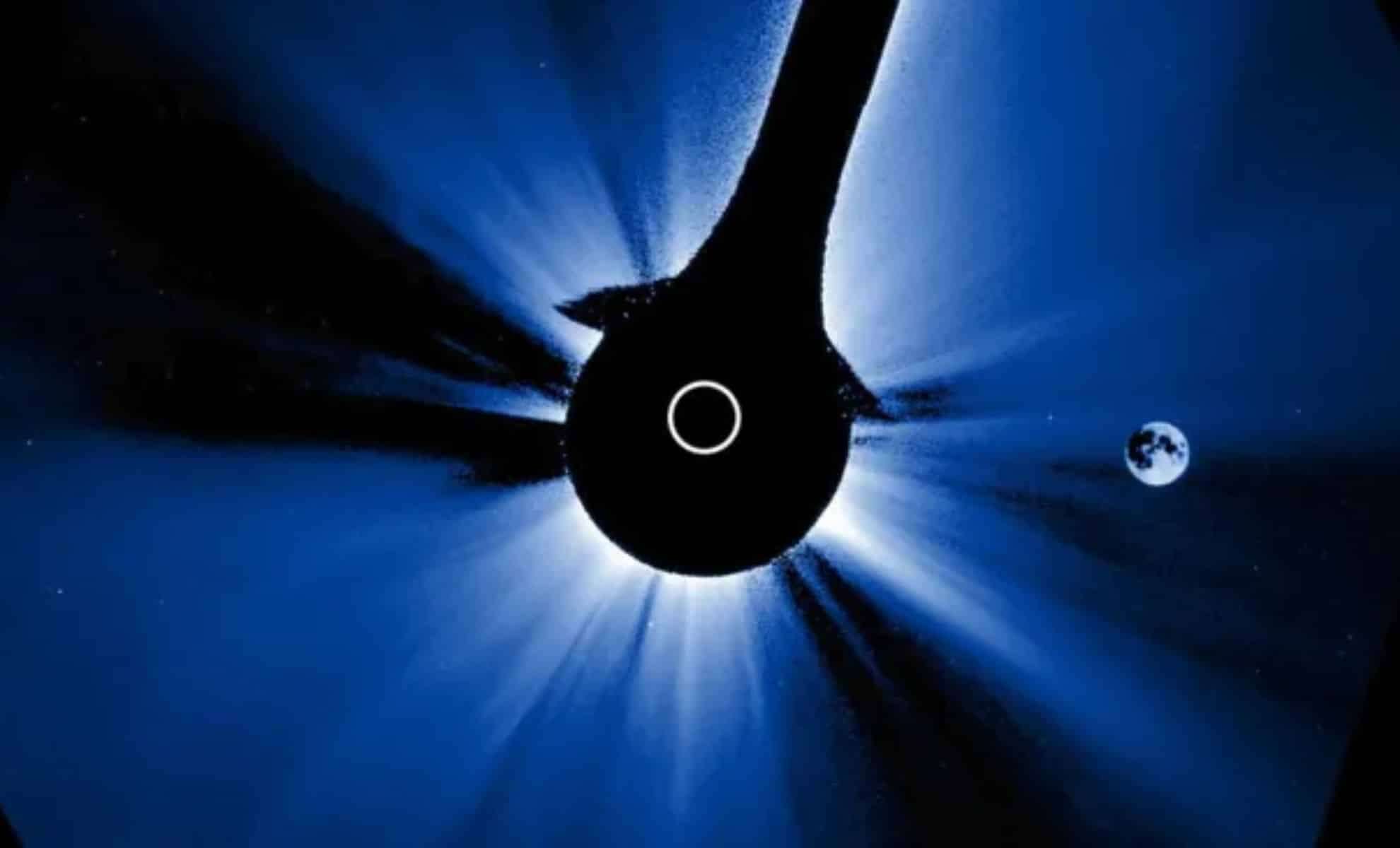
At an altitude of 22,236 miles above Earth, an extraordinary cosmic coincidence was captured by a satellite from the National Oceanic and Atmospheric Administration (NOAA). The image features the moon traversing in front of the sun—a surprising event that had not been anticipated or scheduled. Space.com reported that this striking photo was taken by the CCOR-1 coronagraph instrument aboard the GOES-19 satellite, which remains fixed over the equator in geostationary orbit.
A Solar Observatory With an Unexpected View
The Compact Coronagraph-1 (CCOR-1) is a newly deployed tool designed to monitor the solar corona, the sun’s outer atmospheric layer. It functions by masking the bright solar disk with a small occulting disk, effectively simulating a solar eclipse.
This technique enables scientists to observe subtle features of the corona, such as plasma formations and the onset of coronal mass ejections (CMEs). These insights are critical for forecasting space weather events that can interfere with satellites, GPS systems, and electrical grids on Earth.

What sets CCOR-1 apart is its position in geostationary orbit. Unlike previous coronagraphs, this vantage point allows it to consistently face the sun directly from above the equator. This proximity also makes it possible for the instrument to occasionally record images of Earth and the moon, as vividly demonstrated on August 27, 2025.
The Moon’s Glow Explained
In the captured image, the moon looks nearly fully illuminated, which might initially suggest that it was observed during a full lunar phase. However, NOAA scientists clarified that this bright look was caused by Earthshine—sunlight reflecting off Earth’s surface and illuminating the moon’s darkened side. Although the moon was not fully lit, CCOR-1’s sensitive instruments detected the reflected light, giving the impression of a luminous lunar disk.
This intriguing visual effect highlights the interplay of light between Earth, the moon, and the satellite, emphasizing the dynamic conditions in this unique observation point. As noted by Space.com, this occurrence was purely a consequence of the satellite’s orbit relative to Earth, making such overlaps between the moon and sun inevitable over time.
An Unplanned But Predictable Moment
Though this event was unforeseen, NOAA explains that Earth enters CCOR-1’s field of view twice daily due to strong sunlight reflecting off our planet's surface. Being closer to Earth than earlier coronagraphs, CCOR-1 occasionally experiences intrusions from Earth and the moon. While these are generally considered noise in the data, they sometimes create extraordinary images like this.
This highlights a growing pattern of satellites capturing unforeseen yet striking natural events. Earlier in 2025, NASA’s Landsat 8 documented Mount Vesuvius appearing through thick clouds, and the MODIS sensor on the Aqua satellite recorded the final fragmentation of the planet’s largest iceberg.
Enhancing Solar Monitoring and Space Weather Forecasts
Beyond providing captivating visuals, the CCOR-1 coronagraph plays a crucial role in continuous solar monitoring. By observing CMEs, solar wind, and corona fluctuations from geostationary orbit, the instrument significantly improves the ability to predict disruptions that might affect Earth’s communications, satellites, and power infrastructure.
The GOES-19 mission, launched in June 2024, replaced older coronagraphs nearing the end of their service. Future satellite deployments are planned to bolster space weather monitoring capabilities, ensuring timely alerts and enhanced scientific understanding.
- Categories:
- News










0 comments
Sign in to Comment