
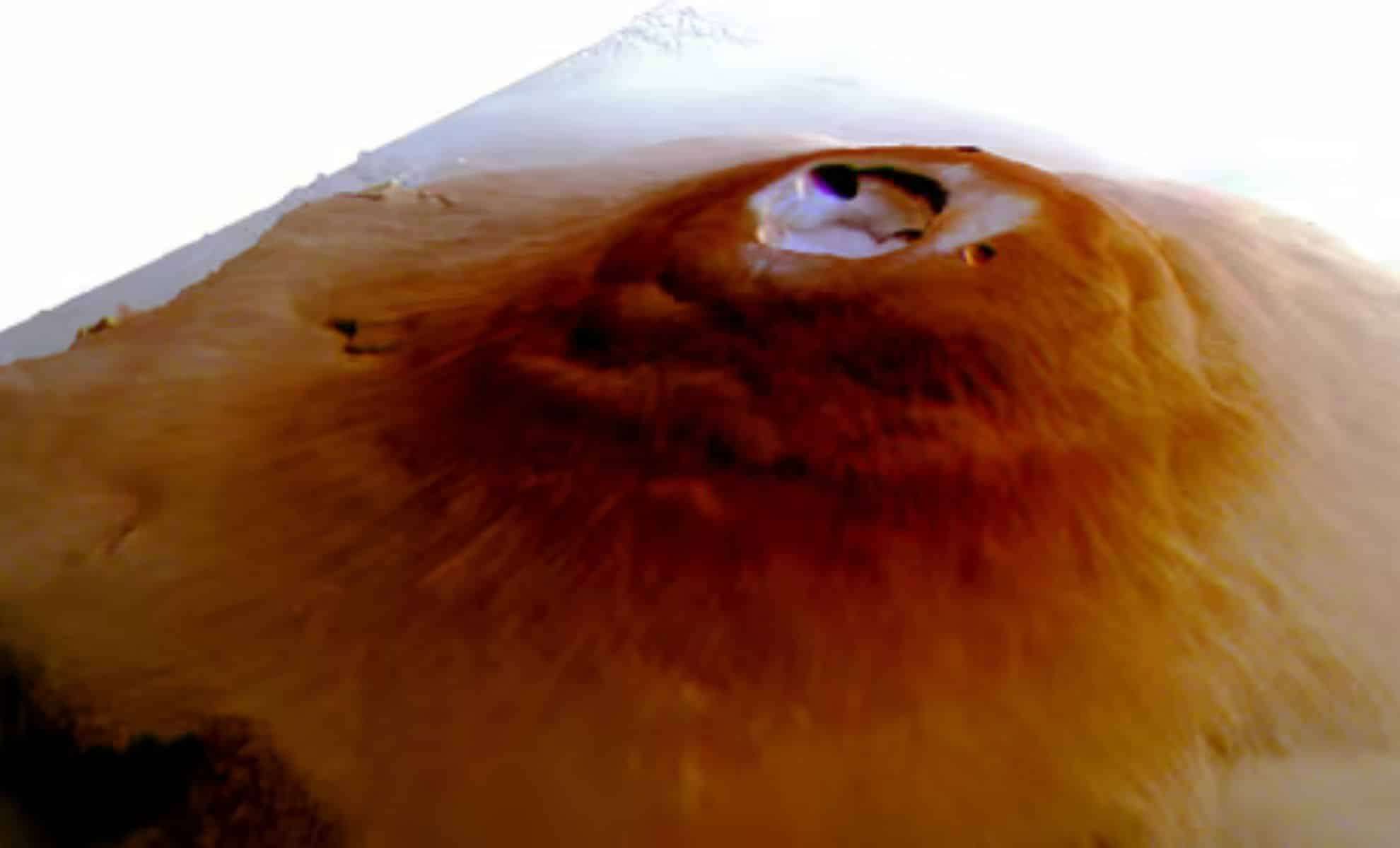
New research has detected delicate frost formation on the towering Martian volcanoes situated close to the planet’s equator, featuring peaks that soar well above three times the height of Mount Everest.
This important finding, reported in a recent Nature Geoscience publication, represents the initial observation of water frost at Mars’ equatorial latitudes. The frost manifests as a barely perceptible ice coating, thinner than a human hair, appearing overnight within the summit craters (calderas) before dissipating shortly after dawn.
How Frost Develops and Was Identified
Scientists from Brown University and the University of Berne have estimated that during cooler periods, approximately 150,000 tons of water vapor—comparable to 60 Olympic-sized swimming pools—condense daily atop these giant volcanoes.

Detection of the frost was achieved through high-resolution color images captured by the European Space Agency’s Trace Gas Orbiter (TGO), with further confirmation via spectrometer data and visuals from Mars Express. In these images, areas covered with frost present a bluish tint, primarily within the caldera floors and certain rim areas, whereas sunlit slopes remain free of frost.
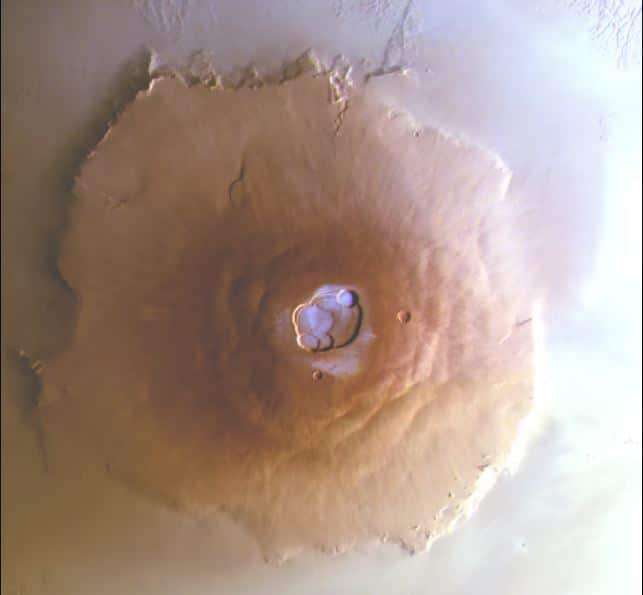
The Tharsis volcanic plateau, located near Mars’ equator, contains several massive volcanoes including Pavonis Mons and Olympus Mons, with heights reaching nearly nine and sixteen miles, respectively. These findings confirm that despite Mars’ thin atmosphere and warm daytime temperatures, frost can form on those high peaks.
Adomas Valantinas, a planetary scientist at Brown University and the study’s lead author, commented, “This is the first confirmation of water frost not only on volcano summits but also in Mars’ equatorial zone.”
Revealing Clues About Martian Climate
This finding sheds light on the atmospheric behavior and potential climatic shifts on Mars. Researchers theorize that frost formation on these volcanoes may link to atmospheric dynamics active in Mars’ past, perhaps millions of years ago.
Valantinas explained that this frost could be a relic from earlier Martian climate cycles, suggesting that precipitation or even snowfall once occurred on these massive volcanoes. “The frost may be a subtle hint of Mars’ previous climate conditions,” he said, adding, “It may connect to atmospheric climate activity from millions of years ago.”
The Influence of Mars’ Winds
Valantinas proposes that Martian winds transport moist air up the volcano slopes, depositing water vapor into the calderas where it freezes into frost seasonally. Models indicate the frost is composed of water ice rather than carbon dioxide, because the summit temperatures are too warm for carbon dioxide frost to develop. “We had considered frost formation near Mars’ equator unlikely, given the combination of sunlight and thin atmosphere that keeps peak temperatures relatively high—unlike Earth’s frosty mountaintops,” Valantinas explained.
Relevance for Future Mars Missions
Identifying water frost atop Martian volcanoes is valuable for upcoming exploration efforts, especially those targeting human missions. A clear understanding of Mars’ current water cycle, both in the atmosphere and near the surface, is essential for mission planning, as water will be a crucial resource. John Bridges, planetary sciences professor at the University of Leicester, emphasized, “Grasping Mars’ contemporary water cycle around its atmosphere and surface will be key for future missions, including crewed ones, where locally sourced water is vital.”
- Categories:
- Astronomy ,
- News ,
- Space










0 comments
Sign in to Comment