
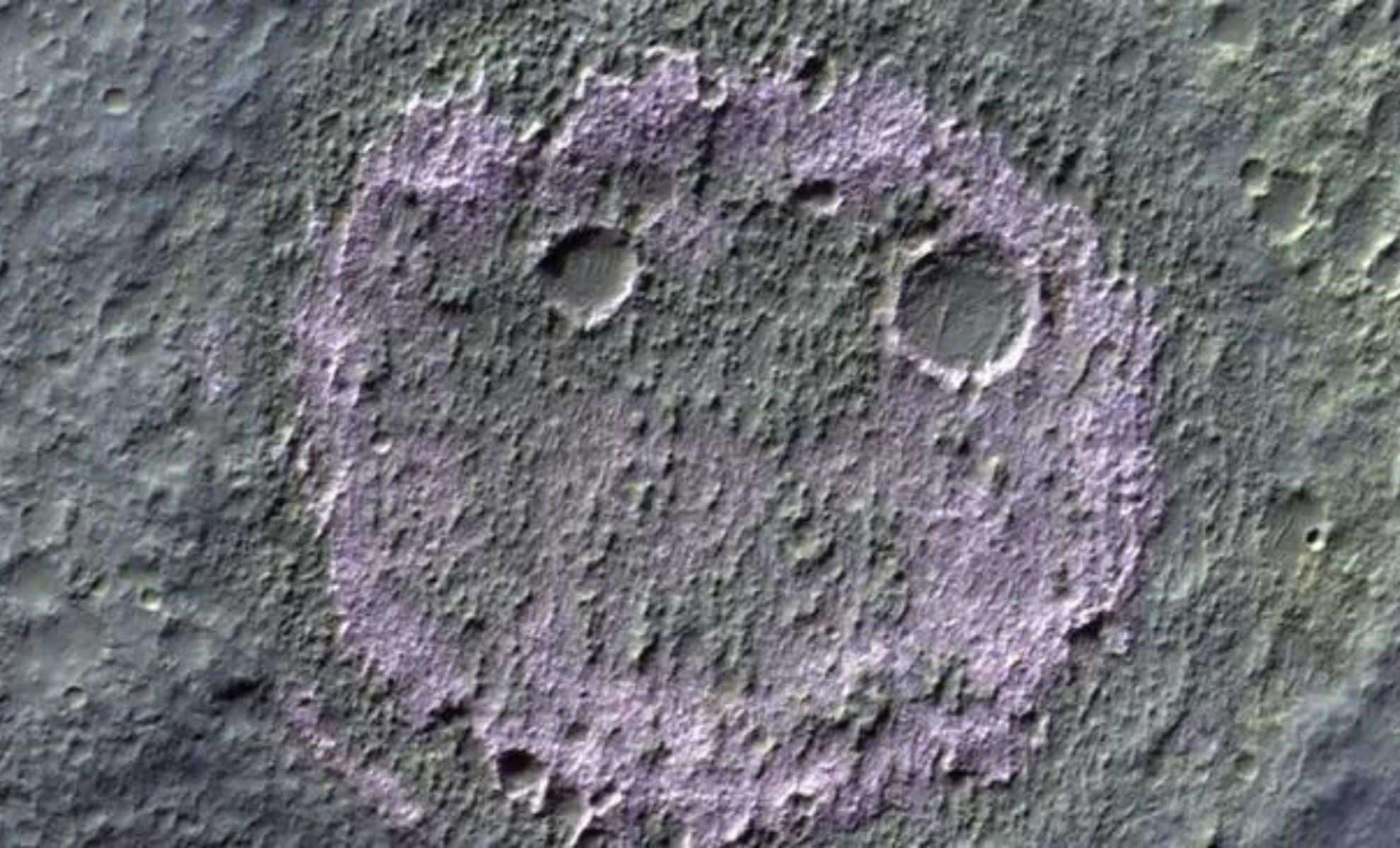
The European Space Agency’s ExoMars Trace Gas Orbiter has captured a fascinating Martian surface feature resembling a smiley face, created by ancient salt deposits.
While whimsical in appearance, this formation carries deep scientific importance. These salts are leftovers from a period when liquid water flowed on Mars, offering critical insights into the planet’s former environments and its capacity to have supported life.
Examining the ‘Smiley Face’ Formation in Detail
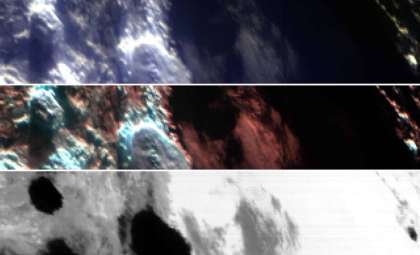
The so-called smiley face consists of two meteor impact craters that look like eyes, accompanied by a crescent-shaped ring of chloride salts acting as a curved mouth. These salts are the remains of dried Martian lakes that existed billions of years ago. Infrared imaging from the orbiter highlights these deposits in vivid pink and violet shades, which would otherwise blend into the Martian landscape under normal light.

Since arriving in 2016, the ExoMars Trace Gas Orbiter has focused on detecting trace gases such as methane, but its imaging instruments have also mapped surface details. This image is part of a research article in Scientific Data documenting 965 chloride salt locations scattered across Mars. Though the exact dimensions of the smiley feature remain uncertain, these deposits range between 300 and 3,000 meters wide, providing a lens into Mars’ ancient climate.

Insights into Mars’ Aquatic History and Climate Evolution
This smiley face and other salt deposits offer valuable evidence of Mars as a once water-rich planet. Billions of years ago, the Red Planet featured extensive lakes, rivers, and possibly shallow seas. However, a major climate transition caused most of the water to evaporate or freeze, leaving behind barren terrain and chloride salt formations.
Researchers attribute this shift to Mars losing its protective magnetic field, enabling the solar wind to gradually strip away the atmosphere. The resulting thin atmosphere could no longer maintain liquid water on the surface, causing the disappearance of Mars’ lakes and rivers. These salty remnants serve as geographic markers for those vanished water bodies and hint at locations where life might have existed.
Could Salt Deposits Hold Traces of Ancient Martian Life?
One of the most compelling possibilities is that these chloride salts may preserve biological evidence. The ESA highlights these salt formations as prime sites for astrobiological research. As the Mars lakes evaporated, briny conditions would prevail, resembling extreme habitats on Earth that support resilient microbial communities known as extremophiles. Such organisms could have endured in Mars’ hypersaline pockets long after surface water vanished.
Moreover, the salts might have acted as natural preservatives, locking away microbial remains for billions of years. Scientists view these environments as offering “optimal conditions for biological activity and preservation,” making them high-priority targets for forthcoming missions. Given erosion has worn away many other ancient markers, salt deposits might harbor the clearest signs of past life.
Salt Deposits: Targets for Upcoming Mars Missions
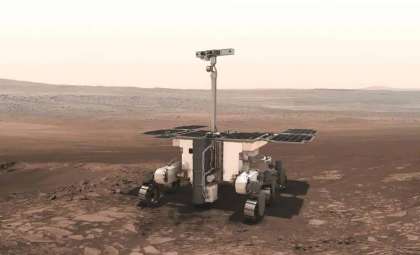
This discovery shapes future exploration strategies on Mars. Features like the smiley face have become focal points for missions such as ESA’s ExoMars rover and NASA’s Perseverance rover, designed to identify traces of ancient life. Focusing on these salt-rich sites could enhance the likelihood of finding biosignatures.
Besides hunting for life, these missions aim to reconstruct Mars’ transformation from a warmer, wetter world to its current frigid state. Investigating chloride deposits will help chart the timeline and processes behind the planet’s water loss and atmospheric decline.
New research also suggests Mars may retain more water than once believed. Discoveries of water frost at the summits of towering volcanoes and hints of a concealed underground ocean renew optimism about the Red Planet’s habitability both past and present.
Future Directions in the Martian Life Quest
The smiley face image from the ExoMars Trace Gas Orbiter represents more than a curious shape — it serves as an important clue in the endeavor to determine if life ever existed on Mars. Continued study of these ancient salt formations will be crucial in unraveling the planet’s biological history.
The orbiter will remain instrumental by surveying atmospheric gases and mapping surface traits indicative of life. Upcoming missions are expected to drill into these salt deposits, seeking preserved microbes that might provide the first definitive proof of extraterrestrial life. What appears as a jovial face might ultimately unlock profound answers about Mars’ secrets.
- Categories:
- Astronomy ,
- News ,
- Science









0 comments
Sign in to Comment