

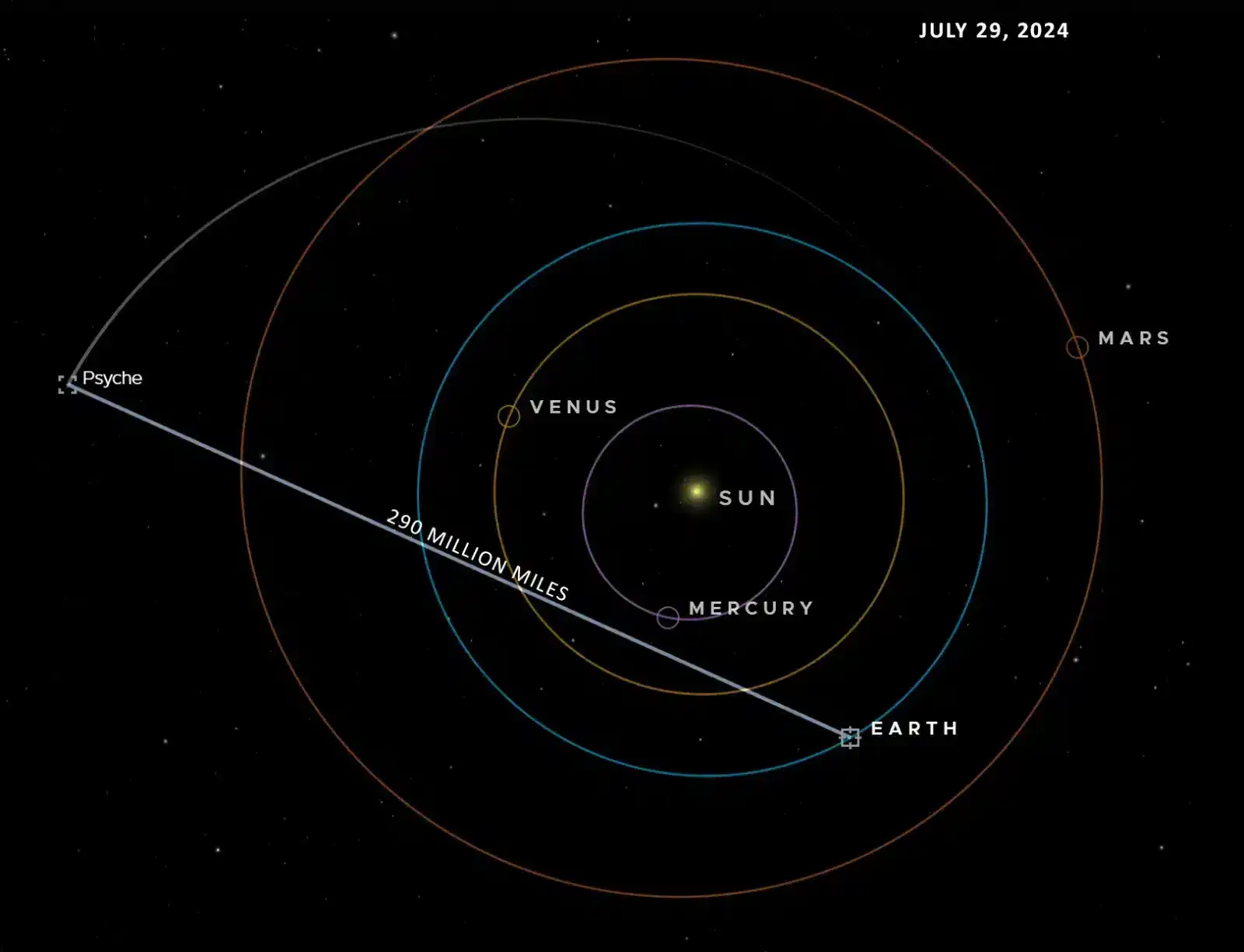
In a remarkable advancement for space communication, NASA has transmitted a laser signal from the Psyche spacecraft to Earth, covering an astounding distance of 16 million kilometers. This pioneering experiment, conducted under the Deep Space Optical Communications Experiment (DSOC), signifies a major step forward in transmitting data over interplanetary distances, heralding a new era for space exploration technologies.
Mission Overview and Cutting-Edge Technology
Launched in October 2023 on a SpaceX Falcon Heavy rocket, the Psyche spacecraft is equipped with advanced instruments, including the high-speed laser communication system DSOC. This system aims to demonstrate optical communication capability that vastly outperforms conventional radio-frequency transmissions. Utilizing near-infrared laser beams, DSOC can deliver data at speeds 10 to 100 times faster than current communication methods.
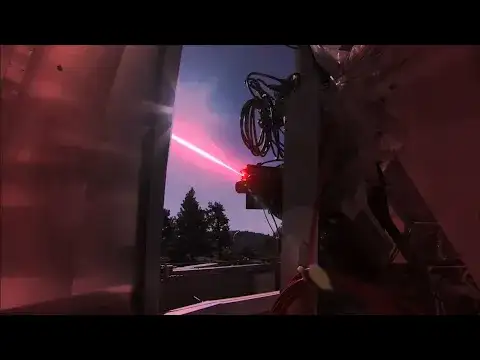
On November 14, 2023, NASA successfully sent a coded laser message from Psyche to the Hale Telescope positioned at the Palomar Observatory in California. This milestone marks the first time that optical communication technology has been proven effective over such an immense distance, far beyond previous demonstrations that were limited to lunar orbit ranges.

The DSOC experiment is part of the broader Psyche mission, which seeks to investigate the metallic asteroid Psyche, believed to be the exposed core of an early planet. Although the spacecraft won’t begin its primary scientific objectives until it arrives at the asteroid in 2028, this test confirms the feasibility of advanced communication methods critical for future space exploration.
Fine-Tuned Precision Amid Complex Challenges
Sending and receiving a laser signal across millions of kilometers presented formidable challenges in targeting and alignment. NASA compares the precision needed to aiming a laser pointer at a coin from a kilometer away while both the target and laser are in motion. The 50-second light travel time between Psyche and Earth further complicated this task.
To overcome these hurdles, NASA implemented sophisticated automation to keep the laser beam precisely directed and synchronized throughout the transmission. Both the spacecraft’s laser transmitter and ground-based receivers were engineered to maintain stable and accurate communication despite the spacecraft’s relative motion to Earth.
The use of near-infrared lasers also increases data capacity by compressing information into shorter wavelengths, allowing for quicker and more efficient transmission compared to traditional radio waves. This advancement could revolutionize how data is sent from deep-space missions, enabling near-real-time delivery of high-quality images, videos, and large scientific datasets.
Impact on Upcoming Space Ventures
This successful demonstration carries significant consequences for future spacecraft communications. As exploration goals grow increasingly ambitious, including crewed missions to Mars, rapid and large-volume data transfer is essential. Current radio-frequency systems face limitations that laser communication is poised to overcome.
Optical communication can also improve the quality and timeliness of information received from robotic spacecraft, which is vital for autonomous operations and decision-making far from Earth.
Scientific Exploration of the Psyche Asteroid
Besides showcasing new communication technology, the Psyche mission aims to study its central target—a unique metallic asteroid in the belt between Mars and Jupiter. Composed mainly of iron and nickel, Psyche may represent the leftover core of a protoplanet, offering scientists a rare glimpse into the early processes of planetary assembly.
Expected to begin orbiting Psyche in 2029, the spacecraft will conduct detailed analyses of the asteroid’s composition, surface features, and magnetic properties over a 26-month period, shedding light on planetary core formation and evolution.
Advancing Space Communication Frontiers
NASA’s achievement with the DSOC laser experiment exemplifies a bold commitment to surpassing traditional communication limits, enabling seamless connectivity across vast space distances. This progress lays the foundation for next-generation missions where rapid, reliable data exchange is indispensable.
The innovations spearheaded by the Psyche project highlight how cutting-edge technology investments will continue to push the boundaries of space science, bringing humanity closer to exploring and understanding the farthest reaches of our solar system and beyond.
Key Takeaways
- NASA’s Psyche spacecraft successfully tested the Deep Space Optical Communications Experiment (DSOC), transmitting a laser signal from over 16 million kilometers away.
- The test exhibited data speeds 10 to 100 times faster than those achievable with traditional radio communications.
- Precision targeting enabled the laser to be detected by the Hale Telescope in California, overcoming challenges posed by the vast distance and relative motion.
- This marks the first optical communication success beyond the lunar orbit, a crucial step towards missions to Mars and further into deep space.
- The Psyche mission’s core objective is to explore a metallic asteroid on a trajectory to deliver insights into planetary formation processes.
- Categories:
- Nasa








0 comments
Sign in to Comment