
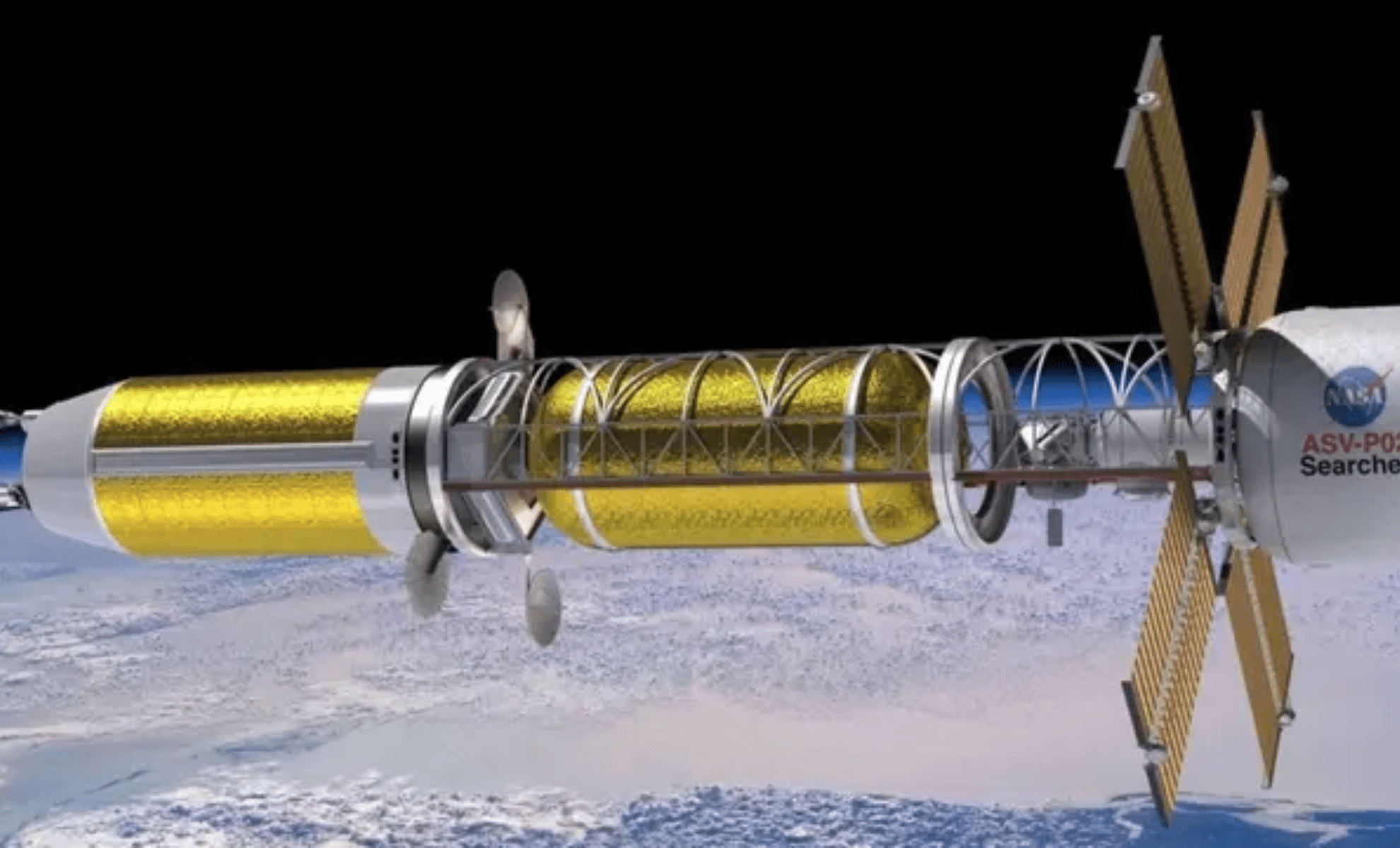
Researchers at Ohio State University have introduced a novel approach to nuclear thermal propulsion that might drastically reduce travel duration to Mars. Taking cues from earlier nuclear propulsion studies detailed on ScienceDirect, their Centrifugal Nuclear Thermal Rocket (CNTR) concept has the potential to transform space exploration. Supported by NASA, this innovative technology promises to boost efficiency and safety, enabling much quicker interplanetary trips and unlocking the door to more ambitious space missions.
Advancing Mars Missions with Efficient Nuclear Propulsion
For many years, cutting down the perilous journey to Mars has been a top priority for space agencies worldwide. The CNTR, engineered by Ohio State University’s team, might offer the breakthrough that turns upcoming Mars expeditions into reality within a decade. Unlike traditional nuclear engines, it uses liquid uranium to directly heat propellant, nearly doubling propulsion efficiency. This improvement could reduce a round-trip Mars mission to less than 420 days, enhancing crew safety and mission feasibility.
Nuclear thermal engines have attracted interest for their superior specific impulse compared to chemical rockets, but the CNTR pushes boundaries further with a design that emphasizes both power and dependability. Spencer Christian, a PhD candidate overseeing prototype development, notes, “If successful, the CNTR engine prototype is steering us toward the next frontier.” This powerful propulsion might not only enable Mars travel but also open avenues for deep solar system exploration.

Addressing the Imperative for Faster Space Travel
Current missions are hampered by long durations that pose serious health and operational challenges. Extended time in space increases radiation exposure, muscle loss, and mental health risks for astronauts. As objectives expand to more distant destinations like Mars, the development of accelerated propulsion becomes vital.
Although chemical rockets excel in launching payloads and short flights, they fall short for extensive deep-space travel due to limited thrust and efficiency. “Maintaining focus on nuclear space propulsion is essential for technological maturation,” emphasizes Ohio State’s Dean Wang. The CNTR system tackles these issues by slashing trip lengths, lowering astronaut risk, and allowing for heftier cargo loads.
The CNTR’s innovations coincide with growing global enthusiasm for nuclear thermal propulsion as a means to access farther solar system regions. Capable of delivering about 1800 seconds of specific impulse—compared to roughly 450 seconds in chemical propulsion—the system promises swifter and more productive voyages not only to Mars but to outer planets like Uranus, Neptune, and Saturn.
Fuel Versatility and In-Space Refueling Potential
The CNTR stands out for its adaptability. Unlike conventional nuclear thermal rockets relying on a fixed fuel type, this design accommodates multiple propellants such as ammonia, methane, propane, and hydrazine. This flexibility could revolutionize mission strategies by supporting spacecraft refueling in orbit, potentially mining fuel from asteroids or objects in the Kuiper Belt.
Using resources found beyond Earth offers a futuristic avenue for sustainable space exploration. The CNTR could empower future spacecraft to replenish fuel supplies mined from extraterrestrial bodies, diminishing dependence on Earth launches. This capability may advance the creation of self-sufficient space colonies and research hubs, lessening logistical constraints.
Moreover, the CNTR’s robust propulsion could facilitate robotic expeditions deeper into the solar system. Missions targeting Neptune and far-flung Kuiper Belt targets would greatly benefit from sustained high thrust, making challenging destinations more accessible.
Technical Obstacles and Future Development
Despite its promise, the CNTR propulsion technology still faces critical engineering challenges before becoming flight-ready. Developers must solve issues related to reliable engine startup, stable operation, efficient shutdown, and controlling uranium fuel loss during missions.
Safeguarding against engine malfunctions is also a top priority. Nuclear propulsion demands exacting precision and durability, benchmarks the technology has yet to fully meet. Researchers are actively addressing these hurdles, aiming to finalize an operational design within the next five years. NASA’s backing will be crucial in supporting research and development to ensure the CNTR meets stringent requirements for human deep-space travel.
Although widespread deployment remains in the future, the progress of the CNTR propulsion system marks a major stride toward making extended space missions more practical. Ultimately, this technology could form the foundation for humanity's journeys to Mars and further reaches of our solar system.
- Categories:
- News











0 comments
Sign in to Comment