
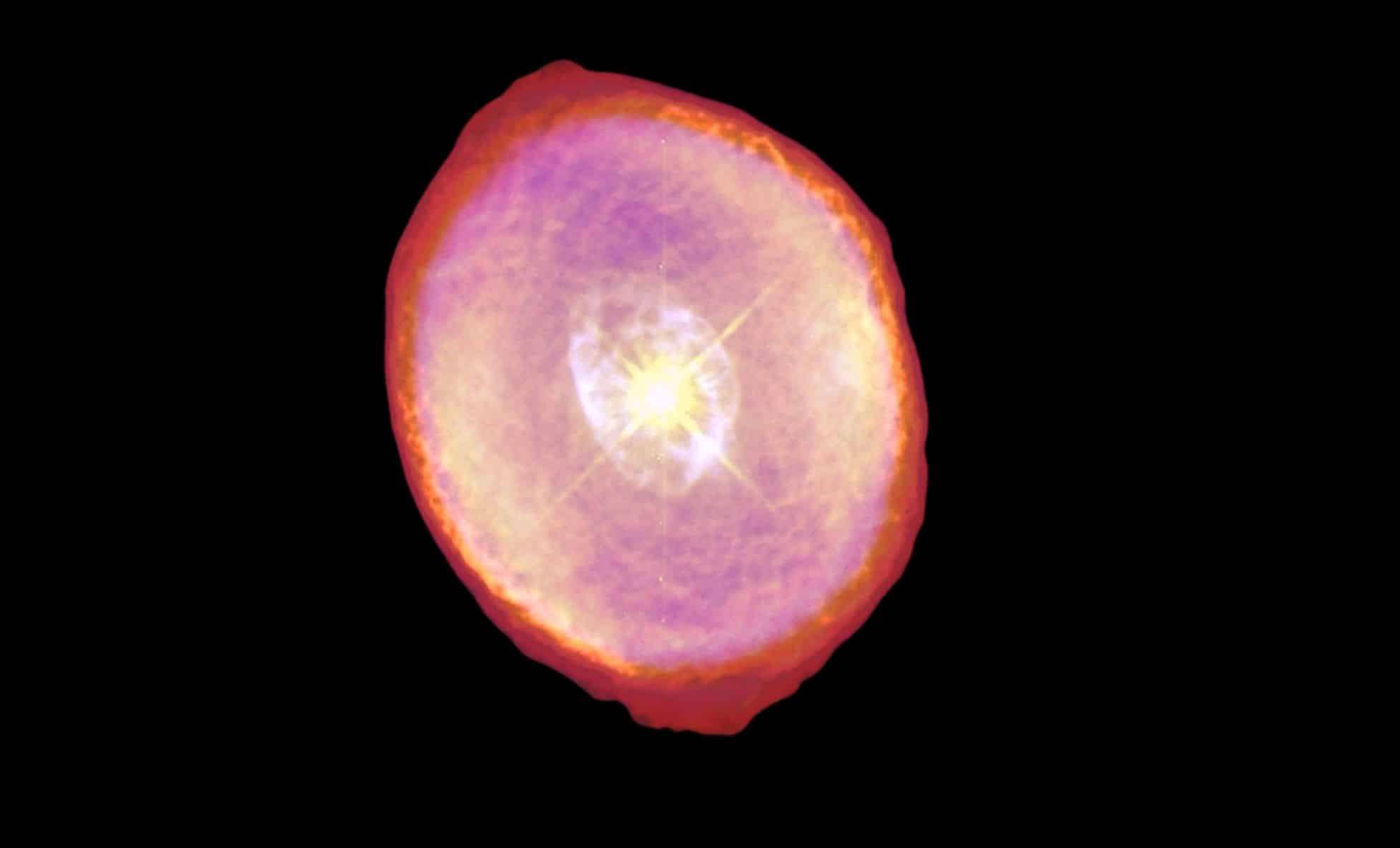
Scientists have captured the gradual yet profound changes of a dying star over 130 years, showcasing one of the most detailed long-term stellar observations ever conducted. Published in The Astrophysical Journal in August 2025, the research focuses on the planetary nebula IC 418, commonly referred to as the spirograph nebula. The team witnessed the star’s surface temperature soaring by nearly 3,000 °C, posing significant questions about conventional models of how stars conclude their lifecycles.
An Extraordinary Century-long Observation of Stellar Evolution
This investigation offers a unique real-time glimpse into the concluding stage of a low- to intermediate-mass star’s life. Located about 2,000 light-years from Earth in the constellation Lepus, IC 418 was first captured in imagery back in 1893. Over the years, its perfectly symmetrical glowing gas envelope and luminous central star have attracted extensive scientific interest.
Using a combination of archival photographic plates alongside recent spectral and light-intensity data, astronomers reconstructed the star’s temperature history. The results are groundbreaking: over this extended period, the star's surface temperature has climbed by approximately 3,000 °C, which far outpaces the heating rates expected from typical solar-like stars nearing the end of their lives.

Further examination revealed that while the temperature increase started off slowly, there has been a sharp acceleration in recent decades. Observations from high-powered instruments such as the Hubble Space Telescope and leading ground observatories confirm this steady and observable evolution, shedding new light on the final stages of stellar death.
Is the Star's Rapid Heating an Anomaly?
Theoretical models of stellar progression suggest stars akin to the Sun expand into red giants, lose their outer layers, and expose their hot cores which then become white dwarfs. This transformation usually spans thousands to millions of years. What sets IC 418 apart is its pace, with the core temperature climbing approximately 1,000 °C every 40 years, the swiftest such case documented among planetary nebulae.
For context, our Sun requires roughly 10 million years to heat to similar core temperatures during its evolutionary path. Though rapid, IC 418’s behavior aligns with the expected lifecycle closing of stars, but at a much accelerated and intensified pace compared to prevailing predictions.
New Insights Into Galactic Chemistry From a Dying Star
Studying the end stages of stars is crucial for understanding how galaxies evolve chemically. The planetary nebula phase contributes heavily to the enrichment of the interstellar medium with vital elements like carbon, nitrogen, and other components essential for life.
The accelerated evolutionary pace of IC 418 challenges current assumptions about when and how efficiently these elements are released into space. If such stars evolve faster than predicted, the period in which they supply these heavy elements might be shorter, impacting models of galactic chemical enrichment over billions of years.
Additionally, these findings hint that stars with lower masses than previously thought might play a larger role in carbon production, adding complexity to existing theories about the origin and distribution of elements in the cosmos.
Preserving a Century of Stellar History
This research underscores the importance of preserving and analyzing historical astronomical archives. By digitizing photographs dating back over a century and integrating them with current spectroscopic data, scientists traced the dynamic death of a star in detail spanning more than a lifetime.
Such temporal coverage is rare in astronomy, where most phenomena evolve over thousands or even millions of years. The progression of IC 418’s central star from faint to significantly hotter and brighter amounts to a landmark in observational astrophysics, providing a rare window into one of the universe’s fundamental processes.
The star is expected to continue increasing its temperature until it peaks near 120,000 °C, before gradually cooling and fading away into a white dwarf, the dense core left behind after nuclear fusion ceases. IC 418 could thus offer a prototype for examining the closing chapters of stellar life cycles.
- Categories:
- News












0 comments
Sign in to Comment