
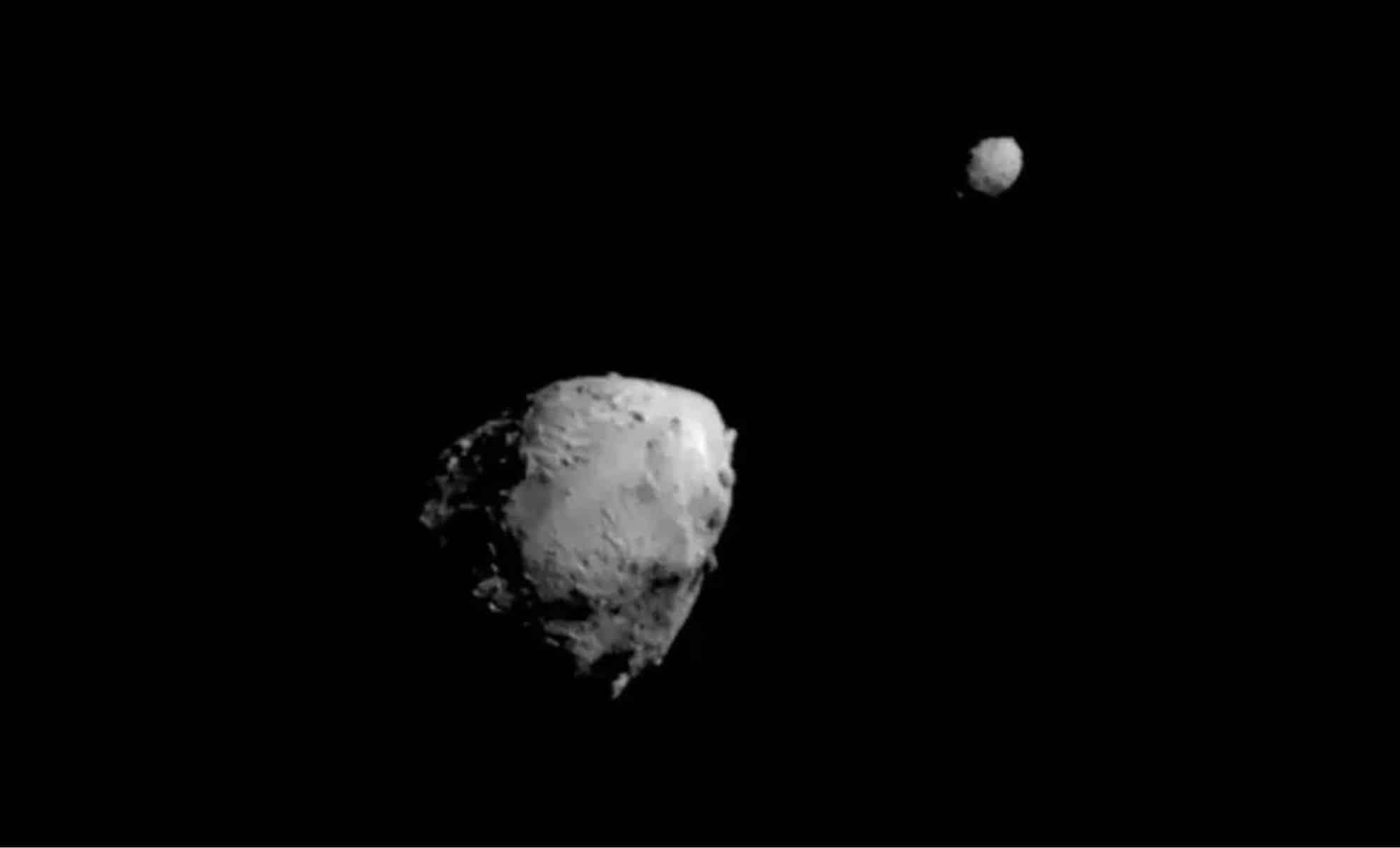
NASA’s pioneering Double Asteroid Redirection Test (DART) successfully demonstrated the ability to modify the orbit of the asteroid moon Dimorphos in 2022, marking a milestone in planetary defense.
This groundbreaking mission might have also set the stage for an extraordinary cosmic event: the emergence of the first meteor shower created by human activity. Researchers now suggest that fragments propelled by the DART collision may one day intersect Earth’s and Mars’s orbits, potentially producing visible meteor displays.
DART: A Trailblazer in Protecting Earth from Space Threats
Implemented by NASA in partnership with the Johns Hopkins Applied Physics Laboratory (APL), the DART mission aimed to prove that an impactor spacecraft could alter an asteroid's trajectory to shield Earth from asteroid hazards. The target was Dimorphos, a small satellite orbiting the asteroid Didymos located about 7 million miles away. By impacting Dimorphos at a staggering speed of 15,000 miles per hour, DART shortened its orbital period by 33 minutes, showcasing a viable method for asteroid deflection.

Beyond changing the orbit, the collision expelled a substantial quantity of ejecta—rocks and dust—that scientists have named “Dimorphids.” Traveling at velocities close to 500 meters per second, these particles have been sent on paths that could eventually bring them into Earth's and Mars’s vicinity.
Dr. Eloy Peña-Asensio from Politecnico di Milano commented on these unexpected results: “Our models revealed that some particles launched by the DART impact are on trajectories intersecting Mars. Interestingly, some fragments might even travel toward Earth.” This raises the exciting prospect that Earth may witness a meteor shower originating from human space endeavors, a first in space exploration history.
The Birth of a Meteor Shower Caused by Humans
A meteor shower generated by human intervention is a novel phenomenon. Although the ejecta from Dimorphos are minute, over an extended period, some could drift into Earth's orbital path and vaporize upon atmospheric entry, producing a meteor shower. While this process may span years or even decades, experts are actively tracking the particles’ courses. As Peña-Asensio observed, “If it occurs, it would mark the debut of a human-induced meteor shower.” Such an event would represent a remarkable intersection of human space activities and natural celestial phenomena.
Predictions indicate that this meteor shower might be observable predominantly in the Southern Hemisphere, potentially around May 2055. The incoming particles are expected to be small and slow-moving, likely generating faint meteors rather than spectacular fireballs. However, pinpointing the exact timing and visibility requires ongoing observation and refined modeling.
Alterations to Dimorphos’ Orbit and Physical Structure
In addition to ejecting debris, the DART collision is believed to have caused notable structural changes to Dimorphos. Recent analyses suggest the impact not only adjusted its orbital period but may have reshaped the asteroid and influenced its trajectory. Researchers continue to study how these modifications might affect the dynamic relationship between Dimorphos and Didymos.
The European Space Agency (ESA) is set to deepen this investigation with the Hera mission, scheduled for 2026. Hera will provide detailed observations of both Didymos and Dimorphos, revealing the long-term impacts of the DART collision and enhancing the accuracy of kinetic impact strategy assessments.
Broader Significance for Space Science and Defense
The likely emergence of a meteor shower derived from the DART mission underscores the profound consequences of human involvement in space. While the mission's primary goal was to shield Earth from future asteroid threats, it may also create a new, visible phenomenon in our sky, highlighting the intricate connection between human actions and cosmic events.
Moreover, DART has proven the effectiveness of kinetic impactors as planetary defense tools, demonstrating how spacecraft collisions can strategically alter asteroid orbits. Yet, the mission also reveals complexities, including unforeseen long-lasting effects on asteroid bodies and their environment.
As humanity ventures further into space, missions like DART emphasize the importance of anticipating indirect outcomes. From changing asteroid paths to potentially sparking meteor showers, DART exemplifies the profound ways human exploration is influencing the universe.
- Categories:
- Astronomy ,
- News ,
- Space ,
- Nasa











0 comments
Sign in to Comment