

Europa, a fascinating moon orbiting Jupiter, has captivated researchers due to its potential to sustain life. Although it is somewhat smaller than Earth’s Moon, Europa is unique within our solar system for compelling signs that it holds a vast, salty ocean beneath its frozen exterior. This makes it a prime focus for studies on planetary habitability.
Recent discoveries from NASA’s Juno spacecraft have sharpened our understanding of Europa’s icy shell and the mysteries hidden beneath it. By assessing the ice thickness and examining its surface makeup, scientists are gaining valuable insights into how materials might transit between the surface and the subsurface ocean, an essential factor in evaluating the moon’s potential to support life.
Radiometric Observations Confirm Thick Ice Crust
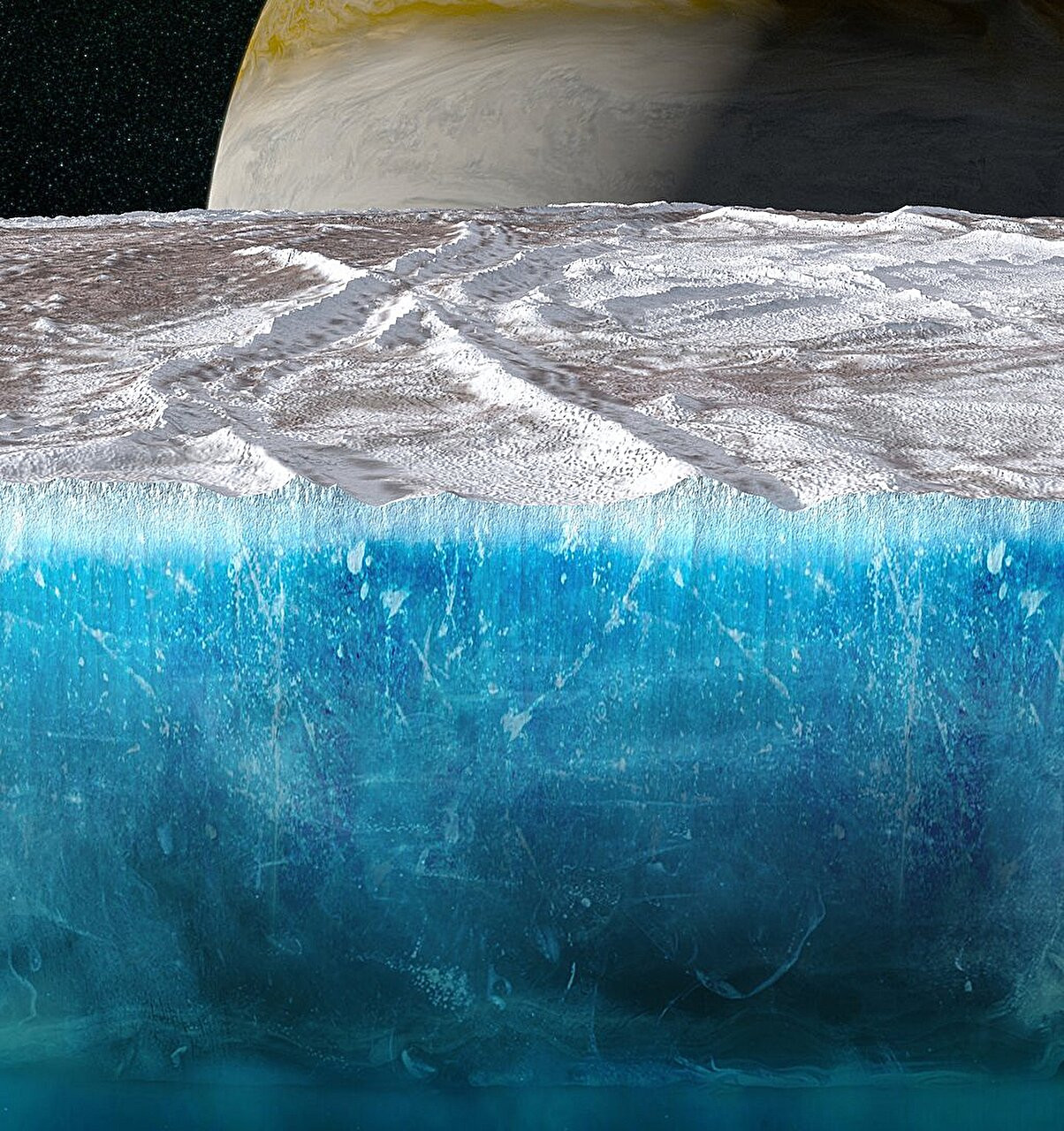
During its close approach on September 29, 2022, Juno navigated to within 220 miles (360 kilometers) of Europa’s surface, utilizing its Microwave Radiometer (MWR) to probe through the ice layers. According to NASA, temperature variations detected at different depths over roughly half of Europa’s surface allowed scientists to estimate the ice shell thickness at about 18 miles (29 kilometers) in the region examined.

Published in Nature Astronomy, this research offers the first concrete measurement resolving prior debates that proposed ice thickness could be as thin as less than 0.5 miles. Juno project scientist Steve Levin highlighted:
“If an inner, slightly warmer convective layer also exists, which is possible, the total ice shell thickness would be even greater. If the ice shell contains a modest amount of dissolved salt, as suggested by some models, then our estimate of the shell thickness would be reduced by about 3 miles.”
Subsurface Ice Shows Scattered Features
Beyond thickness measurements, data from the MWR detected the presence of microwave-reflecting scatterers embedded within Europa’s ice. These are likely small fractures, cavities, or pores only a few inches wide but extending down several hundred feet, indicating that the ice shell is not completely solid but contains porous and cracked zones.
Scott Bolton, Juno’s principal investigator at the Southwest Research Institute, explained that these imperfections are vital for understanding how elements like oxygen or surface-derived nutrients might penetrate downward. Nonetheless, these features are relatively tiny and shallow, suggesting that they do not form major conduits transporting substances from the surface to the ocean beneath.

Future Missions Benefit from New Findings
This enhanced knowledge has crucial implications for upcoming efforts to study Europa directly. NASA has confirmed that the Europa Clipper mission and the European Space Agency’s JUICE probe are destined to arrive in the Jovian system by 2030 and 2031, respectively. Juno’s new data aids in fine-tuning scientific priorities by providing a more detailed understanding of the ice shell’s character.
Determining the exact thickness and features of Europa’s ice is pivotal for selecting suitable landing sites and designing instruments capable of investigating beneath the surface. As Levin remarked, the presence of salt content within the ice might decrease the estimated thickness by nearly 3 miles, illustrating the need for ongoing observations from orbit and on the surface.
NASA’s ongoing Juno mission is scheduled for its 81st close pass of Jupiter on February 25, 2026, continuing to deliver critical insights about Jupiter and its moons. These latest findings mark a major progression in unveiling Europa’s hidden ocean and its prospects for sustaining life.
- Categories:
- Nasa





0 comments
Sign in to Comment