

Emerging studies reveal that the Moon may still harbor a partially molten region beneath its crust, contradicting the long-held view that its interior solidified eons ago. Data from NASA's Gravity Recovery and Interior Laboratory (GRAIL) and the Lunar Reconnaissance Orbiter show that this molten stratum exists between the lunar mantle and its solid metallic core, hinting that the Moon’s geological activity might not be completely dormant. This region, termed a low-viscosity zone (LVZ), exhibits tidal flexing in response to gravitational forces from Earth and the Sun, similar to tidal effects experienced on our planet.
Insights from Lunar Gravity and Tidal Measurements
Like Earth, the Moon undergoes tidal stress due to gravitational interactions with our planet and the Sun. Unlike Earth’s ocean tides, these forces deform the Moon’s solid surface and influence its gravitational field. Utilizing precise gravity data from the GRAIL mission and the Lunar Reconnaissance Orbiter, scientists identified annual gravity fluctuations on the Moon for the first time. This discovery led to the inference that a partially molten layer lies deep within the lunar interior, as existing lunar models without this molten zone cannot account for the observed variations.
While this concept affirms some earlier theories, it is the first occasion where such data robustly supports the presence of a "thick, viscous region" far beneath the surface. The researchers stated, "Interior analysis suggests these observations align only with a low-viscosity zone (LVZ) located at the base of the lunar mantle." This finding challenges the conventional belief that the Moon’s interior had completely cooled, indicating ongoing internal dynamics.

Characteristics and Importance of the Partially Molten Region
The partially molten area within the Moon prompts intriguing questions regarding its origin and thermal maintenance. Scientists propose that ilmenite, a titanium-rich mineral found in lunar samples brought back by the Apollo missions, may play a key role by trapping heat within the mantle. The presence of ilmenite could explain why this molten layer has endured for billions of years. According to the study, “The occurrence of an LVZ near the base of the lunar mantle is most plausibly attributed to partial melting in an ilmenite-rich layer, paralleling findings of partial melt in Mars’ interior revealed by seismic data.”
The hypothesis that the Moon retains a molten layer, analogous to Mars, offers novel perspectives on the evolution of rocky planets and moons. If this layer influences the Moon’s heat flow and tectonic activity, comparable processes might exist in other planetary bodies with similar compositions. Researchers are especially keen on exploring parallels between the Moon and Mars, since both appear to maintain residual interior heat despite their small sizes and lack of recent volcanic eruptions.
Prospects for Further Study and Lunar Exploration
Although current conclusions rely on remote sensing, upcoming lunar missions could provide direct evidence about the Moon’s internal makeup. Scientists anticipate that deploying seismic instruments on the lunar surface could offer detailed data about the molten zone’s extent and material composition. Establishing a sustained lunar outpost, a key ambition of NASA’s Artemis program, would facilitate the installation of seismic arrays capable of detecting subtle mantle vibrations. This approach could help quantify the thickness, constitution, and longevity of the molten layer.
Understanding the Moon’s deep interior also holds practical significance for future exploration endeavors. The study highlights, “The identification of this zone carries substantial implications for the Moon’s thermal evolution and geological activity.” Should the Moon retain some level of internal heat, it could impact constructions of lunar bases, particularly in polar regions where subsurface heat might affect ice stability.
This research further enriches our comprehension of apparently inactive planetary bodies. Like Mars, the Moon might possess hidden heat reservoirs influencing geological processes. As one scientist remarked, “Future missions exploring the Moon’s interior will dramatically advance our understanding of impact dynamics and planetary geology.”
Contextualizing Lunar Findings Within Planetary Evolution
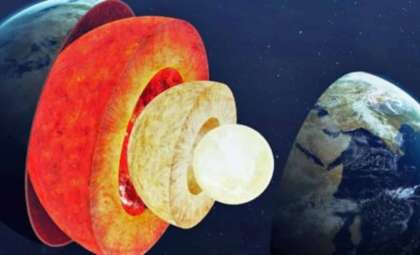
The detection of a molten zone beneath the Moon offers an intriguing analog to Earth’s interior structure. Whereas Earth’s mantle is largely molten and drives tectonic movements, the Moon’s smaller size was believed to preclude such ongoing activity past its early history. Discovering a low-viscosity zone suggests the lunar mantle continues to evolve, albeit slowly compared to Earth. This revelation calls for revising established models of the Moon’s thermal cooling and formation timeline.
The study also underscores the influence of Earth-Moon gravitational interactions, suggesting that tidal forces may help sustain the molten interior. The Moon’s close orbit subjects it to continual tidal deformation, potentially preserving this partial melt. Such a mechanism resembles tidal heating seen in the moons of Jupiter and Saturn, including Io and Enceladus, where gravitational pulls generate internal warmth and geological activity.
In summary, uncovering a molten layer within the lunar mantle reshapes our understanding of the Moon’s interior and heat retention. Upcoming missions outfitted with seismic tools and advanced instruments are vital to confirm the nature of this layer and explore its role in lunar geology. This discovery provides fresh insights into planetary evolution and the similarities among celestial bodies in our solar system.
- Categories:
- Astronomy ,
- News ,
- Nasa









0 comments
Sign in to Comment