

Astroscale, a leading space tech firm based in Tokyo, has marked a breakthrough in tackling orbital debris with its innovative ADRAS-J mission.
In a recent operation, the spacecraft successfully obtained close-range, high-resolution photographs of a sizable piece of space junk—a Japanese H-IIA rocket upper stage that has been orbiting since 2009. ADRAS-J executed two precise flybys, acquiring critical visual data to aid future removal attempts.
This effort is an integral component of a wider program backed by the Japan Aerospace Exploration Agency (JAXA), focusing on creating and testing methods to eliminate dangerous debris from Earth's orbital environment.

Addressing the Risks of Orbital Debris
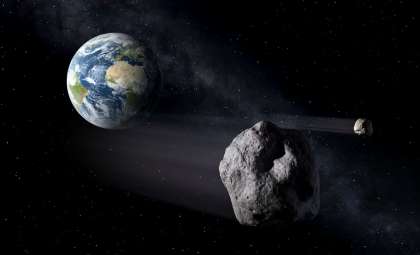
Space debris encompasses defunct satellites, spent rocket parts, and scattered fragments from collisions or decay. These hazardous objects travel at speeds surpassing 15,000 mph, creating dire collision risks for functioning spacecraft, including the International Space Station.
The European Space Agency reports that over 40,500 debris pieces larger than 10 cm currently orbit Earth, accompanied by countless smaller fragments. Impact with these objects could cause catastrophic damage, potentially triggering a chain reaction known as the Kessler Syndrome.
Astroscale’s ADRAS-J mission pioneers techniques for mitigating such orbital hazards. The new imagery showcases the 11-meter rocket stage with unprecedented clarity, obtained from just 50 meters away, underscoring the spacecraft’s exceptional maneuvering capabilities. Astroscale noted, “Our commercial spacecraft has demonstrated unprecedented control by completing coordinated fly-arounds and capturing snapshots under varying lighting while holding a stable vantage point.” This milestone highlights the difficulty of operating near uncooperative orbital debris.
In-Depth Views of Orbital Junk
Data from ADRAS-J revealed the rocket fragment remains structurally intact, a critical insight that will inform the next mission step—physically securing and removing the debris.

The spacecraft's precision approach confirms the effectiveness of its collision avoidance technology. “Navigating so closely around orbital debris is an immense technical challenge,” stated Dr. Toru Yamamoto, head of Japan’s commercial debris removal efforts. “ADRAS-J effectively executed safe maneuvers away from the target, proving the reliability of its onboard systems when engaging non-cooperative objects.”
This mission supports JAXA’s “Commercial Removal of Debris Demonstration” initiative, aiming to develop practical debris capture and disposal technologies. Plans for ADRAS-J2 build on this foundation, intending to use a robotic arm to grasp and guide the rocket stage to a lower orbit, where it will safely disintegrate during atmospheric re-entry. “We chose this target due to its size and common cylindrical shape,” Yamamoto explained. “Successfully removing it could pave the way for retrieving similar debris objects.”
Upcoming Steps in Orbital Cleanup
Astroscale is targeting 2027 for the physical retrieval mission featuring ADRAS-J2. This marks one of the earliest attempts to remove large debris and sets a vital precedent for space sustainability. The company also has plans to remove a decommissioned satellite equipped with a magnetic docking system under contract with OneWeb the same year. Furthermore, Astroscale is competing for a contract from the UK Space Agency to clear two obsolete British satellites in the COSMIC mission.
Worldwide initiatives mirror these efforts. The European Space Agency and Swiss firm ClearSpace are preparing the ClearSpace-1 mission, scheduled to deorbit a smaller rocket fragment by 2026, emphasizing the growing focus on maintaining orbital safety. NASA describes low Earth orbit (LEO) as “an orbital junkyard filled with millions of human-made fragments, including tiny paint flakes to obsolete satellites, all traveling at hazardous velocities.”
Astroscale’s ADRAS-J mission sets a new benchmark in space debris monitoring and removal. The comprehensive imaging and data offer vital insights about debris conditions and dynamics, supporting developing removal solutions. As space becomes increasingly crowded, mitigating orbital debris threats is essential for ensuring the long-term viability of space ventures.
Successes like ADRAS-J and its successors are crucial for preserving a safe orbital environment for future generations. “We are watching you from every angle,” Astroscale communicated via Twitter, emphasizing their meticulous surveillance.
- Categories:
- Astronomy ,
- News ,
- Space ,
- Nasa ,
- Aircraft









0 comments
Sign in to Comment