
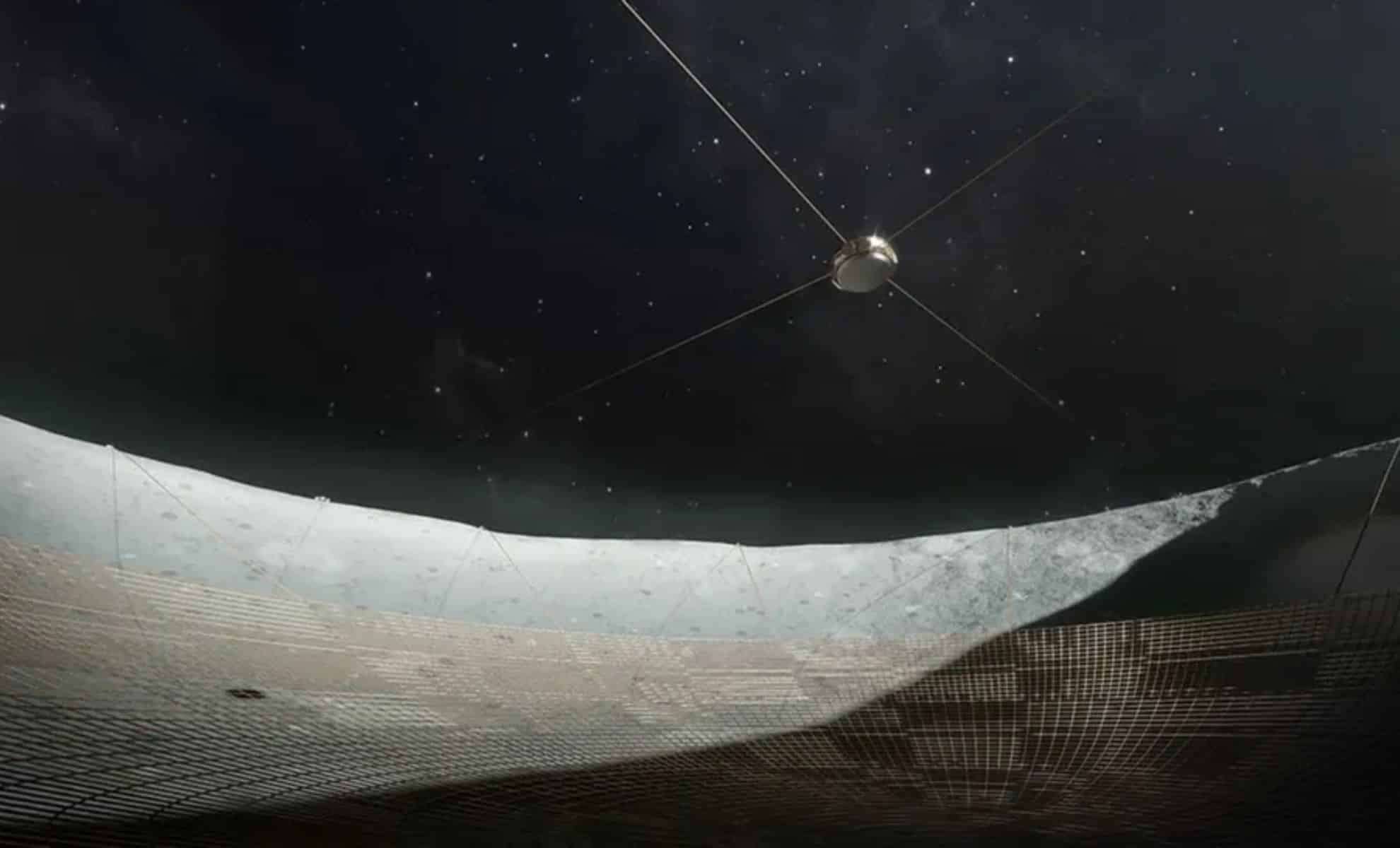
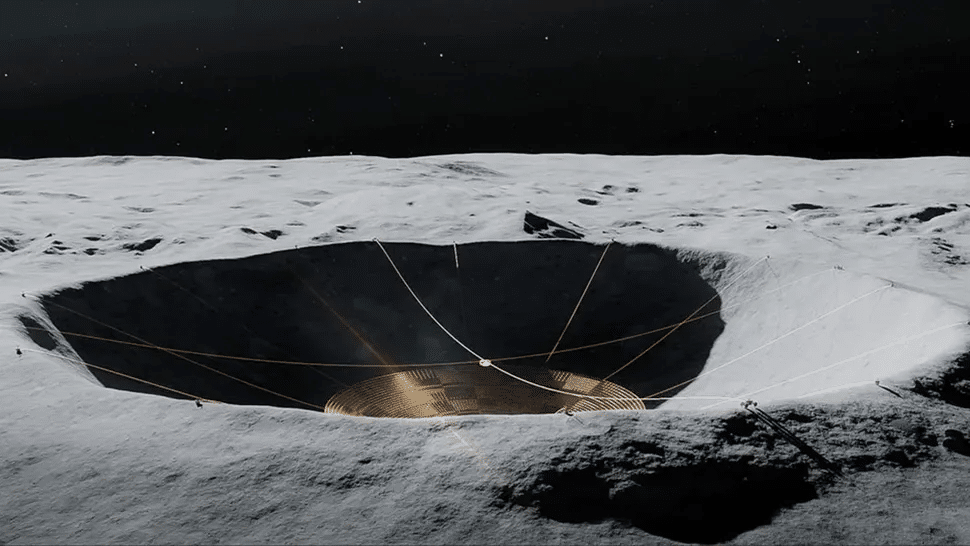
NASA is advancing plans to install a radio telescope on the hidden side of the Moon, nestled within a crater far from Earth’s pervasive radio interference. According to a recent Live Science article, this initiative could transform astronomical observations by enabling researchers to detect ultra-long radio waves that Earth’s atmosphere blocks and whose signals are spoiled by satellite sources. If fully supported, the Lunar Crater Radio Telescope (LCRT) could see construction begin in the 2030s.
A Giant Leap in Radio Astronomy Construction
Stretching over 1,150 feet, the LCRT would be assembled completely through robotic automation inside a natural lunar crater. This project, drawing inspiration from Earth-based radio observatories such as Arecibo and FAST, seeks to harness established engineering with cutting-edge space robotics. The selected crater is located in the Moon’s northern hemisphere, though specific details remain undisclosed to avoid external interference.
The main goal of this lunar observatory is to avoid increasing radio frequency disturbances produced by Earth’s expanding satellite networks, particularly commercial megaconstellations launched by private companies like SpaceX. These satellites emit radio waves that can disrupt sensitive astronomical data. Astronomer Federico Di Vruno from the Square Kilometer Array Observatory cautions that unchecked satellite growth could effectively block key observational "windows" into the universe. The far side of the Moon provides a uniquely protected environment, free from Earth-originated atmospheric and technological noise.

Probing the Universe’s Earliest Epochs
The LCRT’s most groundbreaking capability lies in its detection of very long radio wavelengths that are undetectable from Earth, as they get absorbed or reflected by our atmosphere. These signals are crucial for exploring the cosmic dark ages, the enigmatic era after the Big Bang before stars emerged.
According to Gaurangi Gupta, a principal investigator at NASA’s Jet Propulsion Laboratory, "During this period, the universe was predominantly filled with neutral hydrogen, photons, and dark matter, making it an exceptional environment for testing fundamental cosmological theories." By studying these signals, scientists aim to improve models about dark matter, cosmic inflation, and underlying physical forces. “Research during the dark ages could redefine our grasp of particle physics, dark energy, and the earliest universe.”
The Declining Viability of Earth-Based Telescopes
Terrestrial radio telescopes face growing challenges. The surge in communication satellites not only litters the night sky with visible trails but also blankets it in a pervasive radio frequency haze that contaminates astronomical data. With thousands more satellites in the pipeline, many radio frequencies risk becoming entirely inaccessible from Earth.
A telescope on the Moon stands as a quiet refuge, shielded from Earth’s electromagnetic chatter. "Equipped with advanced technology, the LCRT can tackle these challenges and make lunar-based radio astronomy a reality," Gupta noted. Though the price tag is roughly $2.6 billion, the investment could be vital for ensuring the continuation of radio astronomy.
Development Stages and Upcoming Missions
Currently, the LCRT is in Phase II under NASA’s guidance, backed by prior funding through the NASA Innovative Advanced Concepts (NIAC) initiative. A scaled prototype at 1:200 size is under construction at the Owens Valley Radio Observatory in California. Smaller lunar radio instruments have started collecting data, laying a foundation for the full-scale telescope.
In early 2024, NASA’s ROLSES-1, deployed aboard the Odysseus lander, recorded preliminary lunar radio signals, though these were heavily contaminated by Earth’s transmissions due to its near side location. "The data from these instruments contribute valuable insights into the lunar environment and help refine methods to minimize interference," Gupta explained. Later this year, the Blue Ghost II mission aims to place LuSEE Night, a compact radio observatory designed to pick up ultra-long wavelengths from the Moon’s far side.
- Categories:
- News








0 comments
Sign in to Comment