
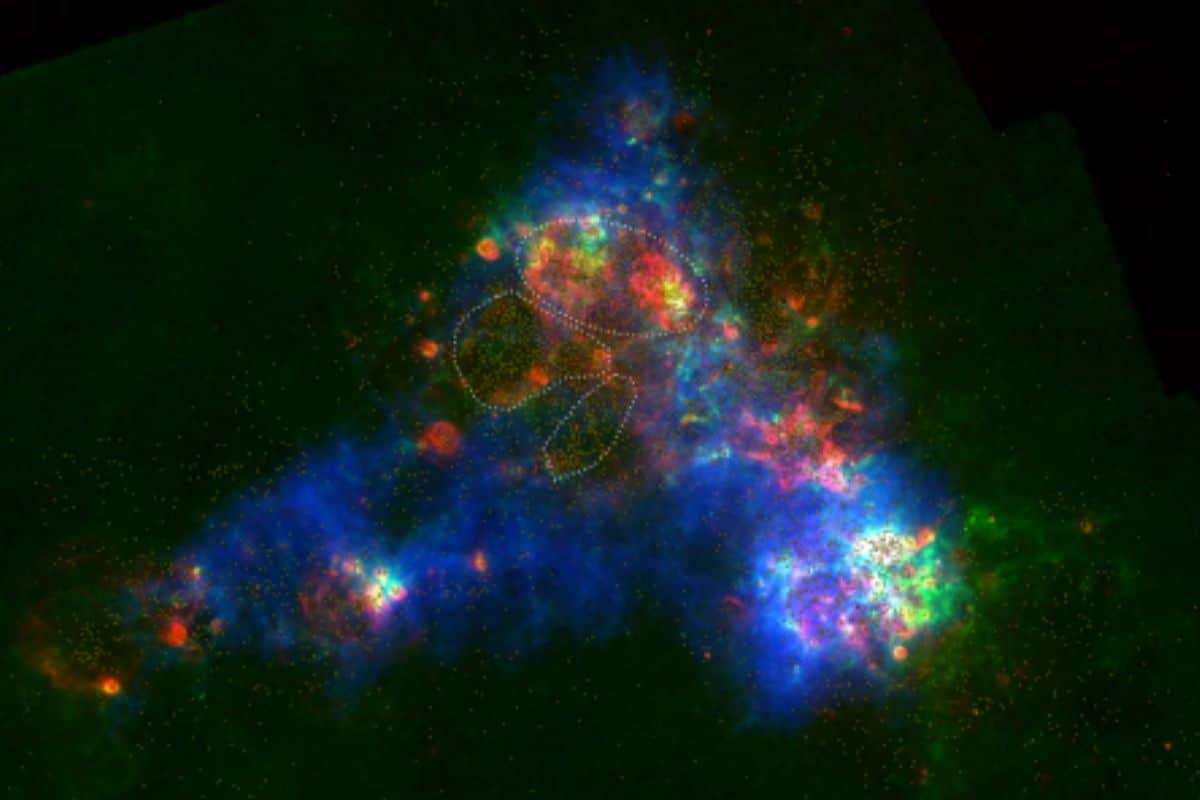
Scientists analyzing data from the European Space Agency’s Gaia mission have discovered that the Large Magellanic Cloud (LMC) is actively disrupting its smaller partner, the Small Magellanic Cloud (SMC). This observation reveals a dramatic cosmic event unfolding just beyond the edges of the Milky Way and challenges existing theories about how galaxies interact and evolve.
Two Neighboring Galaxies Orbiting the Milky Way
The LMC and SMC are dwarf galaxies locked in a gravitational dance with each other and the Milky Way. Situated roughly 160,000 and 200,000 light-years away, they represent the Milky Way’s most notable satellite galaxies.
Although close in distance and origin, new findings reveal that their interaction is turbulent. Researchers have determined that the LMC’s gravity is fiercely tugging at the SMC, stripping away its stellar content.
Gaia Data Uncovers Turbulent Star Movements
By observing nearly 700 massive stars—each more than eight times the mass of the Sun—in the SMC, researchers identified unusual motion patterns.

Co-lead investigator Kengo Tachihara of Nagoya University remarked, “Our initial reaction was to double-check for mistakes, but the findings held firm and were truly surprising.”
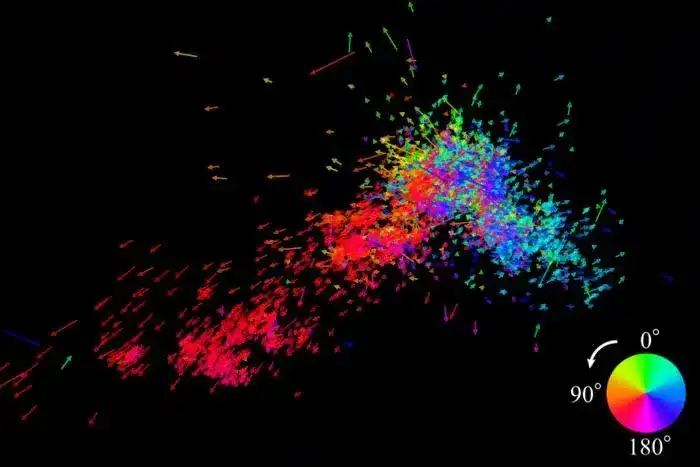
The team found that stars on opposite sides of the SMC were traveling in contrasting directions, a clear sign of intense tidal forces at play. “The stars seem to be pulling apart from each other, reflecting a galaxy under immense stress,” Tachihara noted.
Signs of a Galaxy in Decline
Observations revealed some stars moving toward the LMC while others moved away, indicating the SMC is losing its ability to retain stars—an effect known as gravitational stripping. This process gradually deconstructs a smaller galaxy under the influence of a dominant neighbor’s gravity.
Unexpectedly, these massive stars showed minimal rotational movement. Given that stars generally form from rotating gas clouds, the absence of rotation implies profound disturbances within the SMC’s internal dynamics.
”If the SMC is indeed not rotating, previous estimates of its mass and its interaction history with the Milky Way and LMC might need to be revised,” said Satoya Nakano, also of Nagoya University. “This could potentially change our understanding of the history of the three-body interaction between the two Magellanic Clouds and the Milky Way.”
Insights into Early Galactic Evolution from the Magellanic Interaction
Published April 10 in The Astrophysical Journal Supplement Series, this study highlights the ongoing dismantling of the SMC and the broader implications for galaxy formation. As the SMC slowly unravels, it provides a rare real-time example of how gravitational forces shape galactic destiny.
The fracturing of the SMC opens a window into understanding how galaxies shift under the influence of gravity, time, and dynamic motion.
- Categories:
- Astronomy






0 comments
Sign in to Comment