
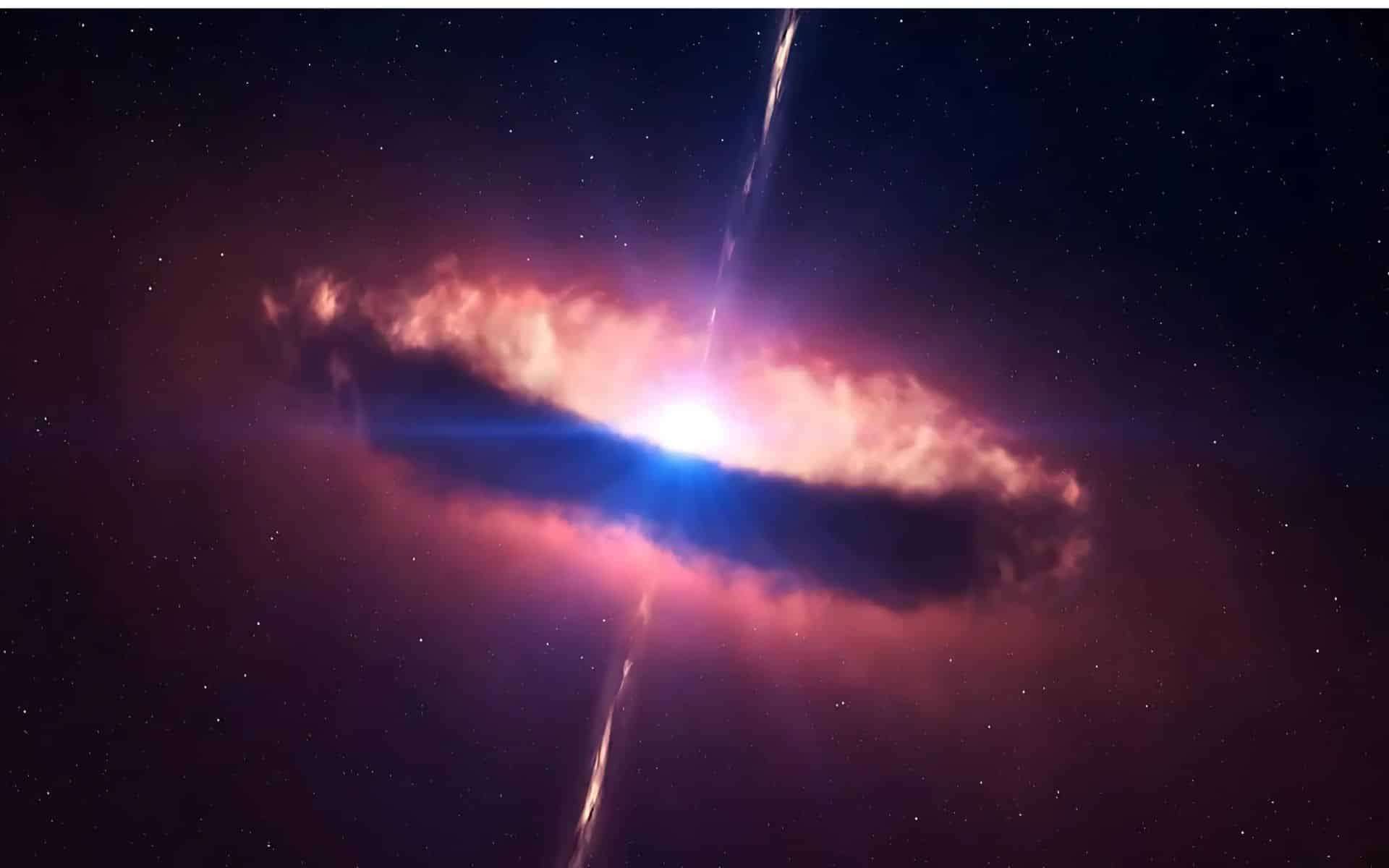
Astronomers have uncovered a remarkable cosmic phenomenon challenging previous ideas about the sources of the universe’s most powerful radiation. Traditionally, the strongest gamma rays were attributed to distant supermassive black holes at galactic centers, but a nearby microquasar named V4641 Sagittarii, located just 20,000 light-years away, is emitting astonishing amounts of energy.
A Cosmic Powerhouse in Our Galactic Neighborhood
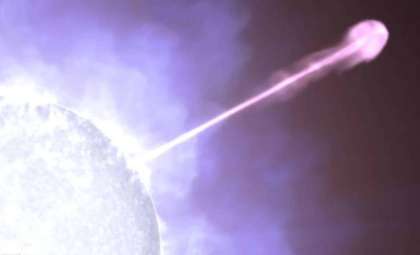
Situated within the Sagittarius constellation, the V4641 Sagittarii system consists of a binary pair where a black hole about six times the mass of the Sun continuously siphons matter from its companion star, which weighs roughly three times as much as the Sun. This intense mass transfer causes the black hole to emit radiation resembling a cosmic particle accelerator.
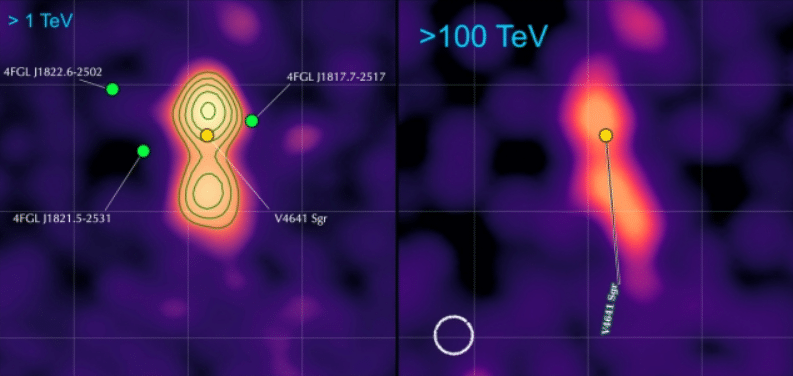
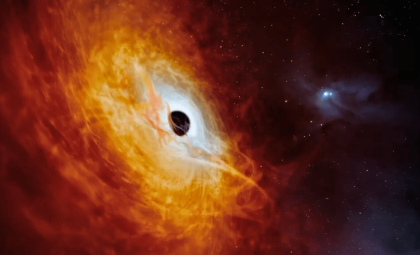
Unexpectedly, the system has been observed releasing gamma rays with energies reaching a staggering 200 teraelectronvolts (TeV)—an energy scale 200 trillion times greater than visible light photons. Such extreme gamma-ray energies were long thought to be exclusive to quasars, the supermassive black hole cores in far-flung galaxies. V4641 Sagittarii challenges this assumption by demonstrating that even nearby microquasars can produce extraordinarily energetic emissions.

Small Binary, Massive Energy Output
Microquasars like V4641 Sagittarii have been considered miniature versions of quasars, featuring smaller black holes and comparatively diminished energy outputs. This new observation suggests that these assumptions require revision.
Dr. Sabrina Casanova from the Institute of Nuclear Physics Polish Academy of Sciences (IFJ PAN) stated, “Typically, microquasar photons have much lower energies compared to those from quasars… Observing photons from a microquasar within our galaxy reaching energies tens of thousands of times higher than usual is truly astonishing.”
This finding pushes the boundaries of current astronomical models. Previously, microquasars emitted energies in the tens of gigaelectronvolts (GeV), but V4641 Sagittarii far exceeds these levels.
Tracking High-Energy Particles with HAWC
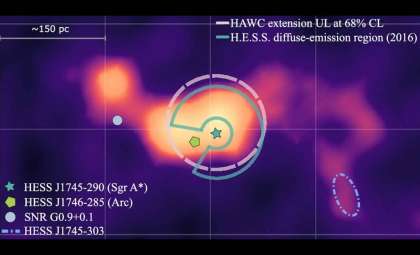
The discovery was enabled by the High-Altitude Water Cherenkov (HAWC) gamma-ray observatory, located on the slopes of Mexico’s dormant Sierra Negra volcano. HAWC employs 300 enormous water tanks that detect Cherenkov radiation generated when high-energy particles travel through Earth's atmosphere, allowing scientists to pinpoint sources of cosmic gamma rays.
Thanks to its extensive field of view, covering about 15% of the sky at once and mapping two-thirds daily, HAWC identified an unexpected gamma-ray signal from a previously quiet area. Physicist Xiaojie Wang, leading the analysis, found the source to be none other than V4641 Sagittarii, shining with energies that defy previous expectations for microquasars.
Revolutionizing Our Cosmic Perspective
This revelation has broad implications beyond our Milky Way. While microquasars like SS 433 have been known to emit photons above 25 TeV, V4641 Sagittarii’s gamma-ray output is on a whole new level, comparable to emissions from the distant quasars billions of light-years away. This proves that even smaller black holes can be powerful cosmic accelerators, a role once thought to belong only to supermassive black holes.
Additionally, microquasars provide a unique opportunity to examine cosmic evolution at a compressed timescale. Phenomena observed in quasars over millions of years can be studied in microquasars within days or weeks, serving as natural laboratories to uncover the physics behind high-energy particle acceleration.
- Categories:
- Astronomy ,
- Space







0 comments
Sign in to Comment