
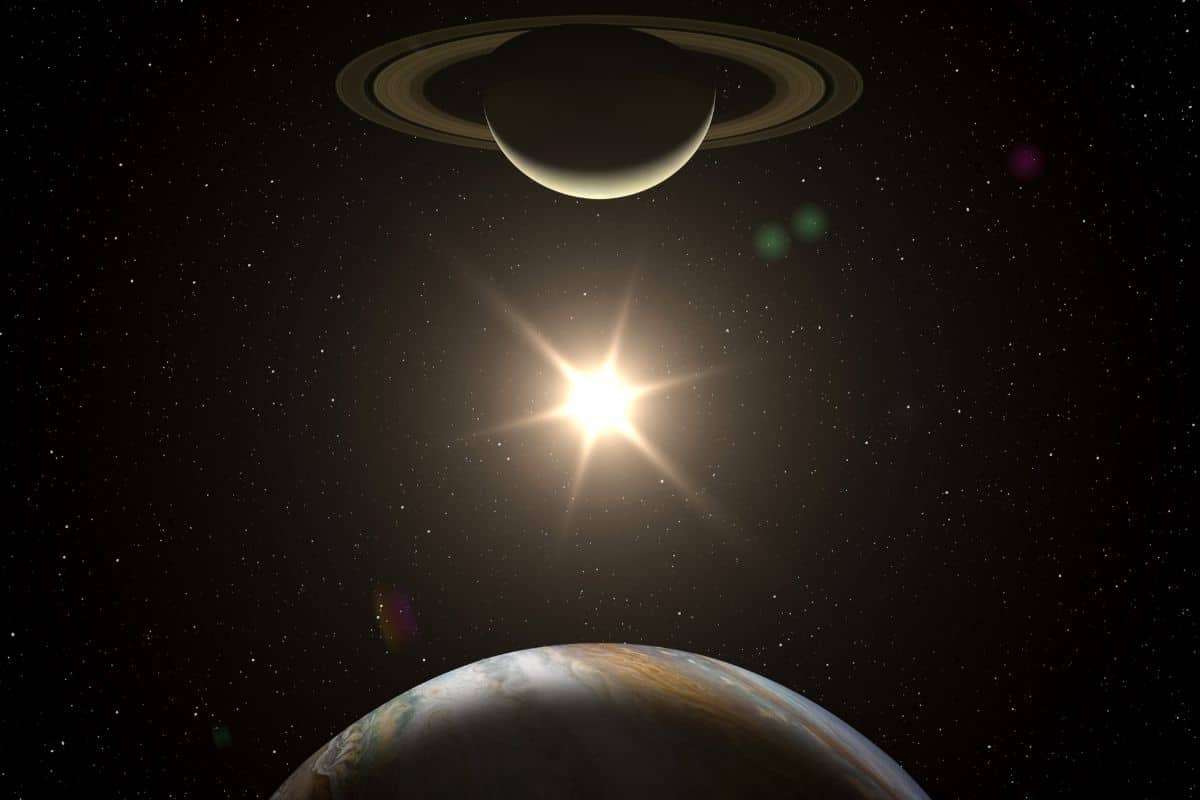
Recent investigations into interstellar objects have unveiled a surprising possibility: tiny particles and perhaps even larger fragments from the nearby Alpha Centauri star system might already be present within our solar neighborhood. While past findings like ‘Oumuamua and Comet 2I/Borisov confirmed that objects from other star systems occasionally traverse our solar system, this new research points to a more continuous exchange of material.
Linking Star Systems Across Space
Alpha Centauri, the nearest stellar system to our own, is approaching at a velocity of approximately 79,000 kilometers per hour (49,709 mph). Although its closest approach is tens of thousands of years away, scientists now propose that some debris from this star system could have already reached us.
At the University of Western Ontario, researchers Cole Gregg and Paul Wiegert employed sophisticated simulations to explore the possibility that small meteoroids from Alpha Centauri regularly enter our solar system. Their models suggest that Earth might annually encounter a few such meteors, with numbers likely to grow as Alpha Centauri draws nearer.

Invisible Interstellar Dust Within Our Solar Boundaries
While large, fast-moving interstellar visitors like ‘Oumuamua are easier to identify, fine particles and dust originating from Alpha Centauri could be far more elusive. The Planetary Science Journal study indicates that millions of objects exceeding 100 meters in size might already inhabit the Oort Cloud— a distant, icy shell enveloping our solar system.
Observing these fragments is difficult due to the vast distance of the Oort Cloud beyond the reach of most telescopes. NASA’s New Horizons spacecraft, equipped with instruments capable of detecting dust in the Kuiper Belt, could help identify such particles, but its limited fuel restricts its journey, possibly preventing it from reaching the Oort Cloud.
Should any interstellar particles penetrate the solar system, the Sun’s gravitational pull would accelerate them, potentially easing their detection.
Alpha Centauri as a Possible Source of Interstellar Comets
The researchers also propose an intriguing possibility that Alpha Centauri might be releasing its own interstellar comets, similar to those spotted in our solar system. The confirmation of Comet 2I/Borisov in 2019 as an interstellar visitor has already demonstrated such exchanges occur.
If Alpha Centauri hosts a belt of icy bodies, some may be traversing our solar system undetected, as current observation technology mainly captures larger, brighter comets that approach Earth closely.
Could Alien Dust be Falling on Earth?
This study reshapes our understanding of how material migrates between stars, hinting that our solar system is not an isolated island but part of a grander cosmic network.
“A thorough understanding of the mechanisms by which material could be transferred from Alpha Centauri to the solar system not only deepens our knowledge of interstellar transport” the researchers explain, “but also opens new pathways for exploring the interconnectedness of stellar systems and the potential for material exchange across the galaxy. ”
If fragments from Alpha Centauri are already within our reach, this raises exciting questions about panspermia—the idea that microscopic life could traverse space aboard debris, potentially spreading life across different star systems.
- Categories:
- Space








0 comments
Sign in to Comment