
Researchers have uncovered two previously unknown species of poison dart frogs in the secluded regions of Brazil's Amazon rainforest, offering fresh insights into the rich biodiversity of this extensive ecosystem. Reported recently in ZooKeys and PLOS One, these rare finds were the result of lengthy field studies combined with advanced genetic analysis, unveiling species within the Ranitomeya genus that had not been observed in over ten years.
Exploring Isolated Wilderness to Reveal New Species
The search for these frogs involved more than trekking through thick jungle. Scientists undertook a demanding expedition, including a small aircraft trip followed by a lengthy 10-hour boat journey navigating the Juruá River near the Brazil-Peru frontier. This remote landscape has long hidden these amphibians from scientific detection.
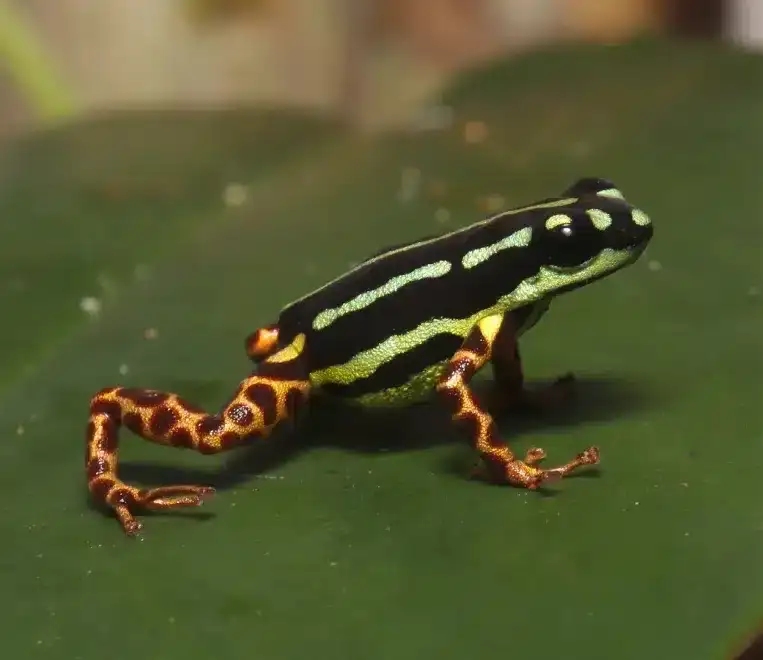
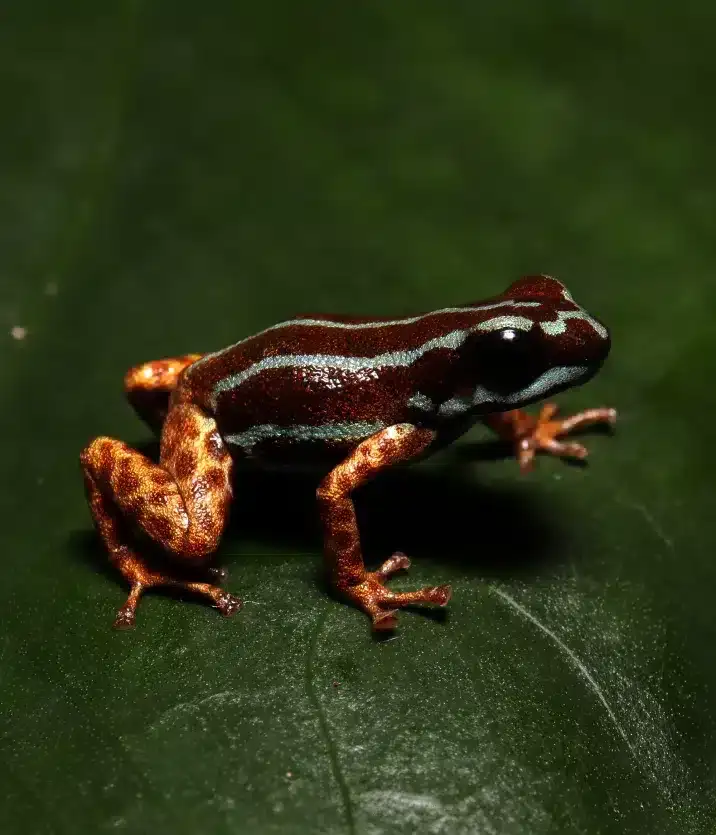
The first frog, named Ranitomeya aquamarina or the “metallic poison frog,” is distinguished by shimmering turquoise stripes set against an intense black body. The second, Ranitomeya aetherea, dubbed for its “celestial sky-blue stripes” on a brick red backdrop, is notable for its distinct coloration and unique habits. Both species are tiny, measuring approximately 15 to 17 millimeters, about the size of a dime, ranking them among the smallest known poison dart frogs.

Distinctive Behaviors Highlight Species Differences
Although similar in size and living environments—both favoring areas around palm-like plants where their tadpoles develop within water pooled in leaf axils—these frogs exhibit markedly different reproductive behaviors.
Ranitomeya aquamarina commonly forms pairs, exhibiting a rare type of monogamy in amphibians, maintaining long-term bonds. Conversely, male Ranitomeya aetherea tend to be solitary, frequently emitting calls to attract females who only stay briefly. These behavioral contrasts illustrate how nearly identical species can diverge in mating strategies.
Beyond Visuals: Confirming Species Through Genetics
Distinguishing these frogs as separate species involved more than spotting physical differences. As Koch explains, “species may look identical with matching colors and patterns,” and sometimes “a single species can display multiple color variations.”
Scientists utilized genetic sequencing, meticulous morphological scrutiny under microscopes, and analysis of vibrational mating calls to validate their classification. Findings revealed that R. aquamarina and R. aetherea are evolutionarily distinct, occupying separate lineages despite similar appearances.
Conservation Concerns Shadow These Breakthroughs
This discovery comes amid escalating threats to the Amazon from deforestation, climate change, and expanding human intrusion. Between the two expeditions conducted in 2023 and 2024, researchers documented rapid growth in cleared land threatening the frogs’ habitats.
Both species inhabit extremely limited zones—small forest patches separated by only a few miles—making them highly susceptible to habitat degradation. While their precise conservation status remains unclear due to scarce data, risks such as habitat destruction and illegal collection for the pet trade present significant challenges.
- Categories:
- News









0 comments
Sign in to Comment