
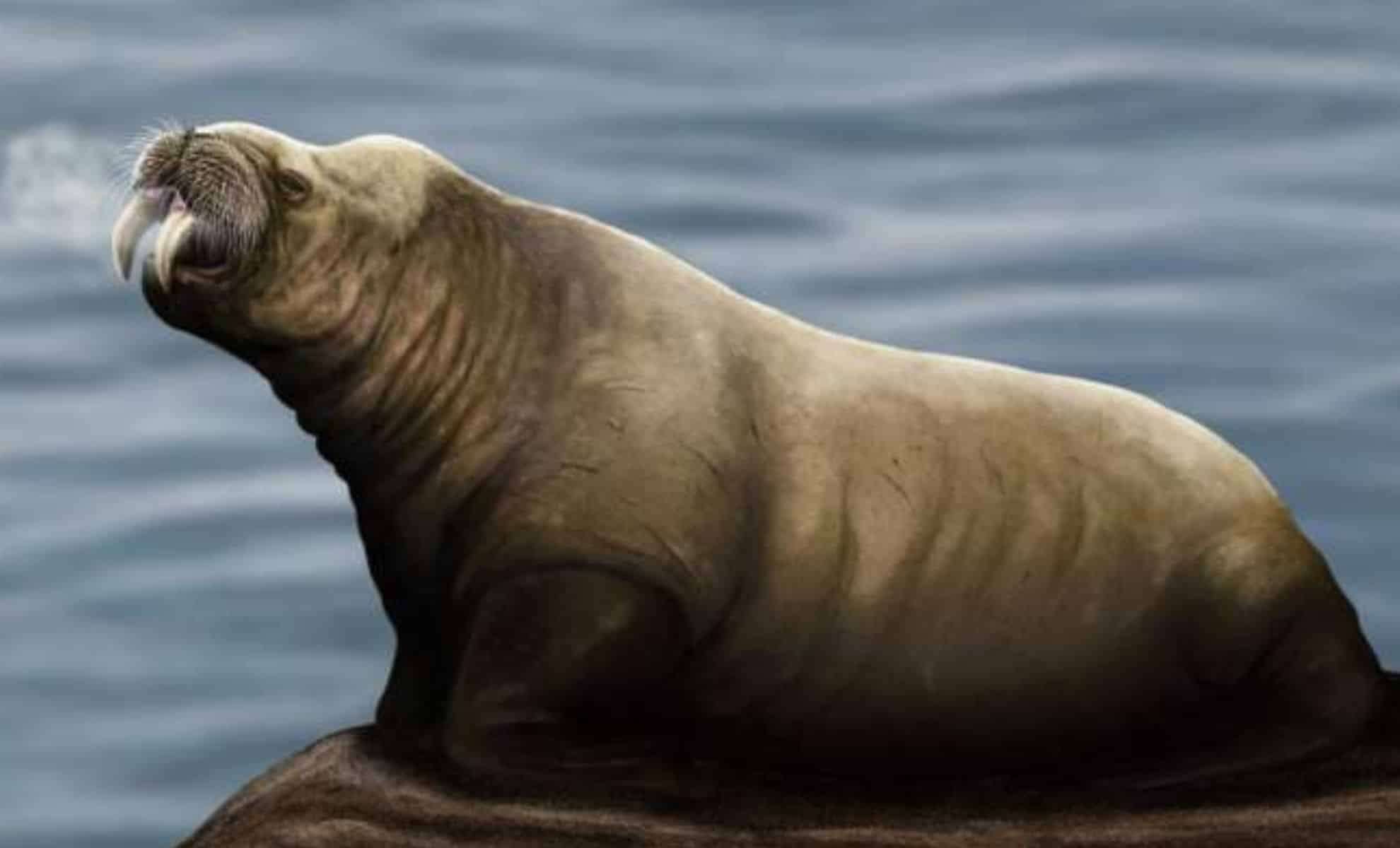
Paleontologists have uncovered a previously unknown extinct walrus-like species called Ontocetus posti.
This ancient marine mammal lived roughly 5.3 million years ago during the Pliocene epoch and was distinguished from fossils located in Norwich, England, and Antwerp, Belgium.
The findings, detailed in the journal PeerJ, demonstrate an intriguing example of convergent evolution, where Ontocetus posti developed specialized feeding mechanisms closely resembling those of present-day walruses, despite distinct environmental contexts and evolutionary timelines.

Revealing the Discovery’s Importance
Originally, fossils attributed to Ontocetus posti were mistakenly assigned to Ontocetus emmonsi. However, detailed examination of jaw bones exposed distinctive traits that classify it as a new species. These traits include four post-canine teeth, an enlarged lower canine tooth, and a fused, abbreviated mandibular symphysis indicating a suction-feeding strategy similar to that of modern walruses.
Lead author Dr. Mathieu Boisville from the University of Tsukuba, Japan, stated, “This discovery enriches our understanding of walrus evolution, illustrating how species independently developed similar adaptations in response to comparable environmental pressures over millions of years.”
The research further explores how climatic shifts, particularly global cooling during the Late Pliocene, may have driven the extinction of Ontocetus posti while facilitating the rise of cold-adapted modern walruses (Odobenus rosmarus).
New Perspectives on the Evolution of Marine Mammals
Finding Ontocetus posti sheds light on pivotal events in marine mammal evolution, especially walruses. The species’ migration from the North Pacific to the Atlantic Ocean around the Mio-Pliocene transition underscores how geological occurrences—like the shutting of the Central American Seaway—shaped species distribution and adaptation. The Late Pliocene global cooling created environmental pressures that Ontocetus posti couldn’t endure, leading to its extinction and paving the way for species suited to frigid habitats.
This discovery also emphasizes the role of convergent evolution in marine mammals, showing how similar ecological demands foster analogous adaptations across lineages separated by extensive evolutionary periods. The morphological parallels between Ontocetus posti and modern walruses highlight evolutionary responses to feeding challenges in disparate environmental conditions.
Advancing Paleontological Studies on Walruses
The research team aims to find additional fossils of Ontocetus posti to enhance knowledge of this species’ unique traits and the environmental factors shaping its evolution. The broader goal is to deepen comprehension of marine mammal evolution and how historic climate changes influenced the development of today’s species.
Dr. Boisville and colleagues stress the relevance of these findings for contemporary conservation, as modern walruses face considerable threats from human activities and climate change. He commented, “Current walrus populations are heavily impacted by factors such as hunting and warming oceans that disrupt their habitats and food availability. Our discovery highlights the critical need to protect these remarkable yet vulnerable creatures.”
- Categories:
- News ,
- Science ,
- Climate change ,
- Evolution











0 comments
Sign in to Comment