
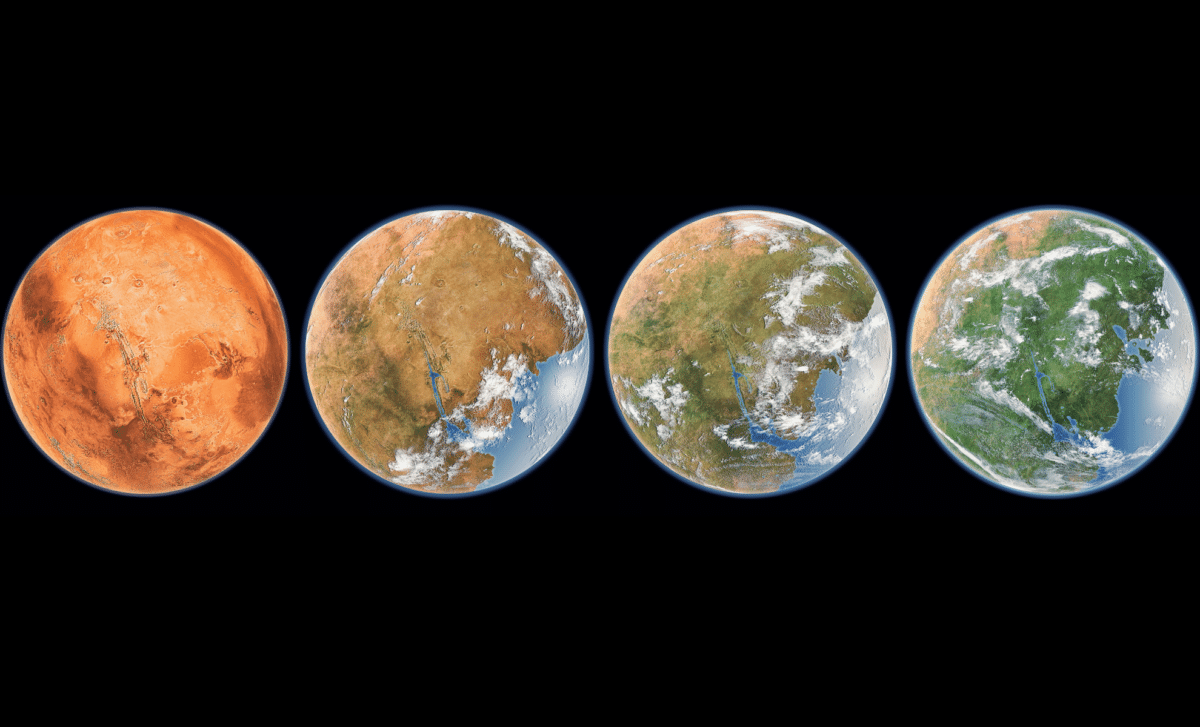
An increasing number of experts are seriously investigating the possibility of turning Mars into a planet capable of sustaining life on a broader scale. Researchers are now formulating concrete plans to explore if raising the Red Planet’s temperature is achievable. Although this vision remains distant, recent studies are moving the concept from fantasy to a framework of verifiable scientific experiments that aim to uncover Mars’ true potential for transformation.
Developing a Research Framework to Evaluate Mars’ Transformability
Leading this initiative is Edwin Kite, a geophysical researcher at the University of Chicago. Kite has outlined a comprehensive plan that seeks to assess the possibility of warming Mars. Instead of assuming terraforming will occur, the approach prioritizes examining the scientific principles, technological needs, financial implications, and associated risks. A key idea involves introducing engineered aerosols into the Martian atmosphere to stimulate warming effects. This step could kickstart alteration of the planet’s environment on a global scale. Furthermore, this work helps establish applied astrobiology as a new discipline focused on creating sustainable ecosystems beyond Earth. The goal is to determine if self-sustaining biospheres might one day exist on Mars, not just isolated human outposts. Described in detail on arXiv, the research is still in its early phase but represents one of the most organized efforts to evaluate the practical realities of planetary engineering.
Kite has underlined the magnitude of the task ahead, stating,

“Creating sustainable habitats and biospheres beyond Earth is an enormous scientific and technical challenge, but it’s one we’ll have to surmount if we’re going to extend life beyond Earth,” Kite told Space.com.
He also stressed how much remains to be learned about establishing life-supporting systems off Earth.
“We do not yet know enough to create a biosphere from scratch,” he added. “Applied astrobiology, like planetary science, requires contributions from many disciplines.”
This perspective highlights a recurring theme: our current knowledge of complex planetary ecosystems remains limited, and Mars presents a complicated scientific puzzle.
Gradual Steps from Localized Habitats to Global Environmental Modification
The strategy emphasizes a progressive approach rather than immediate planet-wide transformation. Early-stage technologies might aim to locally increase temperatures around human habitats. Researchers are exploring solutions such as solid-state greenhouse membranes to extract liquid water from subsurface ice. These systems could enable moisture capture, food production, and essential life-support capabilities for crews. More ambitious proposals include deploying orbiting mirrors to redirect sunlight onto specific Martian regions. Over time, engineered aerosols could amplify Mars’ weak greenhouse effect, gradually raising temperatures over extensive areas.
Scientists caution that each phase requires thorough testing prior to implementation. Present-day Mars is an extremely hostile environment, characterized by a thin atmosphere, freezing temperatures, and scarce liquid water. Even if warming tactics succeed, whether Mars can support a self-sustaining ecosystem remains uncertain. Such biospheres must maintain biological activity and influence atmospheric conditions over long durations, with environmental changes occurring over centuries rather than years. Therefore, this project prioritizes gathering data and addressing uncertainties before considering large-scale transformation.
Small-Scale Experiments Could Yield Crucial Insights
A particularly promising component of this research is a proposed technology demonstration. Scientists intend to send an automated instrument to release under one kilogram of tiny artificial particles into the Martian atmosphere. By using lasers to track particle dispersion patterns, they hope to better understand if aerosol-based warming could work in Mars’ real environment.
Engineering this system presents significant hurdles. The particle dispersal mechanism must operate reliably under Mars’ unique environmental conditions. Ground tests have already been designed, with upcoming trials planned at NASA’s Planetary Aeolian Laboratory in California. This facility can recreate atmospheric environments comparable to Earth, Mars, and Titan. Outcomes from these experiments will reveal how engineered particles behave beyond Earth, providing vital data that simulations cannot fully capture. Even a modest demonstration would contribute substantially to efforts aimed at evaluating terraforming techniques.
Critical Knowledge Gaps Remain in Understanding Mars
Experts recognize that essential questions about Mars are still unanswered. Detailed mapping of underground ice, ongoing climate observations, and additional geological samples are all pivotal for assessing the feasibility of environmental modification. Discovering water reservoirs beneath the surface is particularly crucial since accessible water would be foundational for any future human presence.
Kite noted the importance of international collaboration, referencing upcoming sample-return projects.
“Mars sample return will be done by China’s space agency. The original plan for their Tianwen-3 mission was to grab some rocks from wherever and then head back to Earth,” Kite said. “The new plan is to go around with a helicopter and collect rocks from a wide area. I’m hopeful that they share their Martian samples, allowing all the world’s labs to have a crack at them.”
Another frequently discussed mission, the International Mars Ice Mapper, was studied by several space agencies but is currently inactive. Kite believes this initiative’s objectives remain highly significant.
“It’s a good idea and could always come back,” said Kite. “We should search for deep aquifers using electromagnetic soundings — that’s the best strategy. We don’t know whether there’s still liquid water deep underground. There are big gaps in our knowledge about Mars.”
These uncertainties demonstrate why researchers are taking a cautious stance. A far more detailed understanding of Mars is necessary before seriously considering any attempts at planetary alteration.
A Long-Term Vision Stretching Across Generations
Although interest in terraforming Mars is rising, scientists urge realistic expectations. The technologies remain in early development, and even successful field tests will only mark initial stages in a process that spans multiple generations. The study envisions that significant environmental transformation will require continuous funding, technological advancements, and several decades of dedicated effort.
The timeline projected is extensive.
“Even under optimistic assumptions, warming at kilometer scale is at least a decade away, and wider environmental modification would require sustained investment over many decades beyond that,” states the recent research paper, which Kite led.
However, advocates argue that exploring these pathways now may preserve crucial options for humanity’s future. As the researchers conclude,
“Relatively modest research investments would keep open the option of extending life beyond Earth as Mars’ scientific exploration continues,” Kite and his colleagues concluded.
At present, Mars remains a cold, arid planet visited only by robotic explorers. Although this new roadmap does not guarantee a future transformation, it offers a carefully designed scientific strategy to address a fundamental question in space exploration: can an entire planet be reshaped to support life?
- Categories:
- News









0 comments
Sign in to Comment