
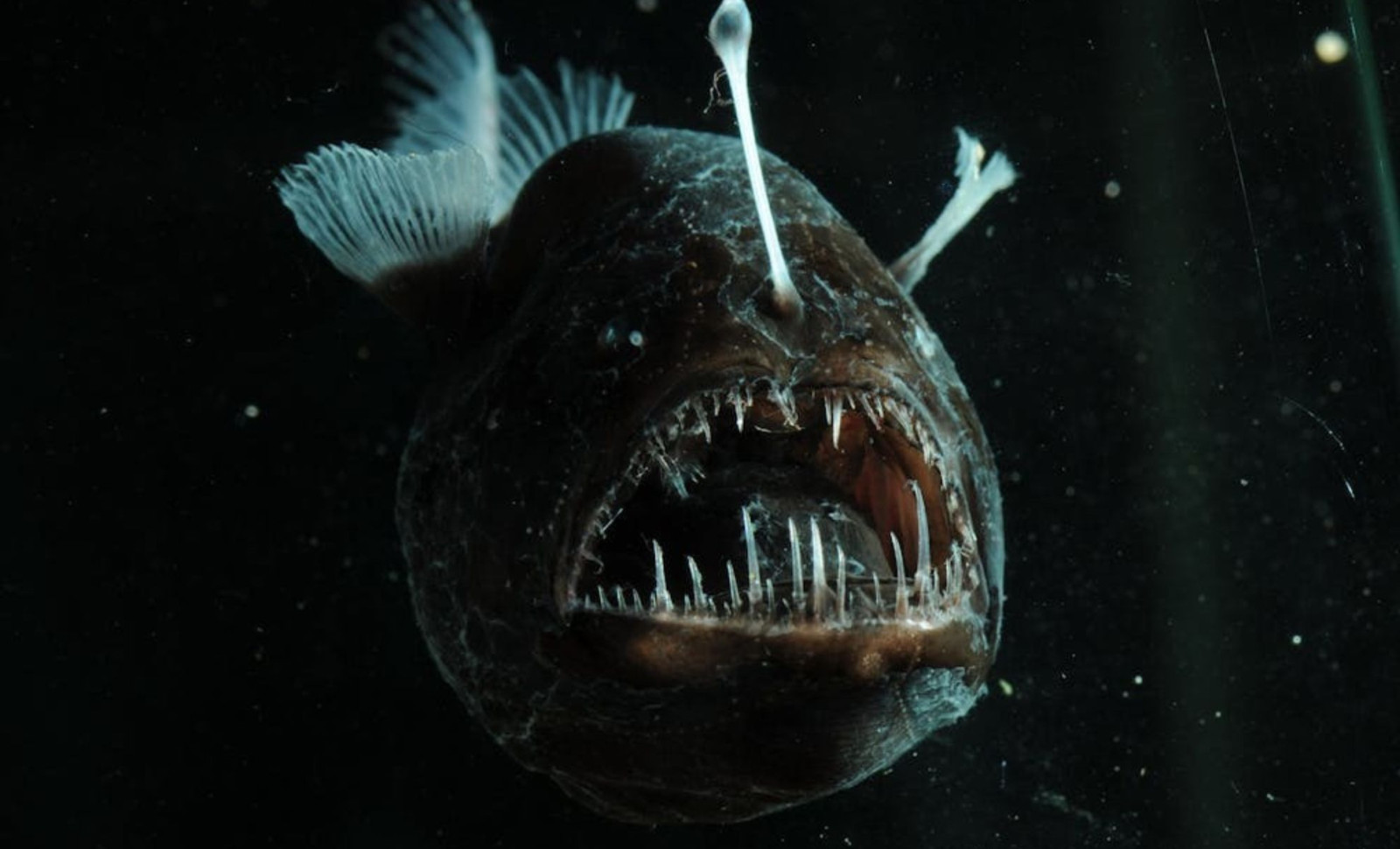
Researchers have identified an entirely novel type of photoreceptor in larval deep-sea fish, challenging over a century and a half of established knowledge about vertebrate vision.
Traditional understanding held that vision relies exclusively on two photoreceptor varieties: cones, which operate in bright conditions, and rods, which function in darkness. This recent discovery introduces a third, hybrid cell combining features of both types.
Exploring the Ocean’s Dimly Lit Midwater Realm
Conducted under the guidance of Dr. Fabio Cortesi from the University of Queensland and published in Science Advances, the research focuses on a fish species residing in the mesopelagic zone. This “twilight zone,” located between roughly 50 and 200 meters deep, is characterized by extremely limited natural light.

Organisms occupying this layer face the challenge of detecting minimal sunlight filtering down from above as well as fleeting glimmers of bioluminescent flashes emitted by other creatures. Both predators and prey depend on these faint signals for survival.
Despite being one of Earth’s largest marine habitats, the twilight zone remains relatively understudied, and every new discovery contributes critical knowledge about adaptations to conditions of low illumination, high pressure, and scarce nutrients.
An Eye Adaptation Like No Other
What sets this species apart is its distinctive mixed visual anatomy. Its eyes do not conform strictly to established categories but instead feature combined elements from different types of photoreceptors.
Generally, vertebrate vision depends on two main photoreceptor cells: rods, which are extremely sensitive in dim light, and cones, which allow for color perception in brighter settings.
“For more than 150 years, textbooks have taught that vision in most vertebrates is made of cones and rods—cones which work in bright light and rods for dark situations,” Dr. Cortesi explained. “But our study of deep-sea fish larvae revealed a new cell type—a photoreceptor that optimizes vision in gloomy or twilight conditions. It combines the molecular machinery and genes of cones with the shape and form of rods.”
This hybrid retinal cell suggests the fish maintains a heightened sensitivity to minimal light while preserving characteristics that enable more adaptable vision. This unique combination likely allows the fish to see faint outlines against dim ambient light from above and detect bioluminescent signals within the surrounding darkness.
- Categories:
- Science











0 comments
Sign in to Comment