
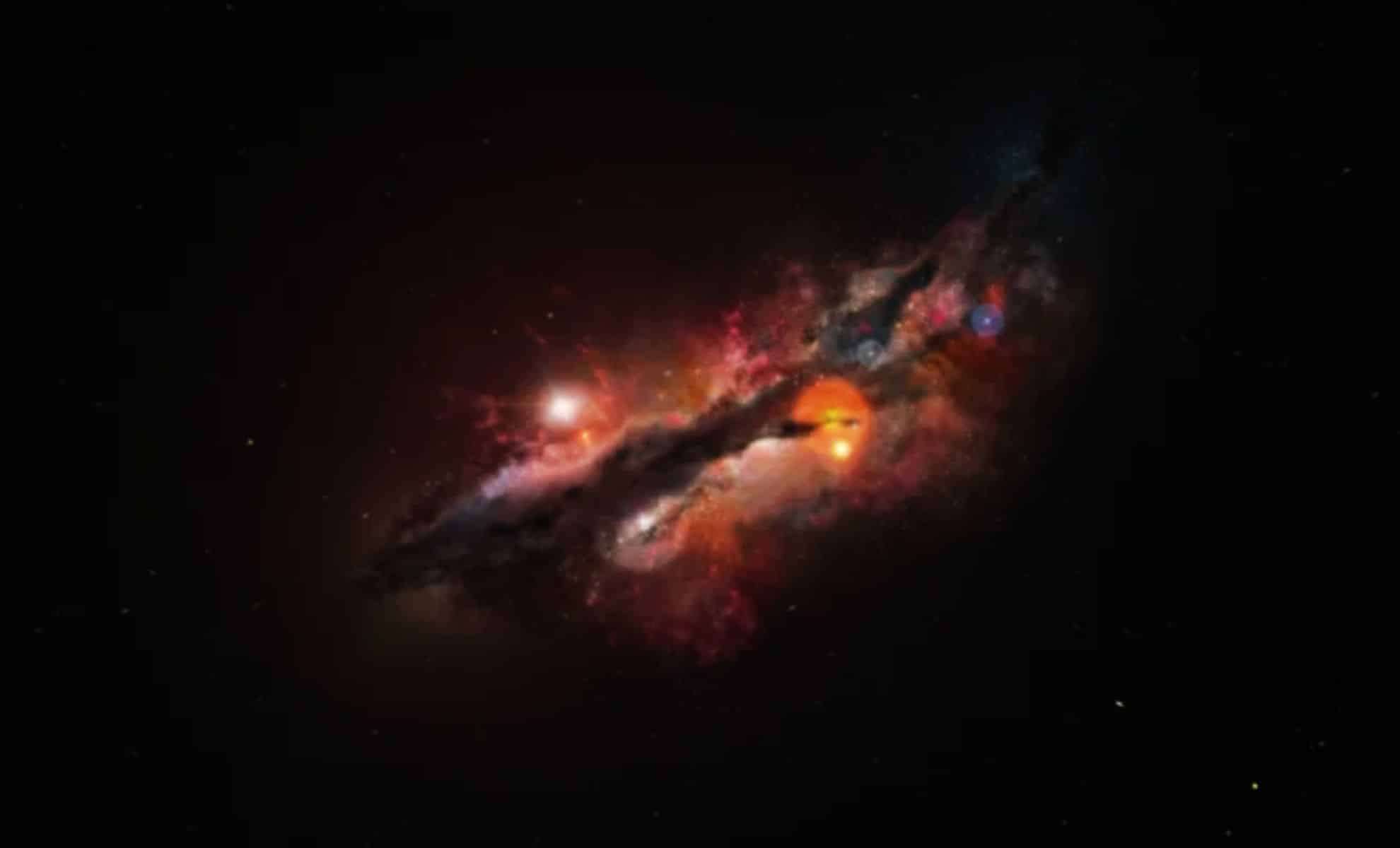
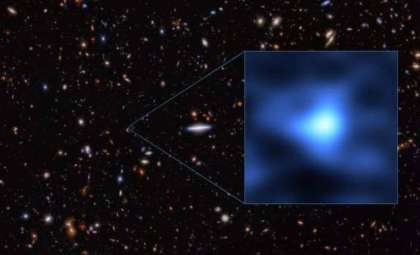
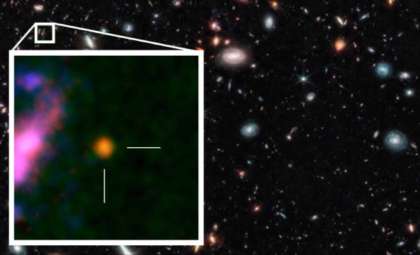
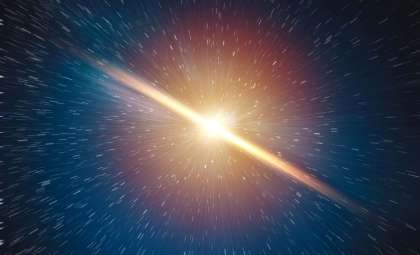
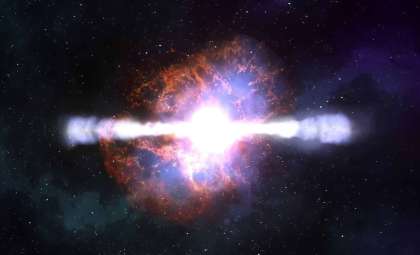
A remarkable breakthrough has transformed our understanding of galaxy development during the universe’s infancy. Researchers have identified oxygen in the emission from JADES-GS-z14-0, currently the farthest galaxy detected. This revelation, detailed in Astronomy & Astrophysics, confirms that complex chemical evolution had already begun merely 300 million years following the Big Bang.
The light we observe from this galaxy has journeyed across 13.4 billion years, granting a direct window into an era previously thought too early for significant heavy element presence. The discovery relied on data from the Atacama Large Millimeter/submillimeter Array (ALMA) and was substantiated by complementary findings from the James Webb Space Telescope (JWST), raising new questions about how stars and galaxies formed in the primordial cosmos.
Oxygen Detection Alters Early Galaxy Formation Perspectives
Oxygen plays a crucial role as an indicator of cosmic chemical progression. Its unique 88-micron fine-structure emission line helps astronomers detect it through interstellar dust over immense distances. ALMA’s advanced sensitivity enabled scientists to pick out this signature from JADES-GS-z14-0 and accurately measure its distance with a margin of error as low as 0.005 percent.

Findings suggest the galaxy’s metallicity in its gas phase is about one-fifth that of the Sun’s, implying that multiple generations of stars had already formed and expired before the observed light was emitted. This contradicts earlier chemical models that predicted such enrichment should occur significantly later in cosmic history.
The region displayed no significant dust presence, resulting in an exceptionally low dust-to-stellar mass ratio below 0.2 percent. Altogether, these discoveries indicate a galaxy that experienced rapid and efficient star formation shortly after the universe emerged from its dark ages.
Insights into Star Formation and Cosmic Development
Observations also revealed ionized gas in JADES-GS-z14-0 moving at roughly 70 kilometers per second, pointing to a dynamical mass close to one billion times the mass of the Sun. This suggests the galaxy is embedded in a massive dark matter halo, challenging previous ideas about when such massive structures could form in the early universe.
This galaxy not only defies the expected timeline but redefines it entirely. Subsequent JWST observations detected an excess emission at 7.7 microns associated with hydrogen and oxygen, corroborating ALMA’s findings of a rich oxygen environment. Furthermore, nearly 10 percent of ionizing photons appear to escape into intergalactic space, potentially impacting the epoch of reionization by allowing light to permeate the previously opaque early universe.
Existing models must now accommodate quicker star formation episodes or improved mixing of supernova-produced elements to explain oxygen’s early emergence. Whether this galaxy represents an anomaly or a broader pattern remains to be investigated.
Scientific Perspectives: Revisiting the Origins of Galaxies
The discovery has elicited excitement and new debates within the astronomy community.
“I was astonished by the unexpected results because they opened a new view on the first phases of galaxy evolution,” remarked Stefano Carniani from the Scuola Normale Superiore in Pisa.
These results challenge long-standing theories. Models based on gradual gas accumulation and low star formation rates now appear insufficient to explain a galaxy like JADES-GS-z14-0. New hypotheses may include dominance of massive stars that enrich their surroundings swiftly or early formation and collapse of gas-rich halos beyond prior simulation predictions.
“This demonstrates the remarkable cooperation between ALMA and JWST in uncovering how the earliest galaxies formed and evolved,” added Rychard Bouwens from Leiden Observatory.
Together, these observatories reveal a cosmos where galaxies might have developed much more rapidly than previously assumed.
Future Explorations: Enhancing Our View of Cosmic Dawn
The investigation continues with planned JWST spectroscopic studies aiming to detect carbon and nitrogen lines within the same vicinity to complete our picture of early galactic environments. Concurrently, ALMA’s higher-frequency observations will seek elusive dust emissions to understand dust formation timelines in relation to metals.
The forthcoming Extremely Large Telescope (ELT) will provide resolutions fine enough to identify star-forming regions just a few hundred light-years across. These tools will determine whether JADES-GS-z14-0 is a rare pioneer or part of a widespread early galaxy population.
ALMA’s future surveys targeting numerous redshift 12 candidates will explore additional oxygen presence to clarify if this detection is unique or part of a larger cosmic phenomenon.
A Galaxy That Challenged Cosmic Timelines
Discovering oxygen in JADES-GS-z14-0 so shortly after the Big Bang compacts our timeline for early galaxy growth, confronting established concepts of how galaxies form. Instead of a slow and steady evolution, this galaxy displays a rapid development phase that stretches and challenges current cosmological frameworks.
As further findings emerge, astronomers are revisiting fundamental assumptions about stellar life cycles, feedback mechanisms, and the composition of dark matter halos. One certainty is that the universe’s earliest epochs were far more dynamic and intricate than once believed, and cutting-edge observatories are only beginning to unravel its ancient secrets.
- Categories:
- News




0 comments
Sign in to Comment