
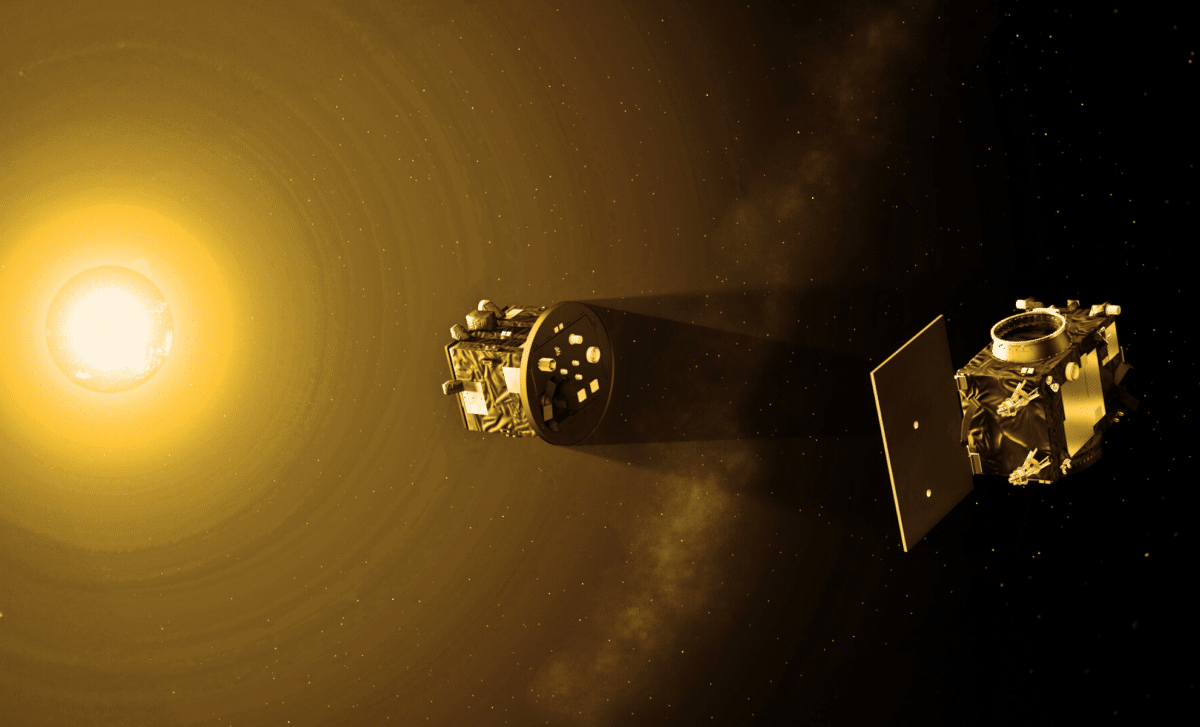
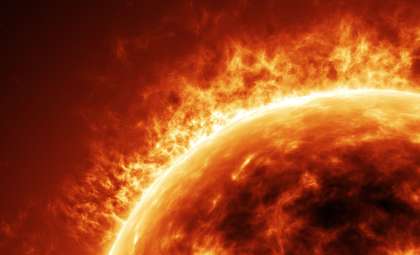
The European Space Agency’s Proba-3 mission has provided an extraordinary glimpse into the Sun’s hidden inner corona, capturing solar prominence eruptions with unmatched detail. Utilizing a pair of spacecraft flying in precise formation, researchers have created artificial eclipses in space, revealing a section of the Sun's atmosphere long concealed from observation.
A Pioneering Advancement in Solar Imaging
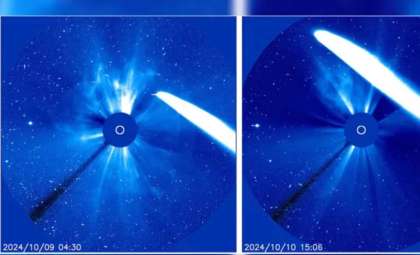
The European Space Agency (ESA) has set a new benchmark in solar exploration with Proba-3, a dual-satellite mission engineered to study the Sun’s most elusive atmospheric layer. This innovative design features one satellite acting as a precise coronagraph, blocking out the Sun's bright disc to expose the faintly glowing corona to the second satellite, thereby enabling continuous observation similar to a natural total solar eclipse.
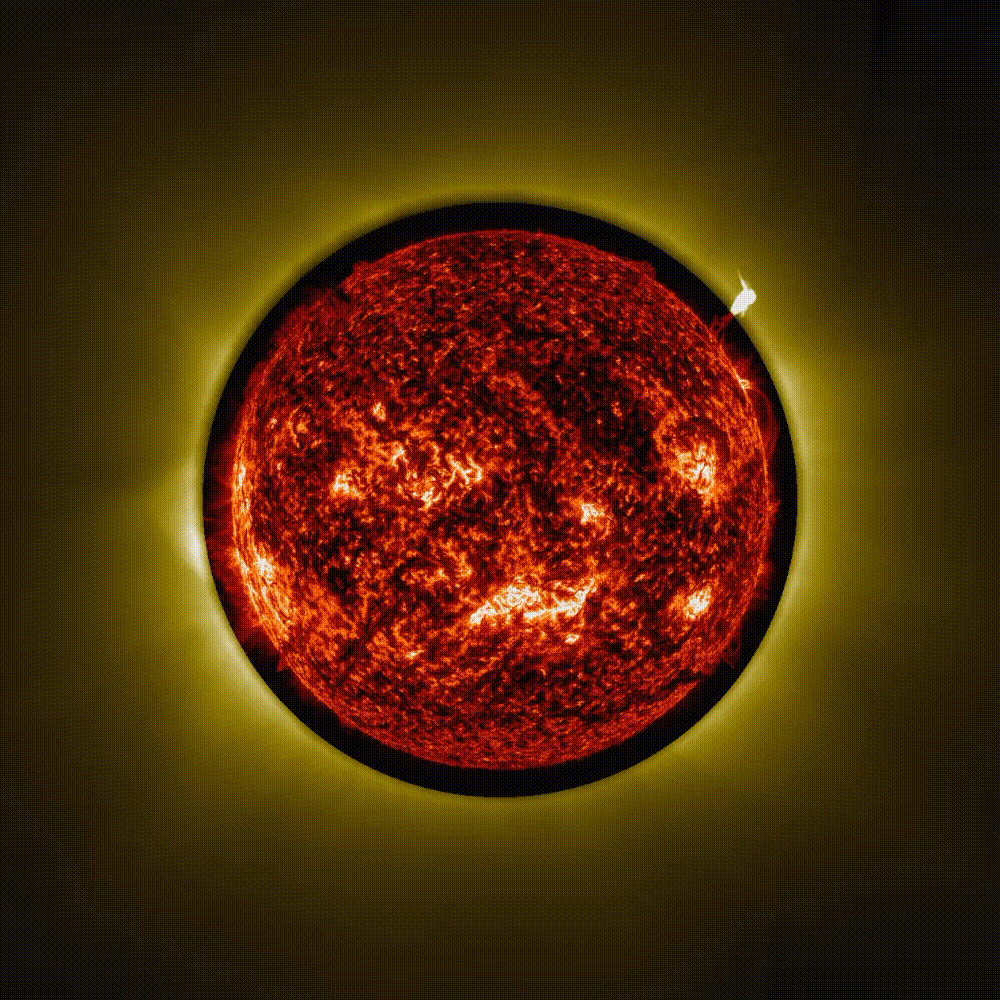
By maintaining exact positioning, the satellite duo successfully generated a stable eclipse environment in orbit, allowing the ASPIICS coronagraph to continuously monitor the corona’s intricate structures. The spectacular imagery, created in partnership with NASA’s Solar Dynamics Observatory (SDO), highlights the Sun’s lively atmosphere in vibrant oranges and gentle yellows.

These visuals penetrate beyond the Sun’s surface, uncovering the inner corona, a critical zone for understanding solar behavior, space weather phenomena, and the propagation of energetic particles across the solar system. Proba-3 signifies a transformative leap in solar science, providing data that complements prior missions such as SOHO and the Parker Solar Probe.
Exploring the Sun’s Intense Corona
“The solar corona reaches temperatures nearly 200 times hotter than the surface beneath,” explains Andrei Zhukov, Principal Investigator for ASPIICS at the Royal Observatory of Belgium. The corona can heat up to several million degrees, a still-puzzling fact given the comparatively cooler solar surface.
During a very active phase on September 21, 2025, Zhukov and his team documented three distinct prominence eruptions within a brief period of five hours. “These prominences consist of relatively cooler plasma—about 10,000 degrees—compared to the surrounding million-degree corona, forming loop-like, flame-shaped structures that sometimes erupt and release plasma into space,” he details.
Capturing three eruptions in such rapid succession is a rare achievement made possible by Proba-3’s capabilities. Zhukov notes, “Recording multiple prominence events so closely together was exceptional and offers invaluable insights into solar magnetic field dynamics and the mechanisms behind solar storms,” which can impact technology on Earth including satellites and communication networks.
Advancing Solar Science to New Heights
The animation derived from Proba-3’s ASPIICS coronagraph fuses solar data revealing the inner corona in yellow light with imagery of the solar disc in dark orange from NASA’s Atmospheric Imaging Assembly (AIA). This combination, highlighting spectral emissions such as those from helium, crafts an image remarkably similar to what one would witness during a natural total solar eclipse.
Beyond its visual impact, the dataset is invaluable for research. The subtle yellow corona glow results from visible light scattering off coronal electrons, an effect that aids scientists in tracking solar material flow and energy transfer. These observations refine models predicting solar activity and geomagnetic storms, essential for protecting Earth’s technological infrastructure.
ESA’s Proba-3 mission, operating under CC BY-SA 3.0 IGO, exemplifies the strength of global cooperation and scientific innovation, bridging the observational gap between the Sun’s surface and its outer atmosphere to deepen our understanding of our dynamic star.
- Categories:
- Space




0 comments
Sign in to Comment