

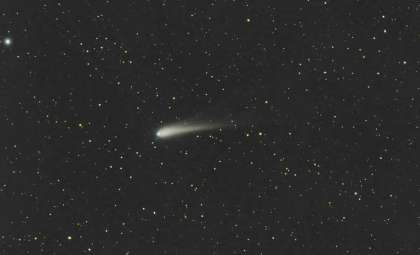
The Tsuchinshan-ATLAS comet, hailed as one of the most spectacular of this century, recently captivated astronomers with a brilliantly illuminated dust tail as it skimmed close to the sun.
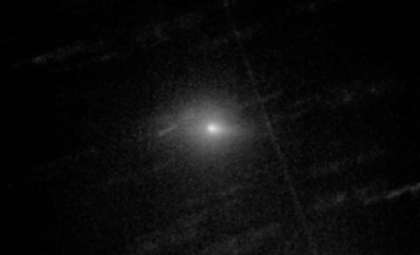
Striking images taken by the Large Angle and Spectrometric Coronagraph (LASCO) onboard the Solar and Heliospheric Observatory (SOHO) operated by the U.S. Naval Research Laboratory (NRL) showcase the comet’s extensive dust trail lighting up the solar vicinity.
The observations made during October 7–11 underscore the crucial role of space-based observatories in capturing fleeting cosmic events. Both researchers and comet aficionados gained unprecedented insights into one of the most vivid comet displays captured in recent decades.

Tracing Tsuchinshan-ATLAS’s Unique Path and Glowing Dust Trail
Comet Tsuchinshan-ATLAS, also known by its official designation C/2023 A3, reached perihelion in early October, producing a bright and intriguing dust trail. As comets near the sun, intense heat causes sublimation of volatile ices—mostly water ice—liberating gas and dust. These particles form a luminous tail that extends away from the sun, sculpted by solar winds and radiation pressure. The LASCO instrument captured crisp images of the comet’s icy core along with a radiant dust tail spanning wide across its lens.
According to NRL, “for a brief period on Oct. 14, the extensive dusty trail of the comet coalesced into a narrow, dense trail spanning the entire field of view.” This was observed as the SOHO satellite, stationed at Lagrange Point L1 between Earth and the sun, crossed Tsuchinshan-ATLAS’s orbital track, providing a rare side-on view of the debris stream. This alignment revealed a concentrated dust trail visible well after the comet’s closest solar approach, highlighting the exceptional capability of combining LASCO’s coronagraphic imaging with SOHO’s vantage point to study dynamic cometary phenomena.
Scientific Insights from Cometary Dust Trails
The dust trails left behind by comets like Tsuchinshan-ATLAS consist of tiny reflective particles that scatter sunlight, making them detectable from Earth and space under ideal conditions. The intensity and shape of these trails offer important clues about cometary composition and how these icy bodies respond to solar heating. LASCO’s observations of Tsuchinshan-ATLAS’s dust tail indicated a notably dense particle release, pointing to intricate interactions between the comet’s materials and solar radiation that make this comet a valuable subject for detailed physical studies.
Having operated since SOHO’s 1995 launch, LASCO has recorded thousands of comets, but Tsuchinshan-ATLAS’s bright and focused dust tail stood out. As NRL explains, “This phenomenon happened as SOHO…flew across the comet’s pathway or orbit and saw the dust trail edge-on,” producing a rare geometric alignment that delivered a detailed three-dimensional perspective of the comet’s trajectory and dust environment. These images offer profound understanding of dust ejection mechanisms and the morphology of cometary dust streams.
Capturing Comets Near the Sun with SOHO’s LASCO
The Solar and Heliospheric Observatory (SOHO), a NASA and ESA collaboration, was initially aimed at studying solar activity, but its Large Angle and Spectrometric Coronagraph (LASCO) has become a key instrument for observing comets near the sun. By blocking the sun’s overwhelming brightness, LASCO exposes delicate cometary features such as the nucleus and dust tails in remarkable detail.
For Tsuchinshan-ATLAS, the coronagraph supplied a sharp image of its vivid nucleus and expansive dust trail, illustrating the comet’s interaction with the solar environment. The NRL imagery further emphasizes SOHO’s advantageous position at Lagrange Point L1, which offers a clear, unobstructed view around the sun. Over 30 years, LASCO has chronicled numerous solar and cometary events, but the distinctive dense trail of Tsuchinshan-ATLAS remains a remarkable highlight.
Future Prospects and the Significance of These Observations
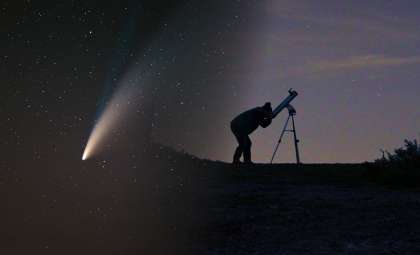
The striking display by Comet Tsuchinshan-ATLAS has drawn considerable attention from astronomers and the public alike. Nicknamed the “Comet of the Century” for its brightness and long-lasting dust tail, it presents an extraordinary chance to analyze comet behavior near the sun. Although faint, the comet remains observable in the twilight sky, best viewed with optical aids from clear, dark locations facing west at sunset.
Studying Tsuchinshan-ATLAS alongside other luminous comets enhances our knowledge of ancient solar system bodies. As advanced space telescopes improve our ability to monitor near-solar objects, new insights are expected into how comets respond to intense heat and radiation. The mission success of SOHO’s LASCO underscores the critical role of continuous solar observation in capturing rare cometary events, paving the way for deeper understanding of these compelling cosmic visitors.










0 comments
Sign in to Comment