
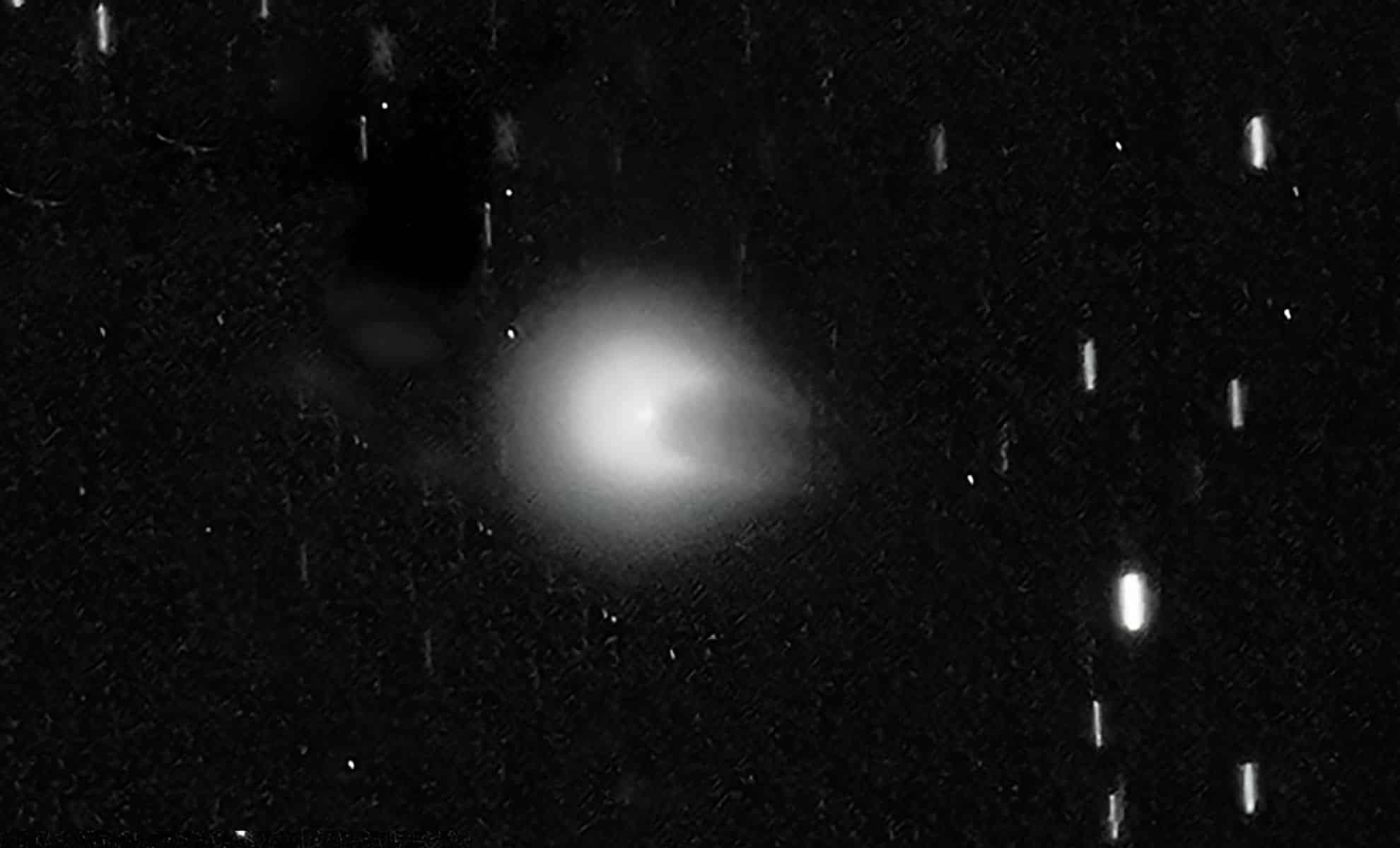
Comet 12P/Pons-Brooks, famously dubbed the devil comet for its horn-like shape, is poised to make its nearest pass to Earth on Sunday, June 2. This intriguing comet has captured attention due to its unique appearance and recent energetic outbursts.
Exploring the Devil Comet’s Unique Traits and Path
The devil comet, scientifically catalogued as Comet 12P/Pons-Brooks, is a distinctive visitor in our solar system that has fascinated astronomers through its remarkable activities and horned appearance. This comet was independently spotted by two astronomers, Jean-Louis Pons in 1812 and William Robert Brooks in 1883, which earned it its combined name. Its moniker derives from the striking horn-like shapes it forms during periods of heightened activity, reminiscent of the starship Millennium Falcon from "Star Wars."
With an orbital period near 71 years, Comet 12P/Pons-Brooks fits into the category of periodic comets that return to the inner solar system on a long but predictable timetable. Each return presents a valuable opportunity for researchers and sky enthusiasts alike due to its rarity. Unlike comets with shorter cycles that are often studied, this devil comet offers only a few chances within a typical human lifespan for close-up examination.

The comet’s trajectory carries it closer to the sun before it swings back toward the distant edges of the solar system. During its current voyage, it reached its closest solar approach, or perihelion, on April 21, 2024, at roughly 74.4 million miles (119.7 million kilometers). The intense heat triggered the sublimation of its frozen materials, releasing gas and dust that create the iconic glowing coma and extended tail. This activity is responsible for the comet’s increased luminosity and striking visual features.
On June 2, 2024, Comet 12P/Pons-Brooks will pass Earth at its nearest in over seven decades, approximately 143 million miles (230 million kilometers) away. Although this distance is vast on human scales, it is relatively close for comet observations, enabling detailed study by astronomers without any danger posed to the planet.
Spotting the Comet from Southern Skies
Dr. Teddy Kareta from Lowell Observatory emphasizes that observers in the Southern Hemisphere have a rare chance to glimpse the comet, possibly the best occasion since the 1950s. Its unusual display and activity make this moment particularly valuable for scientific observation.
Ideal viewing times stretch from roughly 6 p.m. to 7:30 p.m. local time, when the comet will be found in the western evening sky. Though the comet's brightness will have lessened since its peak in late April, it remains visible through binoculars or a modest telescope. Skywatchers are advised to direct their gaze westward just after sunset, as the object may become more challenging to distinguish in twilight.
Noteworthy Outbursts Spark Scientific Interest
The devil comet has recently undergone several active episodes, ejecting gas and dust that form the distinctive horned structure. Such eruptions are quite unusual and have spurred further scientific research. According to Dr. Dave Schleicher of Lowell Observatory, these phenomena stem from solar heating.
As the comet nears the sun, the increasing warmth causes sublimation of volatile compounds like carbon dioxide and carbon monoxide, which build pressure until gases forcefully escape through the surface. These dramatic processes deepen the intrigue surrounding the comet’s behavior.
Ongoing Surveillance and Scientific Insights
Researchers continue to study Comet 12P/Pons-Brooks closely to better understand its rotation and the impact of its eruptive activity. The comet completes one rotation every 57 hours, a lengthier period than initially predicted. This has raised questions about whether jets of material influence its spin.
Scientists have pinpointed two specific regions on the comet’s surface responsible for these jets, prompting curiosity as to why the rest of the surface remains relatively inactive. Dr. Schleicher theorizes that much of the comet’s icy layer has either hardened into crust or evaporated, leaving behind mostly rock and dust. These findings are crucial for comprehending the comet’s distinctive properties and unusual dynamics.
With its close Earth approach underway, astronomers are eager to capitalize on this rare chance to collect valuable observations. Despite dimming brightness, the devil comet’s distinct features and infrequent visit continue to captivate both scientists and the public alike.
Further studies and monitoring are expected to reveal more about this mysterious cosmic traveler, enriching our knowledge of comets and their role within our solar system.
- Categories:
- Astronomy ,
- News ,
- Space








0 comments
Sign in to Comment