
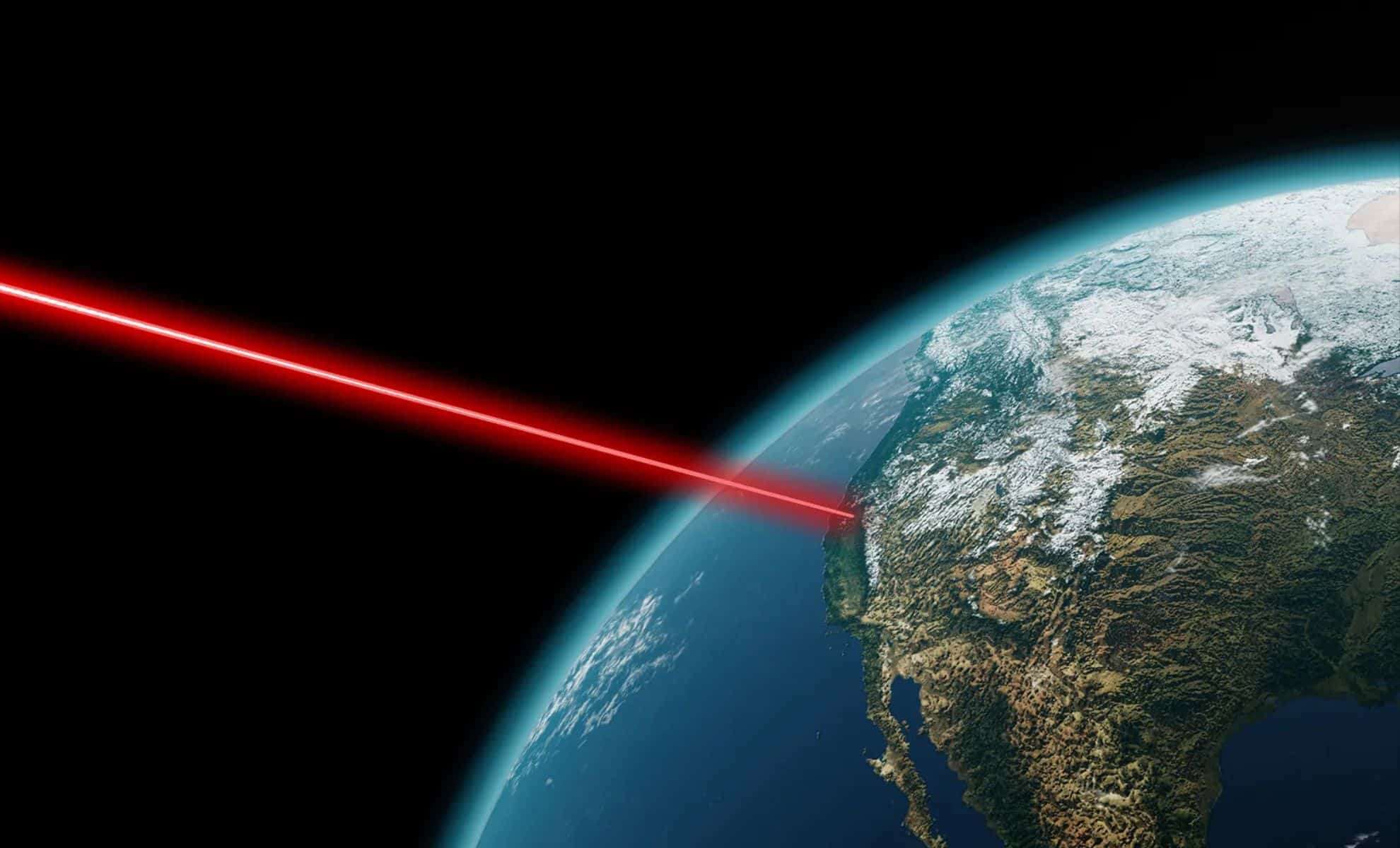
In an extraordinary breakthrough for astrophysics, researchers have identified the most energetic neutrino ever observed—a particle traveling near light speed with energy 30 times greater than any previously detected. Originating from beyond our galaxy, this intense “ghost particle” ushers in a new era for exploring cosmic particle phenomena. Although its precise origin remains elusive, scientists have pinpointed 12 viable candidates, including several blazars, which are highly energetic galactic nuclei driven by supermassive black holes.
The neutrino was captured on February 13, 2023, by the Kilometer Cubic Neutrino Telescope (KM3NeT), situated 11,300 feet under the Mediterranean Sea, during an event cataloged as KM3-230213A. This marks the first-ever detection of such an ultrahigh-energy neutrino from an extragalactic source, offering new perspectives on the energetic universe and helping to unravel extreme cosmic occurrences.
Neutrinos: The Elusive Cosmic Particles
Often referred to as “ghost particles” due to their near-invisibility and weak interaction with matter, neutrinos are among the most puzzling particles in the cosmos. Neutral in charge and nearly massless, they barely interact with other particles, making them notoriously tough to detect. Yet, they carry vital clues about the universe’s most energetic and mysterious events.

“This neutrino almost certainly comes from a cosmic origin and occupies an utterly unexplored energy range,” explained Paschal Coyle from the French National Centre for Scientific Research (CNRS). “Opening this new ‘energy window’ means venturing into unknown territory. This is truly frontier science.” The neutrino registered a staggering 220 million billion electron volts (TeV), far beyond any energy scale achievable by human-made accelerators like the Large Hadron Collider (LHC).
Neutrinos are generated during cataclysmic cosmic events such as supernovae, gamma-ray bursts, and phenomena linked with supermassive black holes. Despite their abundance throughout space, their weakly interacting nature makes detecting them extremely challenging. “Neutrinos rank among the most enigmatic elementary particles,” said Rosa Coniglione of KM3NeT and Istituto Nazionale di Fisica Nucleare. “They have no electric charge or significant mass and rarely interact with matter. They serve as unparalleled cosmic messengers, providing insights into the universe’s most energetic mechanisms and allowing us to probe its outermost regions.”
Detecting Neutrinos with KM3NeT
Capturing this rare high-energy neutrino was an intricate feat. The KM3NeT team uses sophisticated underwater sensors to detect tiny flashes of light resulting from neutrinos interacting with water molecules. Although neutrinos themselves are nearly invisible, their interactions can produce muons—other subatomic particles that leave detectable trails. In this instance, scientists observed a muon traversing the entire detector horizontally, signaling the neutrino’s passage.
“While many muons originate from cosmic rays hitting the atmosphere overhead, they aren’t as significant,” noted Aart Heijboer, the physics coordinator at Nikhef National Institute for Subatomic Physics, Netherlands. “What made this muon exceptional was its horizontal direction. Such a trajectory can only be caused by a neutrino passing through roughly 87 miles [140 km] of rock and water before creating the observed muon.” This detection method allowed researchers to conclusively link the event to a high-energy neutrino.
Blazars and Cosmic Rays: Key Contenders for the Neutrino’s Origin
The source of this unprecedented neutrino remains uncertain, but two leading theories dominate the discussion. One proposes that a blazar—a galaxy’s central supermassive black hole emitting powerful particle jets aimed at Earth—produced the particle. These cosmic accelerators generate immense energies capable of creating neutrinos at such extraordinary levels.
“Alternatively, this neutrino might stem from a cosmic ray, likely a proton, colliding with photons from the cosmic microwave background (CMB),” explained Coyle. Known as a cosmogenic neutrino, this type has been theorized but has yet to be directly observed. Verifying this possibility would mark a significant milestone in neutrino astronomy.
This milestone discovery contributes to the growing field of multi-messenger astronomy, which employs diverse cosmic signals—light, gravitational waves, and neutrinos—to investigate the universe. “KM3NeT’s data quality and angular resolution will improve significantly in the coming year,” said Coniglione. “Future observations should sharpen our understanding of this neutrino’s origin and offer definitive answers.” Unlocking this mystery promises to deepen our grasp of the universe’s most powerful cosmic phenomena.
This article has been republished from the following materials. Note: material may have been edited for length and content. For further information, please contact the cited source.
- Categories:
- News








0 comments
Sign in to Comment