
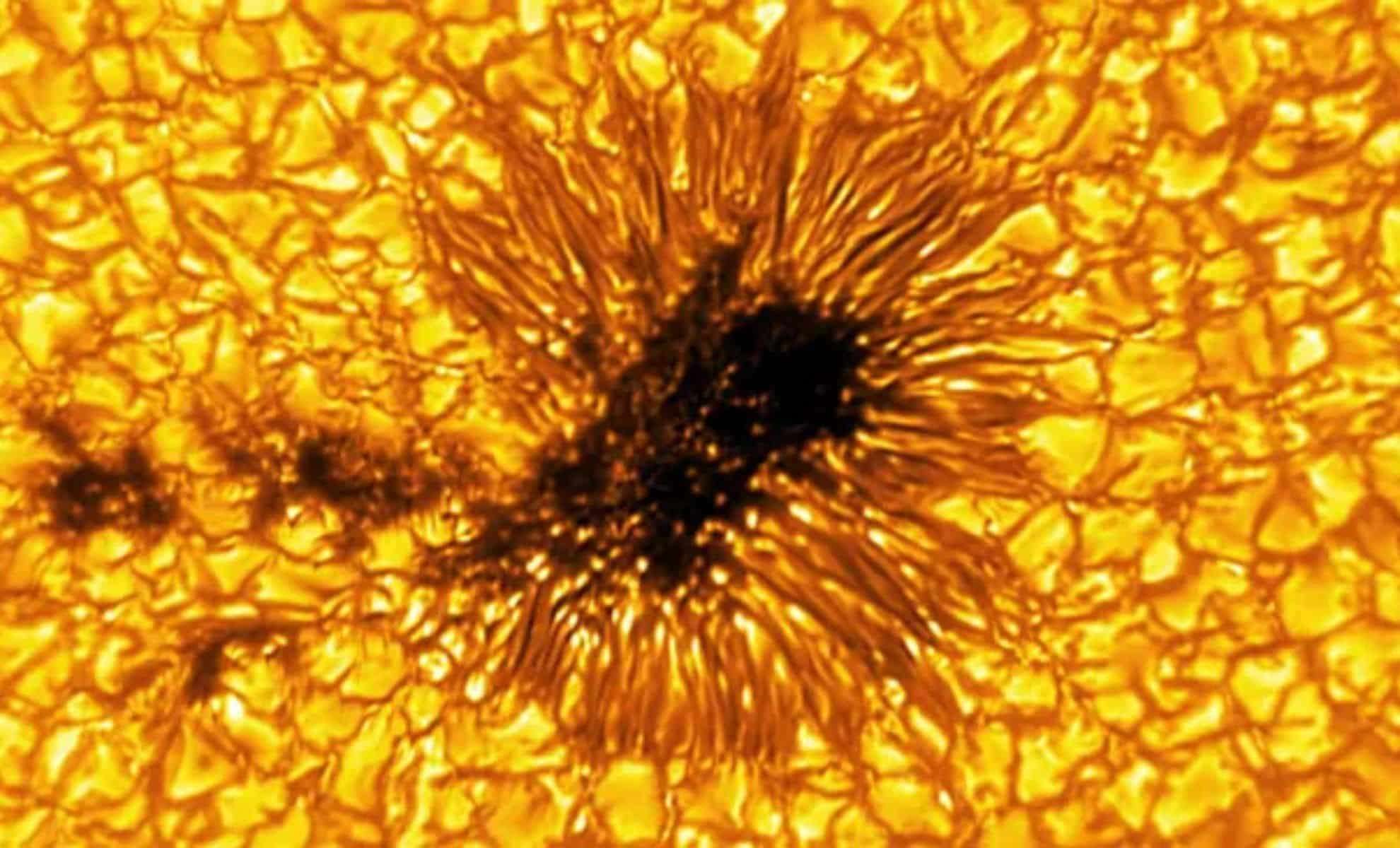
The Daniel K. Inouye Solar Telescope (DKIST), known as the largest solar telescope on Earth, has introduced its most advanced imaging system to date. The newly launched Visible Tunable Filter (VTF) camera has captured a stunning, never-before-seen image of a sunspot spanning an area greater than an entire continent. This extraordinary snapshot was taken on February 28, 2025, marking a pivotal moment in the study of solar phenomena and their effects on our planet.
Situated on Hawaii’s Haleakalā volcano, DKIST has been a leader in solar research for years. However, the activation of the VTF camera elevates its observational prowess. With a remarkable resolution of 6.2 miles (10 kilometers) per pixel, the device allows researchers to investigate sunspots and other solar features with astonishing clarity, despite the sun's immense distance of approximately 93 million miles (150 million kilometers) from Earth.
Revealing a Colossal Sunspot Cluster Than Spans Beyond the U.S. Border
The inaugural image from the VTF exposed a sunspot grouping colossal in size—vastly exceeding that of the continental United States. These dark solar blemishes, formed by powerful magnetic disturbances, significantly influence solar activity and consequently, space weather conditions.

Sunspots play a vital role in affecting Earth’s technological systems, including communication networks, satellite operations, and power infrastructure. As solar storms grow stronger, understanding their source and behavior is critical to forecasting their impacts. This new VTF camera equips scientists with enhanced tools to examine solar flares and coronal mass ejections (CMEs) in finer detail, potentially boosting our ability to anticipate these disruptive events.
Carrie Black, director of the National Solar Observatory, emphasized the breakthrough, stating, “The significance of the VTF’s addition cannot be overstated. It is truly the heart of the Inouye Solar Telescope, and it will enhance our understanding of solar activity in ways we never thought possible.”
Innovations Behind the VTF: Unlocking Solar Secrets
The Visible Tunable Filter (VTF) camera offers more than exceptional images—it captures detailed spectral information critical for analyzing the sun’s surface. Each session with the VTF collects over 10 million spectra, representing the sun’s light intensity across multiple wavelengths.
This extensive information enables scientists to detect atmospheric temperatures, assess magnetic field strengths, and study light polarization—vital components for decoding solar dynamics. Matthias Schubert, the VTF project lead, remarked, “The VTF will give us a much clearer view of the sun’s activities, providing crucial data for predicting solar flares and space weather impacts on Earth.”
Beyond revealing detailed solar imagery, the VTF helps deepen comprehension of the sun’s plasma flows, magnetic activity, and the complex structure of the corona, further illuminating the mechanisms driving space weather.
- Categories:
- News








0 comments
Sign in to Comment