
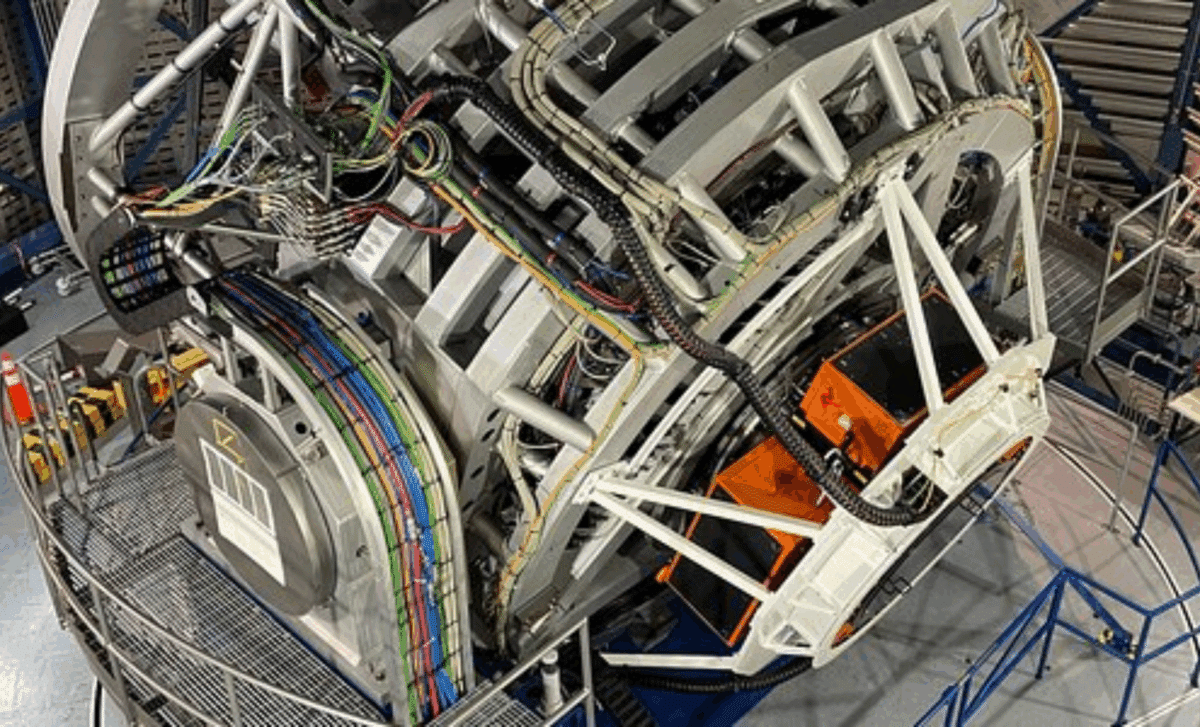
The recently unveiled 4-meter Multi-Object Spectroscopic Telescope (4MOST) marks a significant advancement for astronomical research. Installed on the European Southern Observatory’s VISTA telescope in Chile, it has just reached its inaugural "first light," heralding the beginning of its scientific mission. This innovative telescope aims to investigate the southern celestial hemisphere with unmatched precision, promising fresh insights into phenomena such as stellar creation and the puzzling nature of dark matter and dark energy.
A New Frontier in Cosmic Exploration
Unlike conventional telescopes that capture static images, 4MOST specializes in collecting spectral data, dissecting light into its fundamental colors. This process unveils critical characteristics of celestial bodies, including their chemical composition, velocity, and temperature. Such detailed spectral information offers astronomers an unprecedented window into the workings of the universe.
“This is an outstanding feat made possible by an amazing development team,” said Dr. Roelof de Jong, the principal investigator for 4MOST at the Leibniz Institute for Astrophysics Potsdam.
Add Cosmo Herald as a Preferred Source

By separating light into 18,000 individual color segments, 4MOST provides an extraordinary comprehensive analysis on a scale unparalleled in previous astronomical surveys.
“The first data already look fantastic. To catch light that’s traveled for billions of years in a fiber the size of a hair is mind-boggling,” Dr. de Jong added, highlighting the telescope’s incredible precision and capacity to reveal fine details of distant cosmic objects.
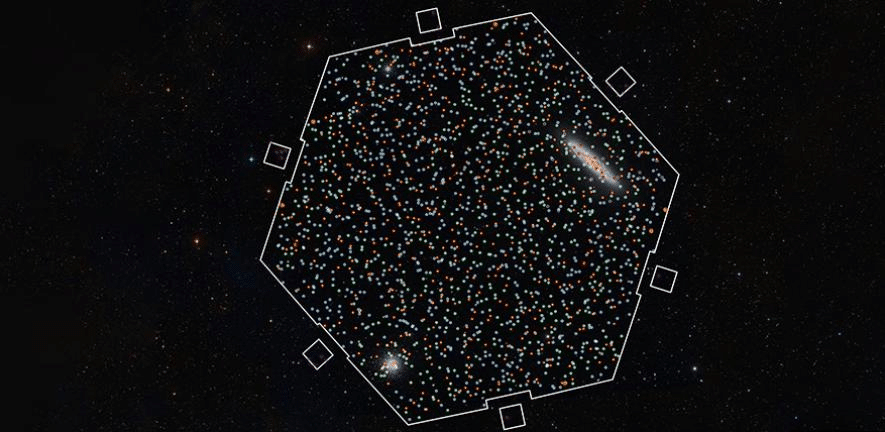
Employing 2,436 ultra-thin optical fibers, each slimmer than a human hair, 4MOST can simultaneously observe thousands of astronomical targets. This multi-object capability is invaluable for compiling extensive catalogs of stars, galaxies, and varied cosmic phenomena, helping unravel mysteries from stellar birth to black hole dynamics.
These impressive features are detailed in a recent report by Cambridge University, celebrating 4MOST’s innovative approach to southern sky observation.
Key Features That Differentiate 4MOST
The cornerstone of 4MOST’s design is its broad field of view, enabling rapid surveying of vast sky regions. Integrated with the VISTA telescope, it includes one of the largest optical camera arrays of its kind, measuring close to a meter across. Nightly scans of the southern sky will generate crucial data enriching our understanding of the Milky Way’s formation and galaxy evolution. As Professor Matthias Steinmetz, Scientific Director at AIP, remarked,
“With first light, we’re opening a new chapter in sky surveys.”
The telescope’s fibers can rapidly reposition within two minutes, allowing swift changes in observational targets. This agility is essential for capturing and studying fleeting cosmic phenomena such as supernovae and gamma-ray bursts.
The Collaborative Effort Behind 4MOST
The 4MOST initiative stems from extensive cooperation among 30 universities and research bodies across Europe and Australia. The University of Cambridge has played a pivotal role, especially in handling the enormous volume of data the telescope produces. Dr. Nicholas Walton, leading the 4MOST Data Management team in Cambridge, described the intricacies involved:
“The 4MOST instrument, with its huge number of optical fibers, has meant the development of a highly sophisticated, high throughput, data flow system, running in Cambridge.”
This advanced processing technology transforms immense amounts of raw data into high-quality information, primed for thorough analysis and discovery.
Beyond being a technical achievement, this project exemplifies international collaboration, engaging over 700 scientists globally. Their diverse research interests range from rare cosmic events to extensive surveys of stellar and galactic populations.
A Leap Into Next-Generation Astronomy
The activation of 4MOST signals a thrilling new chapter for astronomers worldwide. Along with other advanced telescopes entering operation, 4MOST is set to vastly improve our capacity to observe and interpret the universe. Dr. Lisa Kelsey from Cambridge’s Institute of Astronomy, part of the 4MOST team, shared her excitement:
“This is such an exciting time to be an astronomer… it’s taken a long time and a huge team to get here, but we can’t wait to get to work on some exciting new science.”
One of the standout initiatives exploiting 4MOST’s capabilities is the Time Domain Extragalactic Survey (TiDES), focused on transient cosmic phenomena like supernovae and gamma-ray bursts. These short-lived but powerful events illuminate crucial aspects of stellar lifecycles and black hole activity.
Over its anticipated 15-year operation, the telescope will provide essential insights into the universe's origins and future development, solidifying its role as a cornerstone of astrophysical research.
- Categories:
- News






0 comments
Sign in to Comment