
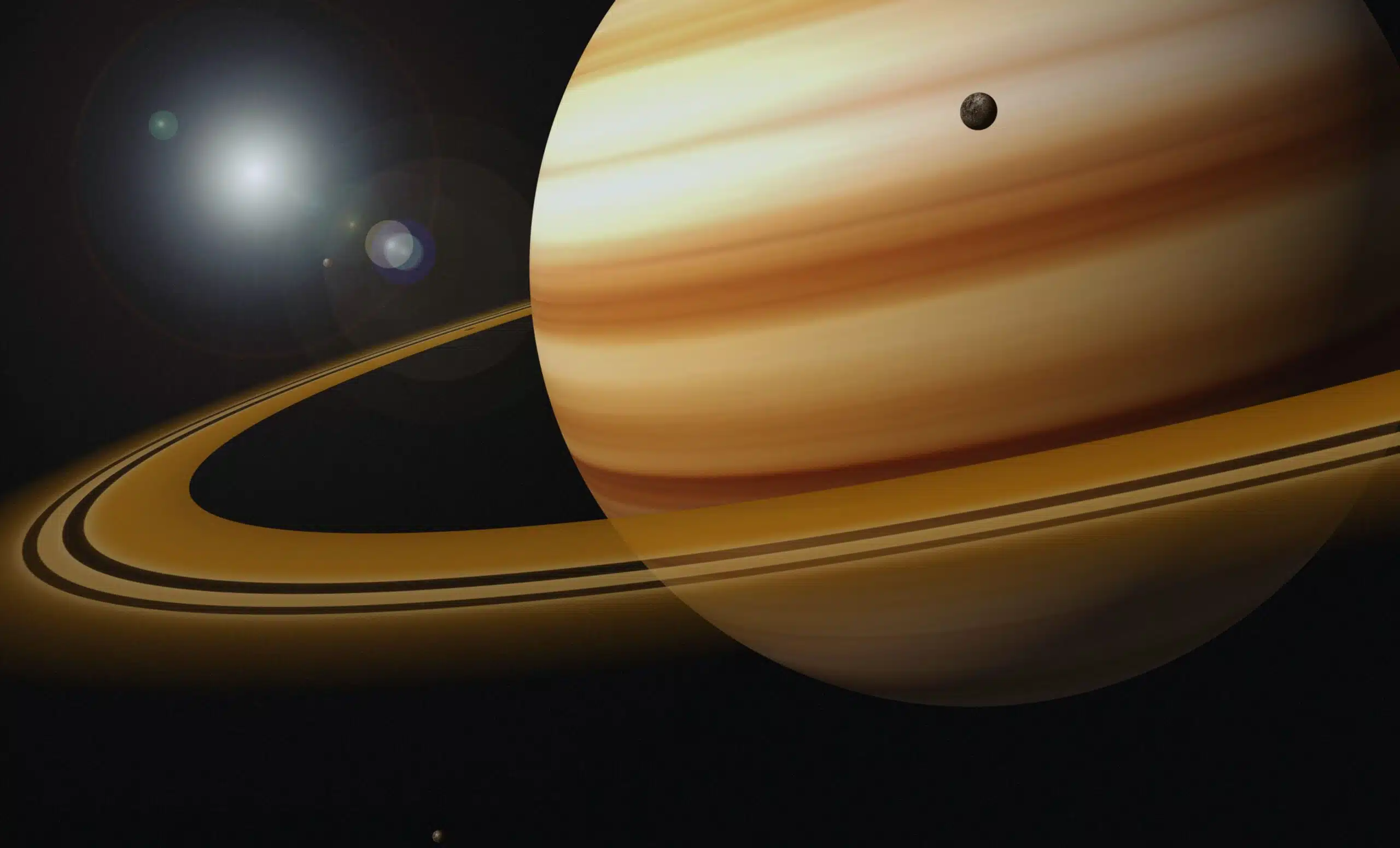
Saturn has dramatically increased its tally to an astounding 274 moons, overtaking Jupiter and firmly establishing itself as the planet with the greatest number of moons orbiting it. The revelation of 128 additional moons, led by astronomer Brett Gladman, goes beyond just counting satellites — it offers insight into the tumultuous and complex evolution of Saturn's orbital family.
These latest moon discoveries aren't your ordinary spherical satellites. Instead, many are irregular moons with chaotic and unpredictable orbits. Unlike the familiar moons that follow stable, near-circular paths aligned with their planet's rotation, these bodies exhibit scattered, often retrograde motion that points to a dynamic past involving collisions and fragmentation.
Unique Trajectories of Irregular Moons
Uncovering 128 new moons was a surprising feat for planetary scientists. Brett Gladman, from the University of British Columbia, emphasizes that Saturn now has the most moons of any planet, exceeding the long-held leader Jupiter.

Gladman and his colleagues utilized the Minor Planet Center, an authoritative database tracking minor bodies in the solar system, to identify these moons, a discovery announced in March 2025. These new satellites are categorized as “irregular moons” because of their eccentric and unusual orbits, often moving opposite their planet’s spin and at steep angles.
Samantha Lawler, an astronomer with the University of Regina, explains that the irregularities signal a chaotic origin. These moons likely originated from captured larger objects whose repeated collisions fractured them into numerous smaller fragments over billions of years.
Many of the recently discovered moons may stem from ancient impacts that shattered larger bodies. Certain clusters, such as the Mundilfari group, indicate collision events that are relatively young in cosmic terms — estimated at under 100 million years old.
Until March, Saturn had 146 known moons, then astronomers discovered 128 new ones, bringing the ringed gas giant's total up to 274 moons—far beyond any other planet in our Solar System.This is the coreography of their dance.[🎞️ thebrainmaze]pic.twitter.com/cZYbqkqX4C
— Massimo (@Rainmaker1973) December 4, 2025
Tracing the Origins of Saturn’s Moon Collection
Multiple researchers, including Gladman, suggest that many of Saturn's moons are remnants of once-larger satellites shattered over eons. Rather than emerging from a single sudden event, the moon population evolved gradually, with fragments coalescing and dispersing across time.
This ongoing fragmentation reshapes our understanding of planetary satellite systems, demonstrating that they remain active and evolving, rather than static. Saturn’s moons are still dynamically forming and colliding, providing an ever-changing natural laboratory.
Saturn has 128 newly-discovered moons. Here they are color-coded by their MPEC release. Orange: MPEC 2025 E153, Purple: MPEC 2025-E154, Green: MPEC 2025-E155. pic.twitter.com/0aO6WXl7Ni
— Tony Dunn (@tony873004) March 12, 2025
Challenges in Naming so Many Newly Discovered Moons
The surge of 128 moons brings the daunting task of assigning names. According to the International Astronomical Union's convention, satellites must be named after mythological figures from Norse, Gallic, or Inuit legends. As Saturn's count balloons, this naming process becomes increasingly complex.
“This is altogether too many moons. How are we supposed to name them all?” remarked Paul Byrne, a planetary scientist at Washington University in St. Louis, who was not involved in the latest research.
Even at over a billion kilometers from Earth, sophisticated telescopes such as the Canada-France-Hawaii Telescope atop Mauna Kea have been instrumental in spotting these small moons. Although not part of this discovery, Lawler described the sheer number of newfound satellites as “hilarious” in light of the enormous naming challenge.
With astronomers continuing to hunt for more tiny moons, Saturn’s dominance as the planet with the highest moon count seems assured. As Gladman notes, it appears unlikely that “Jupiter will ever catch up.”
- Categories:
- Space



0 comments
Sign in to Comment